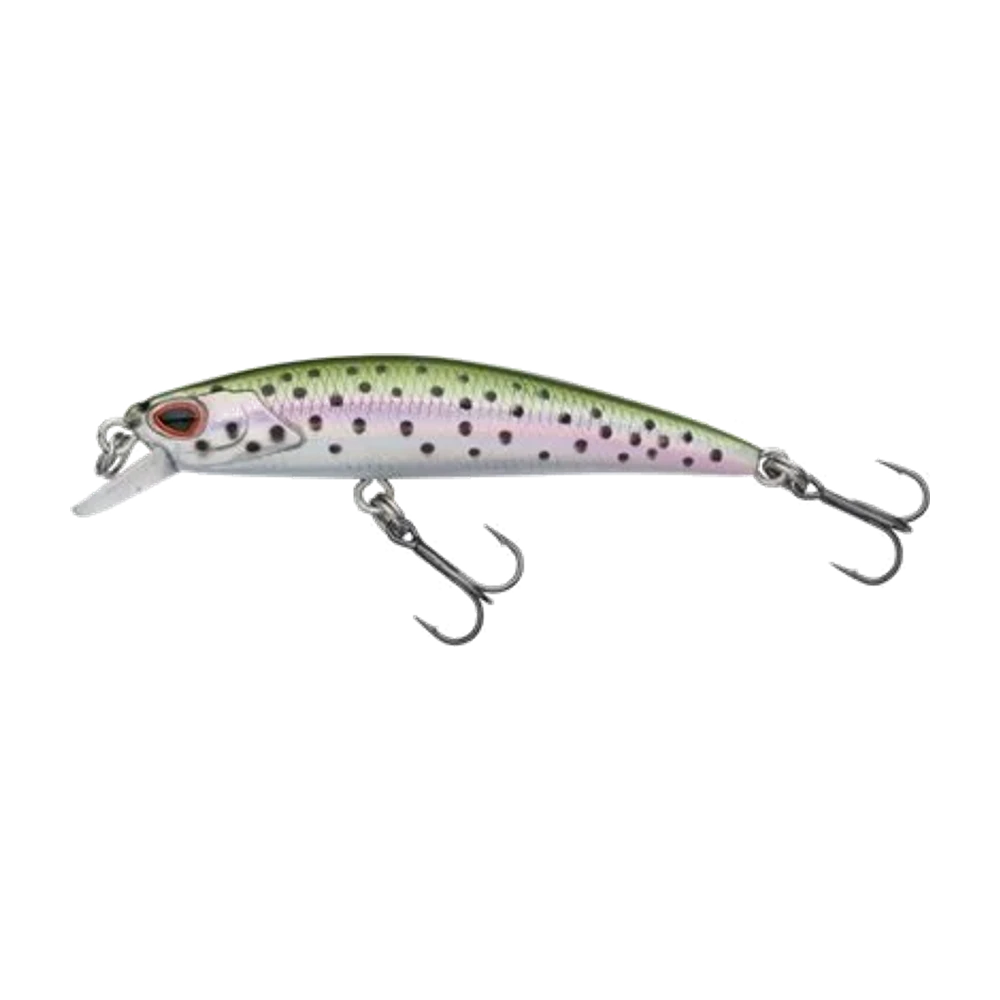
Berkley DEX Bullet Jerk: the jerkbait with a wide glide
The right lure in the wrong spot still catches nothing. CarnaFish spots the zone that works, from a single photo.
December, a big reservoir, eight degrees in the water. The zander are on a plateau at two and a half metres, you can see them on the sounder, and you have spent two hours running soft plastics past them on a straight retrieve without one solid bite. The fish are there and they are not eating — or more precisely, they will not chase.
In that situation, what is missing is not a more attractive lure: it is a lure that stays in the fish's field of view without moving away. A wide-gliding jerkbait does exactly that. It breaks out one way, stops, breaks out the other, and barely moves towards you across the whole sequence. A zander holding station can look at it for fifteen seconds before making up its mind.
The Bullet Jerk is built for that register. The name comes from the tapered nose, designed for casting, but the important part happens afterwards: this is a lure of amplitude, not of frequency.
Wide glide against tight darting
Not all jerkbaits produce the same displacement. That is the most useful distinction to have in mind when you open the box.
Tight darting means a sideways movement of ten to twenty centimetres, nervous and very repetitive. It scores on reactive fish that trigger on speed: feeding perch, active bass.
A wide glide is something else. The lure breaks out hard to the side, sometimes at right angles to the retrieve line, over fifty centimetres or more. Between two jerks it has all but changed lane. For a fish holding three metres away, the lure appears, disappears, reappears somewhere else — without ever fleeing.
The Bullet Jerk is firmly in the second category, and that implies one thing: you cannot fish it fast. A jerk given before the lure has finished its glide produces an aborted movement, and you lose everything the model is good for.
The sequence, jerk by jerk
- Cast and let the lure sink until it reaches its layer — three to four seconds on the sinking versions, two handle turns on the lipped versions.
- One wide jerk, the rod moving from low out to the side over thirty to forty centimetres of travel. Not a sharp snap of the wrist: a movement you accompany.
- Let the lure finish its glide. Count a full second. You should feel the tension go.
- Take up the slack without moving the lure, then pause.
- Next jerk, same movement. The lure breaks out the other way because it has settled in between.
- Every three or four jerks, make a long pause, eight to ten seconds in cold water.
The classic mistake is short, closely spaced jerks. The lure then zigzags on the spot with no amplitude, and all you get is a noisy action with no point to it.
| Water temperature | Pause between jerks | Long pause every 3-4 jerks |
|---|---|---|
| Above 16 °C | 1 second | 3 seconds |
| 10 to 16 °C | 2 to 3 seconds | 5 to 6 seconds |
| Below 10 °C | 4 to 5 seconds | 10 seconds, sometimes more |
On the water: on zander, the bite almost never comes as a knock in the rod. You take up the slack before your next jerk and the line feels heavy, as if you had hooked a plastic bag. Strike then, without waiting for confirmation. If you wait for a real pull, you give the lure back nine times out of ten.
Two species, two setups
For zander, fish the 9 cm on 0.28 to 0.32 mm fluorocarbon, with no wire leader if you are on a stretch without pike. Target plateau drop-offs, channel edges, bridge surrounds. The rhythm is slow, the pauses long, and you fish a precise layer rather than a volume. The bite is subtle: keep your eye on the line at all times.
For pike, move up to the 12 cm and add a supple 30 to 40 cm wire leader. The rhythm changes completely: wider jerks still, shorter pauses, and provocation rather than imitation. On pike, a two-second pause after a fast sequence triggers more often than a ten-second one.
One detail that matters: do not use a stiff wire leader or a heavy snap up front. On a gliding lure, excess mass at the nose reduces the lateral amplitude — which is precisely what you came for.
Not sure what to tie on?
Photograph your spot: CarnaFish reads the scene, cross-checks the conditions and gives you the zone, the lure and the retrieve. Free on iOS and Android.
Its good ground, and the ground to avoid
The Bullet Jerk shows its worth on:
- Big impoundments and deep gravel pits, from autumn to early spring, over plateaus of 2 to 4 m.
- Clear to moderately stained water, where the fish sees the lure from a distance and has time to follow it.
- Fish holding station and inactive, that refuse to chase anything.
- Channel edges and hard drop-offs, where you can track a break without the lure moving fast.
It is poorly suited to searching, though: this rhythm covers very little ground per hour, and on a big unfamiliar water you will waste your day. It is also wrong in strong current, where the pressure of the water flattens the glide, and on very cluttered spots, where two exposed trebles do not forgive.
Bullet Jerk, Shadow Rap or a Japanese jerkbait
The Rapala Shadow Rap plays in the same wide-glide register, with a very slow sink that lets it stay high in the water column. That is often the better choice when the fish is above the lure or the water is shallow. The Bullet Jerk, being denser, works a little lower and handles wind better on the cast — a real advantage on an exposed reservoir in winter.
Against a DUO Realis Jerkbait 120SP, the comparison is about finesse: the Japanese lure offers a very precise suspension and a more controlled dart, at a markedly higher price. The Bullet Jerk delivers most of the behaviour at a price you can accept losing to a sunken tree — which, on cluttered spots, genuinely changes how you fish.
Our beginner's guide to zander lure fishing covers how to read plateaus and drop-offs in winter. And if you are unsure whether to track a break or fish the flat when you reach the bank, CarnaFish reads a photo of the spot and answers.
Key takeaways
- A wide-gliding lure: it breaks far out to the side and advances very little, so it stays in front of a holding fish for a long time.
- The jerk is wide and accompanied, never short and sharp. Always let the glide finish.
- On zander the bite is simply the line loading up. Strike without waiting for a pull.
- 9 cm on fluorocarbon for zander, 12 cm with a supple wire leader for pike.
- A lure for known spots, not for searching; ineffective in strong current.
FAQ
Does the Bullet Jerk really work on zander?
Yes, particularly in cold water on plateaus and drop-offs between 2 and 4 m. Its wide glide keeps it in the field of view of a holding fish without fleeing, which a soft plastic on a straight retrieve does not do.
How wide should the jerk be?
Thirty to forty centimetres of rod travel, in a movement accompanied out to the side. Short, closely spaced jerks kill the glide and turn the lure into a pointless zigzag.
Do I need a wire leader?
On pike, yes, a supple 30 to 40 cm one. On a zander-only stretch, 0.28 to 0.32 mm fluorocarbon is enough and preserves the lure's lateral amplitude better.
How do you detect bites in cold water?
By watching the line as you take up the slack. The bite shows up as dead weight rather than a knock. An immediate hookset at that moment converts far better than waiting.
Which version, 9 or 12 cm?
The 9 cm for zander and medium pike, the 12 cm as soon as you are specifically after pike or need to cast far in wind. The 12 cm calls for a rod rated to at least 30 g.
Is it suited to searching a big water?
No. Its slow rhythm covers very little ground per hour. Use it on spots you have already identified, after locating the fish with a faster lure.
The full pike lure guideSeason-by-season strategy: which family of lure, when, and why.Go from theory to fish
CarnaFish reads your spot from a photo and gives you the game plan: zone, lure, retrieve. Free on iOS and Android.