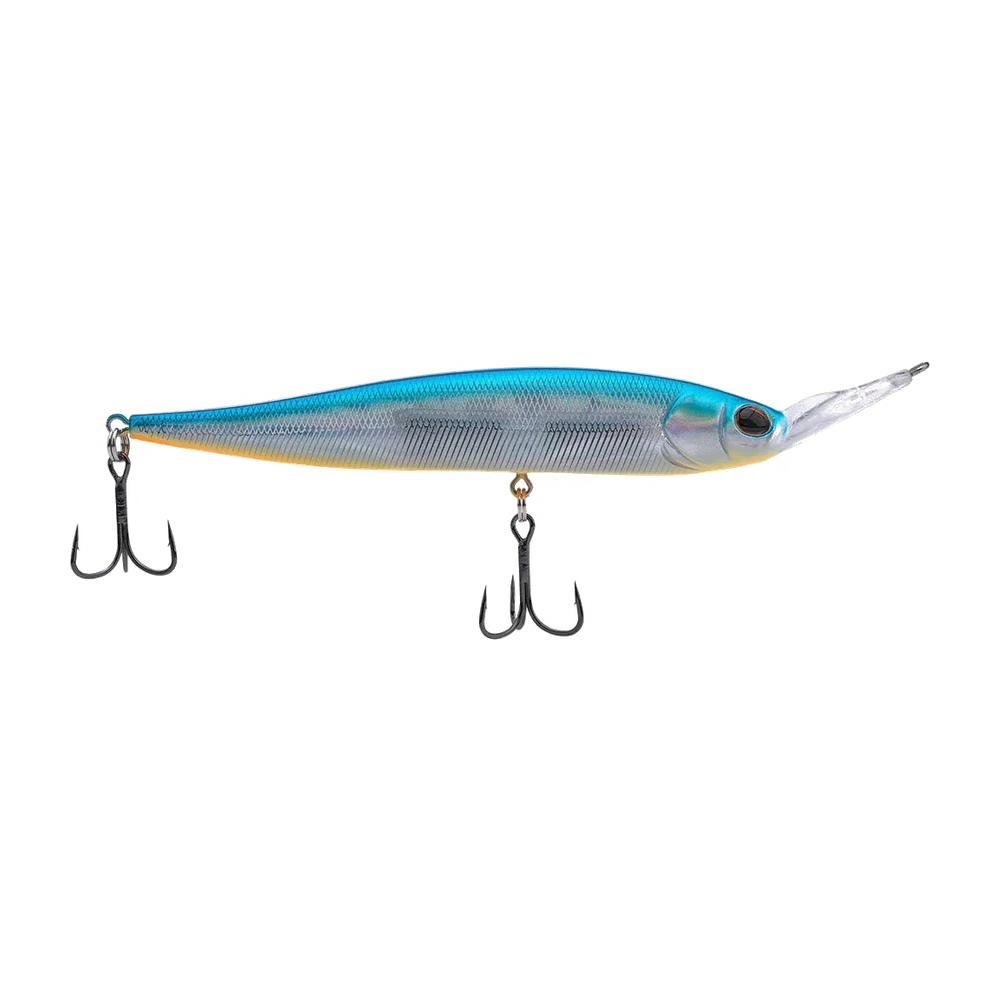
Berkley Krej: the jerkbait that backs up on the pause
Before tying this one on, it helps to know if the spot actually calls for it. CarnaFish reads the scene from a photo.
Every jerkbait angler knows the moment: the fish glues itself to the lure over the last three metres, you stop, it pulls up dead ten centimetres from the nose, it looks. Then it turns away. Nothing the lure is doing right then looks like prey. A minnow that feels a predator behind it does not freeze thirty centimetres from its mouth — it bolts.
That is exactly the gap this lure fills, and its name says so: Krej is "jerk" spelled backwards. Where a classic suspending jerkbait hangs motionless on the stop and waits, this one backs up a few centimetres before settling. The move is short, a matter of centimetres, but it goes the wrong way for the fish tracking it — and that is precisely what makes it open its mouth.
The backward slide is not a gimmick. It turns the pause, normally dead time where you are at the mercy of the fish's decision, into a second trigger that you fire whenever you want.
What the backward slide does to the fish
A predator following a lure builds an interception line. It works out where the lure will be half a second from now and aims at that point. As long as the lure travels at a steady speed the maths are easy, the fish has time — and it also has time to spot what is wrong.
A normal pause breaks that calculation once. The lure is no longer where it should be, the fish has to start again. Plenty of bites come right there, in the first second of the stop.
The backward slide breaks the calculation a second time, in the following second. The lure has not merely stopped advancing: it has come towards the fish. To a predator that reads as an injured baitfish losing control of its swimming — or, more simply, as prey that has just put itself within reach. Both readings lead to the same reaction.
On the water this shows up as a very particular kind of bite: you do not feel a clean knock during the twitch, you feel soft resistance during the pause, as though the lure had picked up a strand of weed. That is the fish taking it head-on, without moving much at all.
The retrieve, from simplest to finest
- The searching rhythm. Two sharp wrist twitches, a two-second pause, half a turn of the handle to take up the slack. You cover water and work out which zones are holding fish. This is the rhythm you start with on an unfamiliar spot.
- The converting rhythm. A single, wider twitch followed by a four to six second pause. The backward slide has time to happen in full and the lure stays a long while in the fish's field of view. Switch to this as soon as you have seen a follower, or as soon as the water drops below 10 °C.
- The double break. Two twitches very close together, a short one-second pause, then a third isolated twitch and a long pause. The sequence imitates prey that panics, gathers itself, then gives up. This is the rhythm that converts wary zander in late autumn.
- The margin rhythm. Short twitches, one-second pauses, slow overall retrieve over five or six metres along a cluttered bank. Here you are not trying to trigger from a distance, you are trying to stay as long as possible in a narrow corridor.
What all four share: the pause is never shorter than one second. Below that, the backward slide has no time to happen and you lose everything the lure is for — you are fishing with an ordinary jerkbait, only worse, because its swimming action under a steady pull is deliberately understated.
On the water: never take up the slack during the pause. The reflex is to turn the handle a quarter turn to "keep in touch", and that is exactly what kills the backward slide: the moment the line tightens, the lure is locked and can no longer travel backwards. Leave three to five centimetres of slack line for the whole duration of the stop, and only wind in as you deliver the next twitch. If you stop feeling anything during your pauses, that is usually why.
Setting the pause by temperature
| Water | Pause | Number of twitches | What you are after |
|---|---|---|---|
| Above 18 °C | 1 to 2 s | 2 to 3 | Cover water, trigger on speed |
| 12 to 18 °C | 2 to 4 s | 2 | The all-round rhythm, your default |
| 8 to 12 °C | 4 to 8 s | 1 | Let the backward slide work on its own |
| Below 8 °C | 10 s and more | 1, very gentle | The lure does everything, you do almost nothing |
The right-hand column is the important one. In warm water the backward slide is a bonus on a pattern that already works on speed. In cold water it is the lure's only argument, and the whole session is about giving it time to express it. An angler using September's rhythm in February will see no difference between this and any other jerkbait.
Where it wins, and where it is useless
It shines on educated fish in clear water, where the fish has time to look and therefore time to refuse; on habitual followers, since backing up is precisely an answer to being tracked; and in cold water on inactive fish, where a ten-second pause costs nothing and where the smallest movement during that pause makes the difference.
There are three cases where it stays in the box, though. In a strong current: the flow cancels the backward slide, the lure is simply pushed downstream and you lose the mechanism. When covering big water fast: every cast demands long pauses, you search very little water per hour, and a crankbait will pay far better. On actively feeding fish: when they are smashing bait on the surface the fish is not asking for finesse, it is asking for speed, and a lure that stops every two seconds gets left behind.
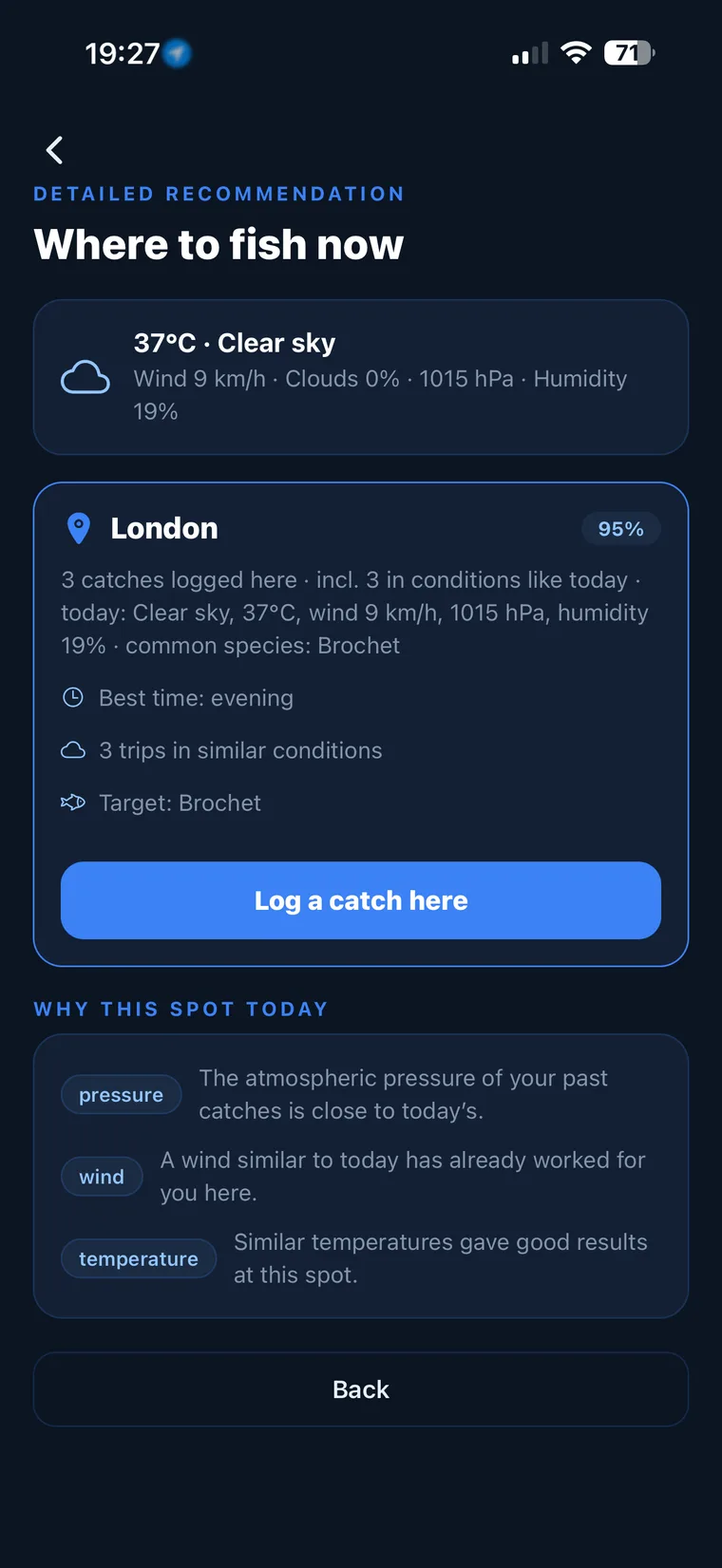
Not sure what to tie on?
Photograph your spot: CarnaFish reads the scene, cross-checks the conditions and gives you the zone, the lure and the retrieve. Free on iOS and Android.
Colours
- Clear water, bright sky: roach or bleak pattern, silver flank, discreet back. The fish studies the lure throughout the pause, so detail counts for more than it does on a fast lure.
- Slightly stained water: dark back and a clean pale belly. Silhouette contrast is what carries, not the pattern.
- Cold water and the end of the day: a touch of chartreuse on the tail. It gives an aiming point during long pauses, when the fish decides on a still image.
Krej, or a classic suspending
The question is not which is better, but which matches what you do with your pause.
An Illex Squad Minnow 95 SP is a benchmark suspending: it holds its depth, it stays rigorously still on the stop, and that is a quality. In cold water on inactive zander, that perfect stillness is sometimes exactly what is needed — the fish rises slowly and inhales a lure that has not moved a millimetre.
The Duo Realis Jerkbait 120 SP plays a different game: more volume, more signal, a calling approach over big water.
The Krej sits elsewhere: it refuses to stand still. If your pauses produce nothing, if you watch followers peel off at the precise moment you stop, this is the one to try. If on the contrary your bites come on very long, perfectly frozen stops, stay with a classic suspending — you have nothing to gain from the change. Our guide to choosing a pike lure places these three approaches within a typical day, and if you are unsure what rhythm to give a particular spot, CarnaFish analyses a photo of it and answers.
Key takeaways
- The few centimetres of backward slide on the pause are the whole point of the lure: without a pause, you are fishing with any old jerkbait.
- Never tighten the line during the stop — the backward slide only happens on slack line.
- Pause length is set by temperature, from two seconds in summer to more than ten in winter.
- The bite often comes as soft resistance during the pause, not as a sharp knock.
- Avoid it in strong current, when searching fast, and on actively feeding fish.
FAQ
Why is the Berkley Krej called that?
"Krej" is the word "jerk" spelled backwards, a reference to its behaviour: on the pause, the lure slides slightly backwards instead of hanging still. The name describes the mechanism.
How long should the pause be?
Never less than a second, or the backward slide has no time to happen. Count on two seconds in temperate water, four to eight seconds below 12 °C, and ten seconds or more in midwinter.
Why can't I feel the backward slide through the rod?
Almost always because the line is tight. The slide can only happen if you leave three to five centimetres of slack during the pause; as soon as the line is straight, the lure is locked.
Does it work for zander?
Yes, and cold water is one of its very best uses, with very long pauses over drop-offs. Zander often take the lure head-on during the stop, which gives a soft bite that is easy to miss.
What fluorocarbon should I use?
0.25-0.30 mm for bass and zander, which leaves enough give in the twitches. As soon as pike are on the spot, switch to a steel or titanium leader, even at the cost of a little finesse in the action.
Does it work in rivers?
Poorly as soon as there is a strong current, because the flow pushes the lure downstream and cancels the backward slide. In slack water, back eddies and old channels, it is back at its best.
The full bass lure guideSeason-by-season strategy: which family of lure, when, and why.Go from theory to fish
CarnaFish reads your spot from a photo and gives you the game plan: zone, lure, retrieve. Free on iOS and Android.