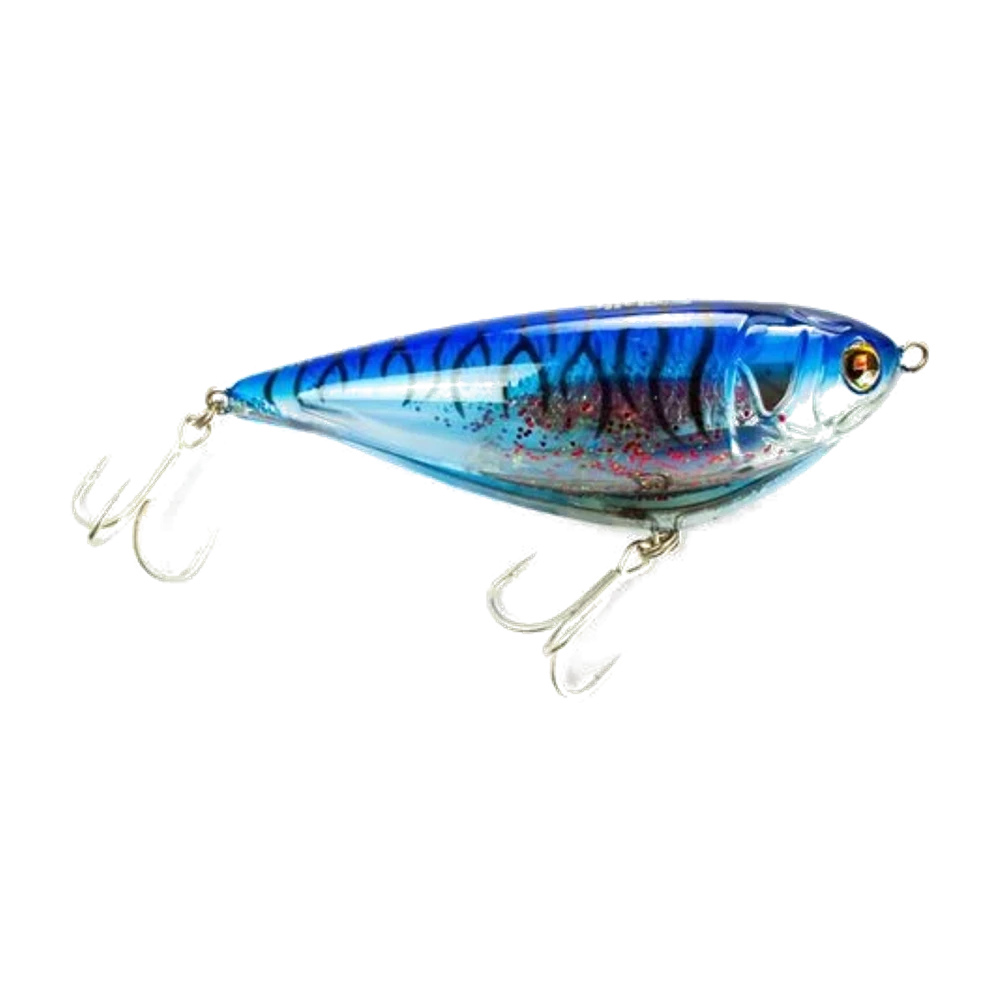
Sebile Bonga Jerk: the jerkbait that stays upright in rough water
One lure, endless conditions. CarnaFish reads your spot from a photo so you are not just guessing.
A well-tuned jerkbait behaves perfectly in the calm water of a pool test. The problem is that we almost never fish calm water. As soon as there is twenty centimetres of chop or a bit of cross current, plenty of slim jerkbaits lie over on their side, ride up, or spin out on the first acceleration.
The Bonga Jerk answers that with its geometry. Its belly line is noticeably deeper than a standard minnow's, which gives it a genuine keel surface below the line of pull. The result: the lure stays vertical when things get rough, and it recovers its attitude immediately after every jerk.
That is also why you find it in a pike box as readily as in a bass bag: both grounds share the same constraint, water that is rarely smooth.
What a keel does to a jerkbait
A jerkbait's side dart comes from controlled instability: you pull, the lure breaks out sideways, then it settles back on line. The whole art is having enough instability for the dart and enough stability for the return.
On the Bonga Jerk, the deep belly plays three roles:
- It lowers the centre of gravity, so the lure rights itself after every dart, even in broken water.
- It offers a lateral surface, which widens the dart when you pull sharply: the lure moves decisively sideways instead of pivoting on the spot.
- It damps parasitic roll on a straight retrieve, which makes it usable as a simple crank-and-cover lure when you are searching.
In practice you get a lure that accepts two very different uses under the same reference: hard jerks for fish that need provoking, or a slow straight retrieve to sweep an edge without thinking about it.
The retrieve: two jerks, half a pause
- Cast and take two turns to pull the lure under the surface and tighten the line.
- Two medium-amplitude rod-tip jerks, tip pointed at the water, wrist and forearm. The lure goes left, then right.
- A short pause, one to two seconds. Shorter than on a cold-water jerkbait: here the pause is there to let the lure settle, not to tempt the fish for ten seconds.
- One turn of the handle to take up slack, then start again.
- At the end of the retrieve, accelerate hard over the last three metres. That final flight converts a lot of follows, particularly with bass.
A useful variation when fish refuse: three very tight jerks followed by a dead three-second stop. That density of movement then sudden silence works well on fish that escort the lure without committing.
On bass in particular, try the opposite rhythm too: one single wide dart, very broad, followed by two steady turns of the handle. That mix of isolated dart and continuous swim mimics a baitfish that has broken from the shoal and is trying to rejoin it, and it often triggers when tight jerk sequences do nothing.
On the water: when there is chop, drop the rod tip below horizontal and shorten your jerks rather than lengthening them. A high tip pulls the lure out of the water between waves and you lose contact; a low tip keeps the line under the crest, and it is that permanent contact that lets you feel a bite in rough water.
Adapting the setup to the ground
| Ground | Leader | Hardware | Note |
|---|---|---|---|
| Lake, pike | 0.40-0.50 mm fluorocarbon or supple wire | Stock trebles | Fluorocarbon preserves the action better |
| River, perch and medium pike | 0.30-0.35 mm fluorocarbon | Stock trebles | Favour the small sizes |
| Shoreline, bass | 0.35-0.45 mm fluorocarbon | Heavy-duty stainless rings and trebles | Rinsing after the session is compulsory |
| Estuary, coloured water | 0.40 mm fluorocarbon | Heavy-duty | Move to stronger colours |
Going to salt water is not a trivial step. The stock trebles of a freshwater jerkbait bend out on a good bass taken in the surf, and split rings open. Changing the hardware slightly alters the buoyancy: check how the lure behaves at rest after the swap, and compensate if needed with a treble one size down at the front.
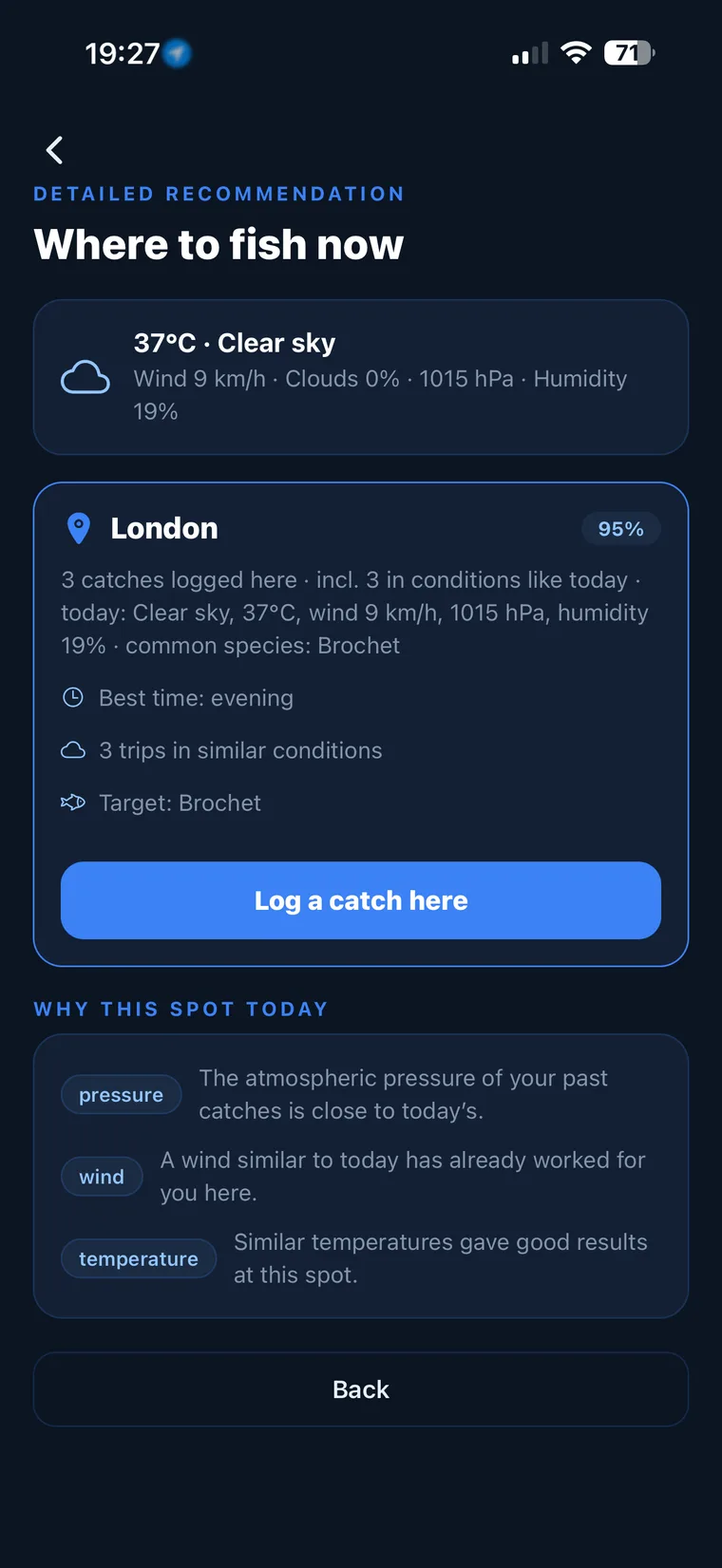
Not sure what to tie on?
Photograph your spot: CarnaFish reads the scene, cross-checks the conditions and gives you the zone, the lure and the retrieve. Free on iOS and Android.
Where it gives its best, and where it falls short
It belongs anywhere the water is moving:
- Windy lake and gravel pit margins, when chop puts fine minnows in trouble.
- Rivers with moderate current, on an across-and-down retrieve along the edges.
- Beaches and headlands on the coast, on bass feeding shallow in rough water.
- Dam outflows and eddies, where stability counts more than delicacy of action.
It is less convincing on perfectly smooth, very clear water, in midwinter, on educated fish: there, a finely tuned suspending jerkbait with long pauses will do better, because the Bonga Jerk needs movement to exist. Nor is it a deep lure: beyond a metre and a half, you are fishing above the fish.
Bonga Jerk or Magic Swimmer
The Sebile Magic Swimmer 128 is a jointed lure with a serpentine swim, which works on its own on a straight retrieve and needs no rod input. That is the choice when you want to cover water steadily and let the lure do the work.
The Bonga Jerk is a lure you work. It produces nothing spectacular on a constant retrieve — it waits for your jerks to deliver its darts. You reach for it when the fish needs provoking rather than seducing, and when conditions make a jointed lure's swim unreadable. The Sebile Stick Shadd fills yet another slot, closer to the gliding fall and vertical fishing.
Our guide to lure fishing for bass covers the sea conditions that make a jerkbait relevant. And if you are unsure whether to work it or crank it straight when you reach a rough spot, CarnaFish reads a photo of the spot and answers.
Key takeaways
- A deep belly acting as a keel: the lure stays vertical in chop and returns level after every dart.
- Two jerks, a short one to two second pause. Not the long pause of a cold-water jerkbait.
- Low rod tip in the chop, shorter jerks: contact with the lure is what gets you the bite.
- In salt water, swap rings and trebles for heavy-duty stainless and recheck the buoyancy.
- Unconvincing in smooth, clear, cold water, and pointless beyond 1.5 m of depth.
FAQ
Does the Sebile Bonga Jerk work in both salt and fresh water?
Yes, and that is one of its strengths: the same action suits pike on a windy lake and bass on a rough beach. The hardware does have to be upgraded to stainless for saltwater use, and the lure rinsed after every session.
What depth does it run at?
Between 0.5 and 1.5 m depending on the version and the retrieve speed. It is not a deep lure: if fish are lower, you need to switch to a weighted soft plastic or a diving hard bait.
How long should the pause be?
One to two seconds only. Unlike a cold-water jerkbait where the long pause is the retrieve, here it is mainly there to let the lure recover its attitude before the next jerk.
Should you change the hooks for bass fishing?
Yes, every time. Freshwater trebles and rings deform on a bass taken in the surf. After the swap, check that the lure still behaves correctly at rest and adjust the front hook size if needed.
How do you fish it when there is chop?
Drop the rod tip below horizontal and shorten the jerks. That keeps the line under the wave crests and maintains contact with the lure, without which you will not feel the bite.
Can you just retrieve it straight?
Yes. Its keel limits parasitic roll, which makes a slow straight retrieve usable for covering an edge. But most of its potential still lies in the darts you provoke with jerks.
The full pike lure guideSeason-by-season strategy: which family of lure, when, and why.Go from theory to fish
CarnaFish reads your spot from a photo and gives you the game plan: zone, lure, retrieve. Free on iOS and Android.