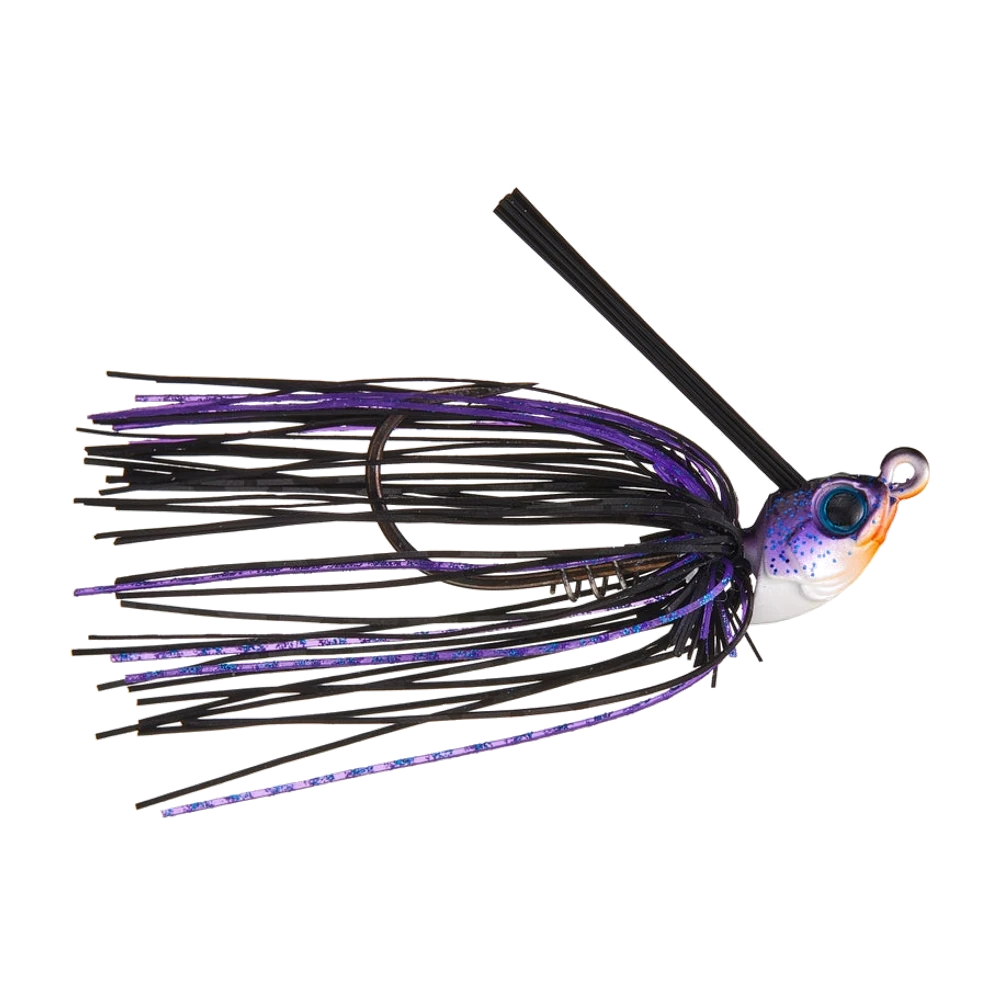
6th Sense Konda Finesse Swim Jig: the downsized swim jig
Not sure this lure fits YOUR spot today? CarnaFish tells you in 10 seconds, from a photo.
A line of docks along a lake shore, a metre of water, and fishing pressure you can read at a glance: every boat runs that bank. The bass are still under the structure, but they have watched 1/2 oz jigs and full-size bladed jigs go by all weekend. That is exactly the situation where dropping one notch in size and noise changes your bite count — and that is the Konda's slot.
What finesse means on a swim jig
A standard swim jig weighs 3/8 to 3/4 oz, carries a heavy-wire 5/0 hook and a generous skirt. It is designed to push through thick vegetation and haul a fish out by force. The Konda keeps the same swimming logic but trims every dimension: 9 g (5/16 oz) or 12.5 g (7/16 oz), a fine-wire hook in 4/0, a thin-cut weed guard, and a short skirt, custom-trimmed so it does not bulk up the profile.
The result is not a weaker jig, it is a jig telling a different story underwater. The short skirt pulses faster and tighter, the overall profile stays narrow, and the fish sees a small prey item moving through rather than a bundle of silicone. On heavily pressured water, that difference shows.
It is swum, not dragged
The Konda is not a bottom jig. You cast it, let it sink a second or two, and bring it back on a steady retrieve at mid-depth, keeping it just above the vegetation or tight to structure. The speed is medium to brisk — fast enough that the skirt stays swept back and the trailer works, not so fast that the jig climbs to the surface.
Every few turns of the handle, give a small rod-tip snap. The jig breaks off line, the skirt opens for a fraction of a second and closes again, and that flash of volume is what converts followers. It is the swim jig equivalent of a crankbait's bottom contact: irregularity, not regularity.
If you catch grass, do not pull against it. Give a short, sharp snap of the rod tip instead: the Konda is light enough and its guard thin enough for the jig to tear free forward. Nine times out of ten the strike comes within a second of that release.
Skipping docks
That is the second job this jig is built for, and it requires precise technique. The cast goes sidearm, rod parallel to the water, on a flat trajectory so the jig skips across the surface like a stone. Two or three skips are enough to get under a dock or an overhanging bush.
The three conditions for skipping to work
A compact jig: that is exactly why the Konda's skirt is trimmed short. A bulky profile grabs water on the first contact and stops dead.
A flat, dense trailer rigged straight. A trailer with long open claws kills the skip. A small compact swimbait or a gathered craw slides much better.
A slightly loosened spool and a thumb on it. The jig has to be free to continue after every skip without the spool overrunning.
The mistake that bends hooks
The Konda's hook is fine wire. That is a deliberate choice: thin wire penetrates more easily into a closed mouth and raises the hook-up rate on the soft takes of wary fish. But it does not forgive a lumberjack hookset with a heavy rod and 50 lb braid. Set the hook by sweeping, from the arm rather than the wrist, with a medium to medium-heavy rod and a drag set fairly light. It is also why this jig is not a pike tool: fine wire bends on a hard jaw.
The trailer is half the lure
The Konda comes with a screw-lock keeper that threads into the nose of the trailer instead of impaling it. Two concrete benefits: the trailer survives dozens of skipping casts, and it does not tear on a short strike where the fish only pulls at the back of the bait.
Three trailer choices cover most situations. A compact paddle-tail swimbait such as a Keitech Swing Impact Fat 3.8 adds steady vibration and stabilises the swim: the default over baitfish. A flat-clawed craw like a Strike King Rage Craw slows the jig and widens the profile, useful in cold water or over crawfish bottom. And a small slim swimbait like a Keitech Easy Shiner 3 keeps the most discreet profile when fish refuse everything.
Not sure what to tie on?
Photograph your spot: CarnaFish reads the scene, cross-checks the conditions and gives you the zone, the lure and the retrieve. Free on iOS and Android.
Colors by water
- Clear water: green pumpkin or a shiner tone, with the skirt matched to the trailer. Under heavy pressure, that is the safest call.
- Over baitfish schools: full silver white, skirt and trailer, to read as a single stray shad.
- Stained water or under cover: black and blue, the combination that keeps a readable silhouette once light stops getting through.
Where it sits between a jig and a bladed jig
The Konda occupies a narrow but real slot: quieter than a bladed jig, more mobile than a bottom jig. Against a Molix Chatter Bait or a Z-Man ChatterBait Jackhammer it gives up vibration signal but gains in passage and in acceptance from educated fish. Against a Strike King Tungsten Football Jig it abandons bottom contact to cover distance at mid-depth. In a box the three complement each other rather than compete.
The remaining question is where to cast it, and that is where CarnaFish saves time: a photo of the spot, and the app suggests the zone, the depth and a presentation suited to the day's conditions. To build tackle and spot-reading fundamentals, our beginner's guide to bass fishing is the right way in.
Key takeaways
- Only two weights, 9 and 12.5 g, both on a 4/0 hook: you pick on depth and retrieve speed, not on fish size.
- A mid-depth swimming lure, not a bottom contact lure. Brisk retrieve punctuated by rod-tip snaps.
- Fine-wire hook: excellent hook-up rate, but a soft sweeping hookset is mandatory and pike are off the menu.
- The screw-lock keeper allows repeated skipping without destroying the trailer, provided the trailer stays compact.
FAQ
Which weight should I pick, 9 or 12.5 g?
The 9 g for fishing under a metre and a half, slowly, or for skipping under low structure. The 12.5 g as soon as there is wind or current, or when you want to move faster at two metres and deeper.
Do I really need a trailer?
Yes. Without one, the Konda's short skirt is not enough to stabilise the swim and the jig tends to roll onto its side. The trailer makes up half the profile and nearly all the vibration.
Will a fine-wire hook hold a big fish?
It holds if your hookset and drag suit it: a sweeping set rather than a snap, a fairly light drag, a medium to medium-heavy rod. With a very stiff rod and a locked drag, fine wire can open up.
Does the Konda go through thick grass?
Through sparse vegetation and along branches, yes, its fine-cut guard does the job. In a dense mat, a jig with a thick guard and a heavy-wire hook is better suited — that is the trade-off of the finesse choice.
Can it be fished in bottom contact like a regular jig?
Occasionally, but that is not its purpose. The head is shaped to move forward, not to hold bottom and tip up. For bottom work a football jig remains far more effective.
How is it different from a bladed jig?
A bladed jig adds a vibrating blade and produces a strong signal detectable from a distance. The Konda swims silently with a smaller profile: fewer fish drawn from far away, but a better acceptance rate on heavily fished water.
The full bass lure guideSeason-by-season strategy: which family of lure, when, and why.Go from theory to fish
CarnaFish reads your spot from a photo and gives you the game plan: zone, lure, retrieve. Free on iOS and Android.