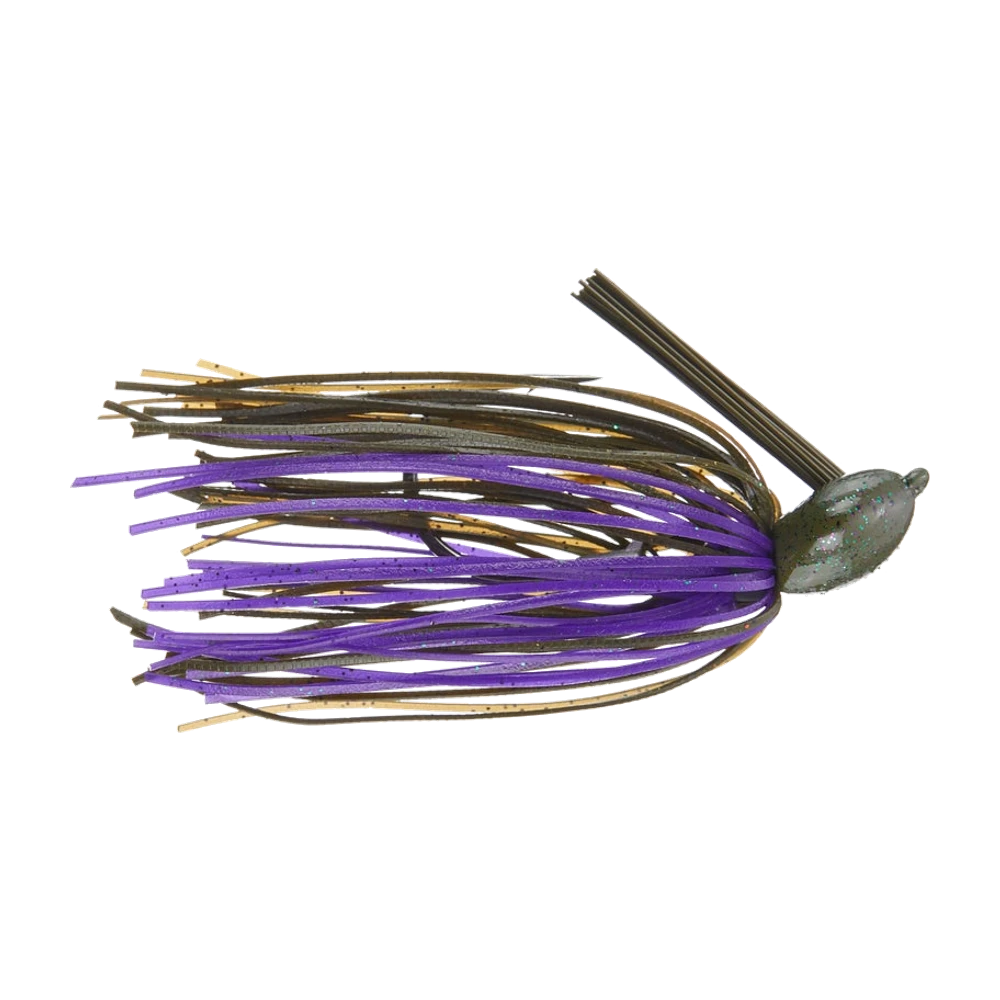
Berkley Flippin' Jig: the jig for digging fish out of hard cover
Before tying this one on, it helps to know if the spot actually calls for it. CarnaFish reads the scene from a photo.
A tree down in two metres of water, three main limbs and a tangle of smaller ones. The fish is in the middle of it, not out front. You can swim a bait past it all day and never see him. To get him out you need a lure that drops vertically between two branches, comes back up without hanging, and arrives with the fish attached. That's exactly what a flipping jig is drawn for, and it's a job where construction details matter more than anywhere else.
The Arkie head: a compromise, not a style
This jig's head is an Arkie type: broad, flattened on the sides, with a relatively flat underside. That shape has one precise virtue — it crawls. Set down on a branch or a rock, it doesn't wedge into a corner the way a round head does; it slides over the obstruction and tips across it.
That's a different choice from a football head like the one on a Strike King Tungsten Football Jig, which excels at dragging over gravel but jams in tight wood. The Arkie accepts all three kinds of cover: hard, soft and in between. It's champion of none, but it's what you want when you don't know exactly what's under the boat.
The 40-degree recessed line tie, the detail that makes the difference
This is the jig's most interesting feature and the least visible in a photograph. The line tie isn't mounted flat or perpendicular: it's recessed into the head and angled at 40 degrees. Two concrete consequences.
The first is mechanical: the knot sits sunk into the mass of lead, so it's shielded from rubbing against wood and rock. On a technique where you saw your knot against a branch on every drop, that isn't a comfort detail — it's the difference between losing a big fish and landing it.
The second is geometric, and it matters even more. The 40-degree angle orients the pulling axis so the hook point travels upward when you set, in the direction you're pulling. On a long-range hookset, under cover, with braid rubbing on timber, that's what turns a felt bite into a hooked fish.
Never set sideways with a flipping jig. Take the rod to vertical, arms extended, and pick up the slack before you drive. A sideways set rotates the head inside the cover and the point rarely comes out in the right place — the recessed tie angle is useless if your pull doesn't go upward.
A stiff weedguard: accept it, don't trim it
This jig's weedguard is deliberately thick and rigid. That's the opposite of the medium setting you find on a swim jig like the Berkley Finesse Swim Jig, and it's logical: the point here isn't to brush soft grass aside but to protect a hook point against hard wood and rock.
Most anglers' instinct is to thin it with pliers because they feel it hampers the hookset. On this kind of fishing, that's almost always a mistake. With a heavy rod, braid and a firm upward set, a stiff weedguard collapses without trouble. A trimmed weedguard, on the other hand, lets the point dull against the first stump, and a dull hook forgives nothing.
If you really have to soften it, fan the fibres out with your thumb rather than removing any: you gain flex without opening a gap in front of the point.
The trailer keeper, a detail that pays off over a day
The trailer retention system is a detached barb, set separately on the shank. Its point is simple: the trailer stays put cast after cast, and above all it stays centred. A trailer that slides down or pivots on the shank means a jig that swims crooked and no longer falls straight between branches.
In practice, what you mostly gain is time. On a day of flipping you make three to four hundred presentations. Repositioning the trailer every ten casts costs you half an hour of fishing. Rig a clawed trailer like the Berkley Crazy Legs Chigger Craw if you want to slow the fall, or a more compact one if you want to get down fast.
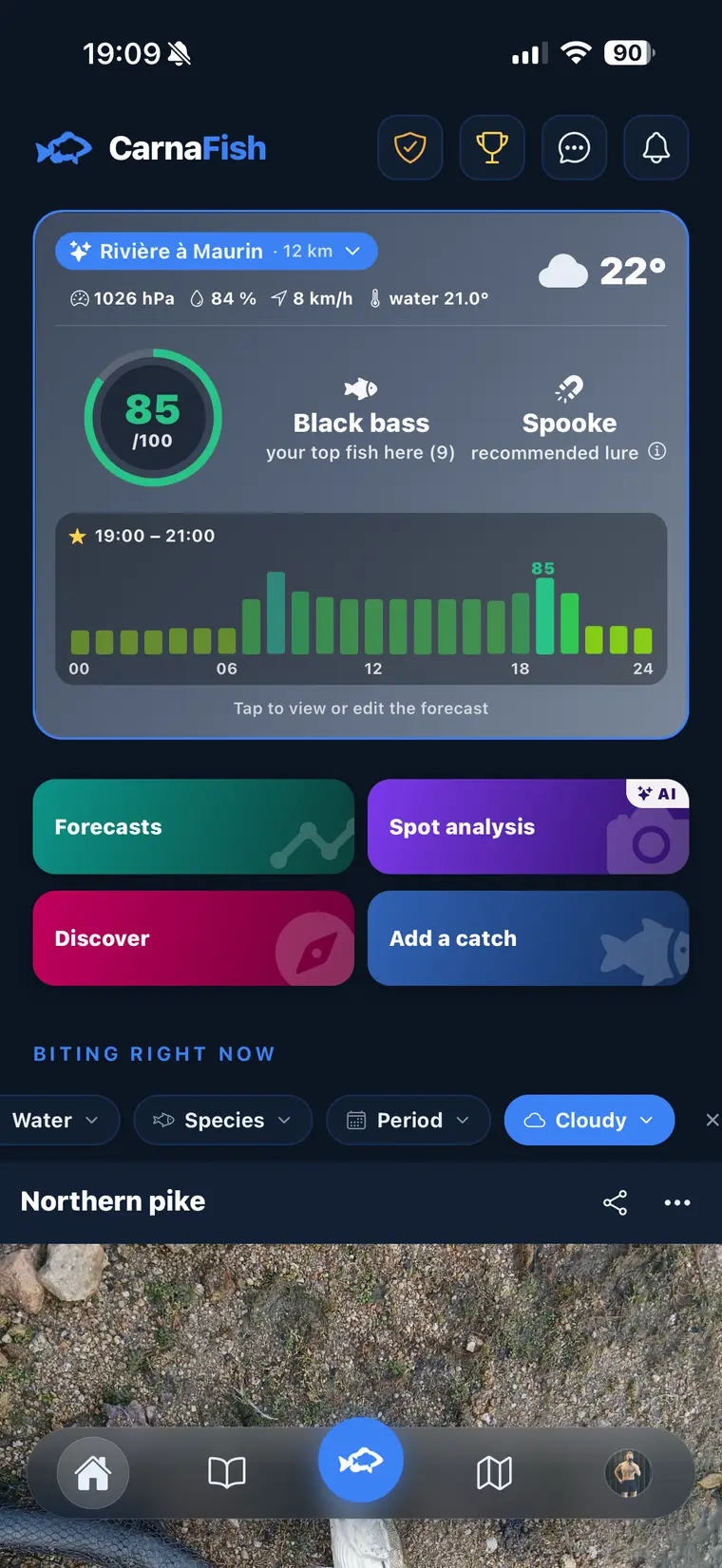
Not sure what to tie on?
Photograph your spot: CarnaFish reads the scene, cross-checks the conditions and gives you the zone, the lure and the retrieve. Free on iOS and Android.
When to reach for this jig instead of something else
A flipping jig is not a searching lure. It earns its place once you've identified the cover and want to present precisely, one piece at a time, moving slowly. In cool water, in spring before the spawn and in autumn when fish pin themselves to wood, it's often the only lure that genuinely reaches the fish.
Its limit is clear: it covers very little ground. On a lake you don't know, start with a fast bait to find the area, then bring out the jig to work what you found. In Europe as anywhere else, most blank jig days are days when the angler kept working empty cover.
Colour by bottom and water
- Hard bottom, gravel or rock, clear water: crawfish brown, which matches the real colour of the main prey over that kind of bottom.
- Stained water, overcast skies, submerged wood: black and blue, the classic flipping contrast, readable once visibility drops.
- Clear water with vegetation: green pumpkin, more discreet, paired with a trailer in the same colour family.
Avoid rigging a trailer in a markedly different colour from the skirt. On a compact lure, that break splits the silhouette and turns one object into two.
Finding the right tree before you pull out the jig is 80% of the work. That's exactly what CarnaFish does: a photo of the spot, and the app suggests the zone, the depth and the presentation suited to the day's conditions. To learn how to read cover before you even cast, our guide to reading a fishing spot walks through the clues to look for.
Key takeaways
- The Arkie head crawls over every kind of cover: it's the versatile choice when you don't know what's down there.
- The 40-degree recessed line tie protects the knot and aims the hookset upward — set vertically, never sideways.
- The stiff weedguard shouldn't be thinned: with a heavy rod and braid, it collapses by itself on the set.
- A flipping jig covers no water: find the fish with something else, then exploit them with this jig.
FAQ
What weight of Flippin' Jig should I choose?
The manufacturer doesn't publish a weight chart for this model. Reason from cover density instead: the tighter the obstruction, the more weight you need to drop straight between branches without drifting. Check the weight printed on the packaging.
Should I cut the weedguard?
No, barring very specific cases. With a heavy rod, braid and a vertical hookset, a stiff weedguard collapses without getting in the way. Trimming it exposes the point to dulling against wood within the first few drops.
How do I set the hook properly with this jig?
Pick up the slack, then take the rod to vertical, arms extended, in one firm movement. The 40-degree recessed line tie is built so the point travels upward: a sideways set cancels that advantage.
What trailer should I rig behind it?
A clawed trailer to slow the fall and hold the zone longer, a more compact one to drop fast into deep cover. The Berkley Powerbait The Champ Craw is a good starting point for the first option.
What's the difference with a football jig?
A football jig, with its head wide and flat across the axis, excels at dragging over gravel and rock but jams in tight wood. This model's Arkie head is less specialised but goes everywhere, branches included.
Is it a good lure for searching an unknown lake?
No, that's its main shortcoming. It covers very little ground. Find the area first with a fast bait, then bring out the jig to work the cover you've identified precisely.
The full bass lure guideSeason-by-season strategy: which family of lure, when, and why.Go from theory to fish
CarnaFish reads your spot from a photo and gives you the game plan: zone, lure, retrieve. Free on iOS and Android.