Berkley Spin Rocket: the slim propbait for clear, flat water
Rather not fish it blind? Photograph your spot — CarnaFish cross-checks the conditions and points you the right way.
A reservoir on a September morning, not a breath of wind, water so clear you can see bottom in three metres. The bass are there, visible, and they refuse everything. It's the most frustrating scenario in topwater fishing: the fish sees everything, including whatever is wrong with your bait. The Spin Rocket is built for exactly that context — a long, slim body that disturbs little, and two props that make the noise for it.
A profile that glides instead of shoving
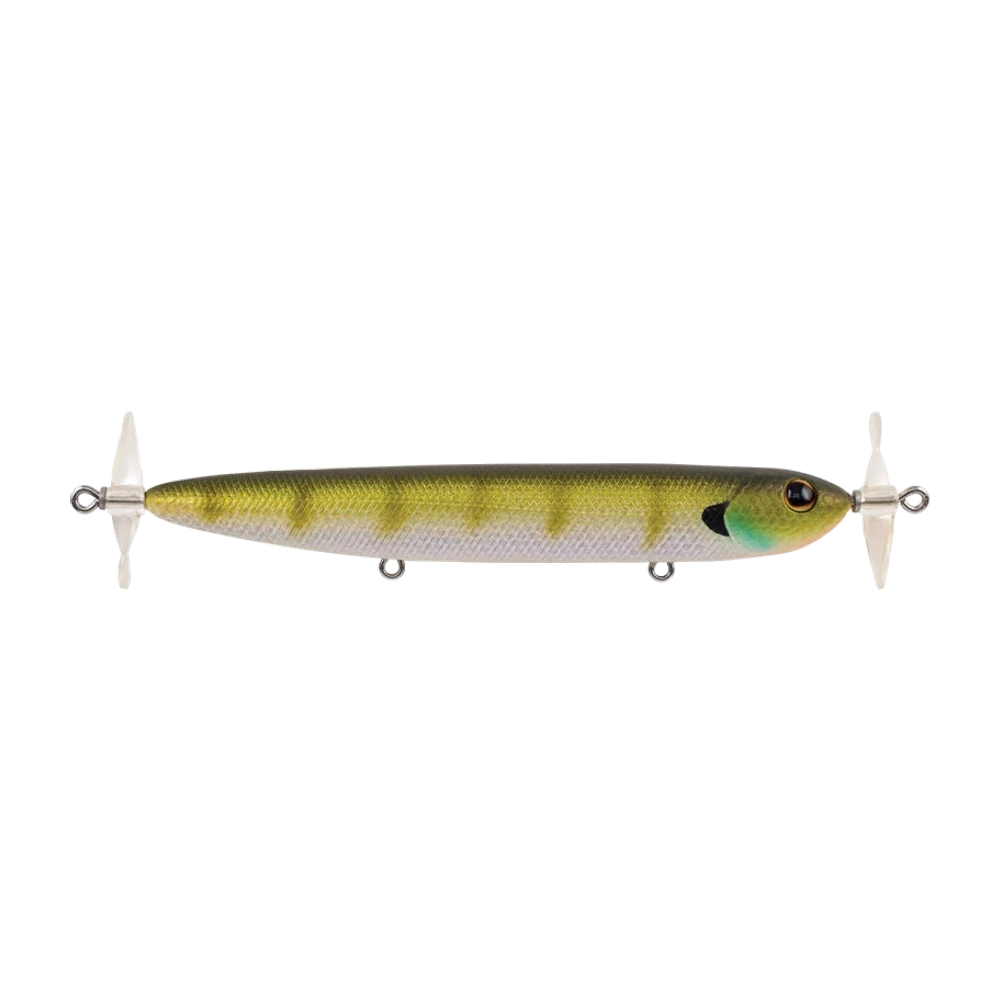
The Spin Rocket was designed by Justin Lucas, who had already specced the Berkley Spin Bomb. This one takes the exact opposite line: where the Spin Bomb is short and deep so it can pivot in place, the Spin Rocket is long and hydrodynamic, cut to glide. At 10.8 cm / 4.25 in for 14.2 g / 0.5 oz, it covers real distance on every pull rather than staying put.
That choice has two consequences. The first is better water coverage: a handful of casts sweeps a whole bank, which makes it a search bait rather than a grinding bait. The second is subtler: a slim body displaces less water, so it disturbs the surface less between prop beats. On a glassy lake, that quietness of the body matters as much as the noise of the blades.
Clear props that start turning at crawl speed
The two clear plastic props are dished into cups and drawn with an enhanced blade area. Berkley claims a double effect: they spin from slow speeds, and they throw the maximum amount of spray.
In clear, flat water that's exactly what you need. You can reel very gently, just enough for the blades to bite, and get a fine sizzle instead of a heavy racket. The bait then stays credible to a fish that has all the time in the world to inspect it. The transparency of the blades isn't only cosmetic: seen from below against the light, they don't form the opaque mass that gives an object away.
On mirror water, always start at the slowest speed where the props still turn without stuttering. If three casts produce nothing, jump straight to the aggressive rip rather than to an intermediate speed: it's the two extremes that work, not the middle.
Three retrieves, three situations
The soft twitch. Rod low, two short taps of the tip, the bait glides twenty to thirty centimetres and the props spit. Pause of one to three seconds. This is the retrieve for flat water and wary fish.
The straight retrieve. Steady reeling, no rod input at all. The two props lay down a continuous wake. Simple, and often enough when fish are actively chasing fry on top.
The aggressive rip. Long, hard pulls, the bait bounds forward and throws two plumes. This is the mode to try when the surface ripples or when nothing has worked gently: it triggers reflex strikes from fish that would never have come up to a slow presentation.
Tackle and rigging
A 2.10 m medium-heavy casting rod, 30-40 lb braid, a fluorocarbon leader of at least a metre — in clear water that's the part of the rig the fish sees. Berkley lists three Fusion19 trebles on this bait, a generous set-up that forgives badly aimed strikes but tangles in braid easily on the cast. Lay the bait flat on the water by thumbing the spool at the end of the cast and you'll avoid three quarters of your hook tangles.
A discreet rolling swivel between braid and fluorocarbon is strongly advised. Two props turning the same way will always end up twisting a leader, especially if you rip the bait.
The classic mistake
Fishing the Spin Rocket like a walking bait. Plenty of anglers impose a walk-the-dog rhythm on it, rod high, expecting a zigzag. The body isn't built for that: it glides straight. Keep the rod low and pointed at the bait, and let the props do the work. A high rod lifts the nose out of the water and puts the front blade out of a job.
Not sure what to tie on?
Photograph your spot: CarnaFish reads the scene, cross-checks the conditions and gives you the zone, the lure and the retrieve. Free on iOS and Android.
Colour by clarity
- Clear water, sun: the barred green-gold pattern on the photographed bait, which copies the livery of a small bank fish without excess flash.
- Fry schools in open water: a more neutral pearl silver, throwing short flashes without drawing a pattern.
- Low light, heavy cloud: opaque white. From below only the silhouette counts, and an opaque body cuts out better than a detailed one.
When to pick it over a walking bait
A Heddon Super Spook imposes a zigzag that demands a steady rod rhythm and wears you out over a long session. The Spin Rocket covers the same ground for less effort and adds a constant sound signal. The walking bait, on the other hand, stays better when you need a strong lateral move to pull a fish out from under cover. And once the wind gets up, it's a louder lure like the Berkley Screamin' Choppo you should be tying on.
Knowing which bank to attack before you choose a lure is what makes a day. CarnaFish answers that question: a photo of the spot, and the app suggests the zone, the depth and the lure type suited to conditions. To learn to decode a spot before tying anything on, our guide to reading a fishing spot lays out the method.
Key takeaways
- 10.8 cm / 4.25 in for 14.2 g / 0.5 oz: a long body that glides and covers water, the opposite of the Spin Bomb working in place.
- The clear props already turn at slow speeds, allowing a fine sizzle rather than a heavy racket on flat water.
- Three useful retrieves: soft twitch in clear water, straight retrieve over active fish, aggressive rip when nothing else works.
- Rod low and pointed at the bait: a high rod lifts the nose and switches the front prop off.
FAQ
What size is the Spin Rocket exactly?
Berkley lists a single format: 10.8 cm / 4.25 in for 14.2 g / 0.5 oz, classed as a topwater bait. There is no other size in this reference.
How many hooks does it carry?
The maker lists three Fusion19 trebles. That's a generous set-up for a bait this length, forgiving on badly aimed strikes but worth some care on the cast so the hooks don't catch the braid.
Does it work in rough water?
It works, but that isn't its ground. It was built for shallow, clear water in calm conditions. As soon as the surface ripples hard, a louder tail-prop bait takes the advantage.
Can I just reel it straight in?
Yes, that's one of the three intended retrieves. A steady retrieve is enough to spin both props and lay down a continuous wake, which works very well when fish are already feeding on top.
Do I need a swivel?
It's strongly advised. Two props turning the same way eventually twist the leader, especially if you alternate with hard pulls. A small rolling swivel between braid and fluorocarbon sorts it.
Spin Rocket or Spin Bomb?
The Berkley Spin Bomb to grind on a precise target, because its short body pivots without moving forward. The Spin Rocket to search for fish along a bank, because it glides far on every pull. The two complement each other more than they compete.
The full bass lure guideSeason-by-season strategy: which family of lure, when, and why.Go from theory to fish
CarnaFish reads your spot from a photo and gives you the game plan: zone, lure, retrieve. Free on iOS and Android.