Yum FF Sonar Minnow: the soft minnow built for live sonar
This lure shines under specific conditions. CarnaFish tells you in 10 seconds if today is one of them.
Ten years ago you fished an area. Today a share of anglers fish one fish: it shows on the screen, you drop a lure on it more or less vertically, and you watch live whether it rises or turns away. That way of fishing created a very specific need in lure design, and Yum's FF Sonar Minnow was drawn to answer it — which makes it a highly specialised bait, excellent in its niche and fairly ordinary outside it.
A lure designed to be watched
The brief for a forward-facing sonar bait is unusual. It has to return a readable echo on the screen, stay stable in the water so you can steer it to the centimetre, and above all move very little while still moving. A lure that wriggles too much becomes unreadable on screen and looks suspect to a fish studying it from three metres away.
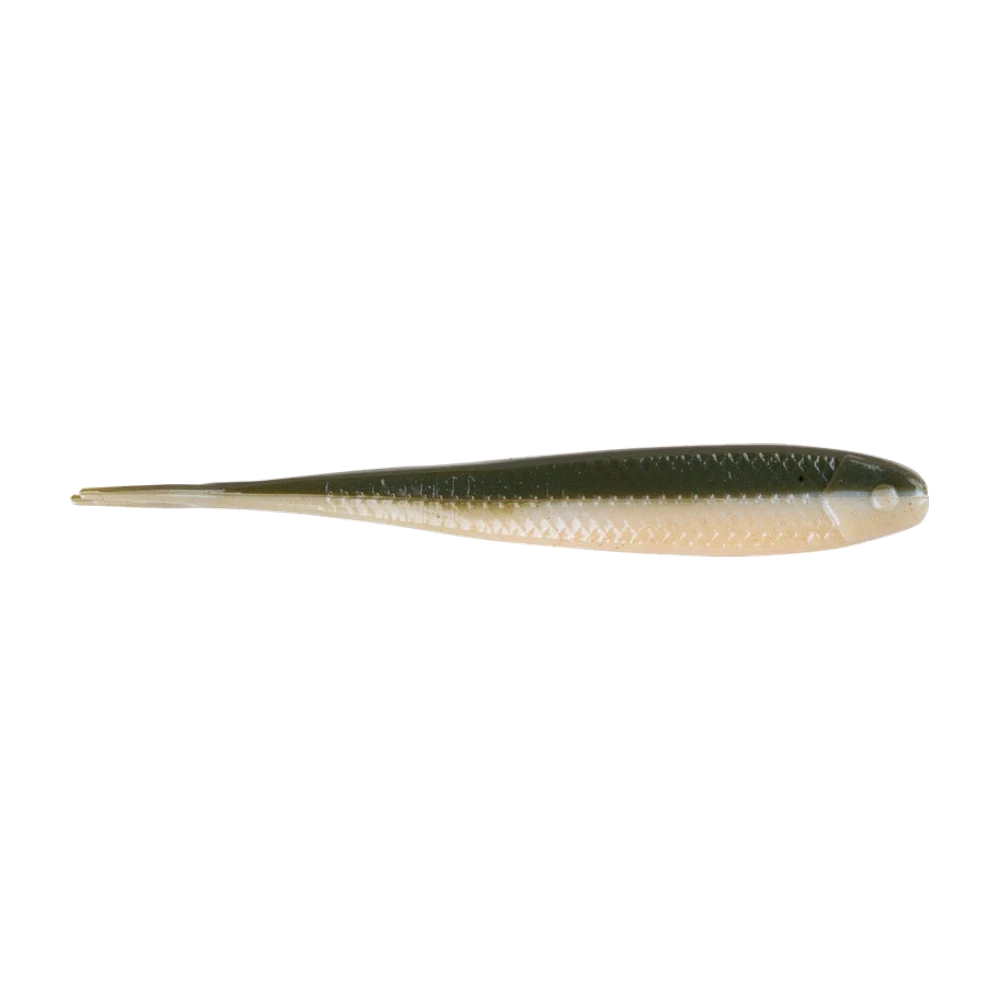
Yum answers that with three choices you can see on the bait. A solid body — not hollow — that holds a straight line and does not spin when you hold it suspended. A thick rounded nose, designed to seat cleanly on a finesse jighead without creating a step. And a small, very fine forked tail that quivers at the slightest movement of the boat or the hand but never produces a real swimming action.
That last point is the heart of the lure. The tail is so fine that it works on minimal input: boat roll, a slow drift, a tremble in the rod tip is enough to animate it. The result looks like a small fish holding in open water without going anywhere, which is exactly what an isolated fry does mid-column.
The bait was developed with Bassmaster Classic winner Jason Christie and loaded with Yum's F2 scent, whose stated job is to lengthen hold time in the mouth. In a style of fishing where you often set the hook on what you see on screen, that extra second is not a luxury.
The habit that changes everything in this game: never drop the lure onto a fish's head. Put it above him, fifty centimetres to a metre higher, and lift slowly if he closes in. A predator will happily rise to eat; it almost never drops down to do it.
The rig: a dedicated jighead and nothing else
Yum states that the FF Sonar Minnow pairs with its own FF Sonar Jig Head. That is not an absolute requirement, but the logic is clear: the lure's thick rounded nose is sized to butt against a finesse head's collar and form a perfect continuity. A badly matched head creates a step at the junction, and that step is enough to make the bait rotate in open water — fatal when you want to hold it still in front of a fish.
On weight, think in sink time rather than depth. Two to three grams to hold mid-water in four or five metres, five to seven to reach ten metres and beyond quickly, or to hold vertical in a breeze. The goal is always to be able to stop the lure where you want and see it stay there.
What the maker does not say
This model's description gives no length, no weight and no pack count. That is a real gap on a bait where size directly dictates the jighead you need. Before ordering, check the length printed on the packaging or with your dealer, and do not buy jigheads in advance on an assumption.
The same description calls it a shad-shaped body. On the actual bait the profile is distinctly more slender than a classic shad: it is a thin minnow, with a body that tapers progressively into a thread-like tail. Keep that silhouette in mind when choosing — it matches a fry or a small roach better than a deep-bodied bleak.
Three retrieves that work
The motionless hold
The default setting. You drop the lure to the depth of the fish on screen, stop, and do nothing. Swell, drift and your own breathing are enough to work the tail. If the fish closes in, lift ten centimetres. If it turns away, drop twenty. This is a steering game, not an animation game.
The shake on the spot
When the fish is looking but not rising, put a very short tremble into the rod tip for two or three seconds without raising or lowering the bait. The tail vibrates and the body stays put. That is often what decides a hesitating zander.
The slow lift
As soon as the fish commits, lift steadily and smoothly, fifteen to thirty centimetres per second. Do not stop when it arrives: a lure that flees gets eaten, a lure that freezes abruptly gets inspected.
The classic mistake
Working it like an ordinary soft plastic, with firm pulls and falls. On this bait the pulls produce nothing useful: a solid body does not vibrate, the tail folds flat, and the fish loses visual contact. The less you do, the better this lure fishes.
Not sure what to tie on?
Photograph your spot: CarnaFish reads the scene, cross-checks the conditions and gives you the zone, the lure and the retrieve. Free on iOS and Android.
Colors by water clarity
Yum advertises its own patterns without naming them here. Think in families, it holds up better:
- Clear water: naturals with an olive back and pearl belly, as in the photo. That is the livery of a coarse-fish fry in almost every European water, and the default choice as soon as the fish sees the bait from a distance.
- Stained water: solid light tones — white, pearl, light translucent. A pale body stands out better against a loaded background and stays readable when visibility drops to a metre.
- Low light or real depth: dark dominants. At fifteen metres, contrast beats colour.
Where this bait makes sense, and where it does not
Its ground is open, deep water: slack-water margins on big lakes, reservoir drop-offs, river holes, anywhere fish suspend over a distant bottom. It also assumes you own a unit that can show the lure and the fish at the same time — without that, most of its point disappears and a Keitech Shad Impact 3 or a Damiki Armor Shad will do just as well for less money.
Conversely, along the bank, in cover, on fish pinned to the bottom, or whenever you need to cover water fast, this bait is off-brief. A Yum Money Minnow covers those situations far better.
One last point worth stating: live scanning sonar is subject to restrictions in some competitions and to ongoing debate in Europe on a number of waters. Check local rules before investing in the equipment, and remember that reading a swim with your own eyes is the skill that works everywhere.
That is exactly what CarnaFish sets out to build: a photo of the swim, and the AI suggests a zone, a depth and a presentation consistent with the day's conditions, sonar or no sonar. To go further on deep-water predators, our guide to getting started with lure fishing for zander runs through the lure families worth knowing.
Key takeaways
- A specialised forward-facing sonar bait: solid body, rounded nose, minute forked tail that quivers without ever producing a pronounced swimming action.
- The nose is sized to seat on a dedicated finesse jighead; a mismatched head makes the bait rotate while suspended.
- The maker publishes no length, no weight and no pack count: check the size before buying jigheads.
- The less you animate it, the better it fishes. Firm pulls are counterproductive on this model.
FAQ
How long is the FF Sonar Minnow?
The maker's description does not say, and gives neither weight nor pack count. Check the figure printed on the packaging before ordering, and above all before buying jigheads meant to match the bait.
Do you really need forward-facing sonar to use it?
No, but without a screen you lose most of its point. This bait is made to be steered vertically in front of a fish you can see. Without sonar, a conventional soft shad covers the same depths with far more tolerance in how you work it.
What jighead weight should you pick?
2 to 3 g to hold mid-water in four or five metres, 5 to 7 g to get down fast beyond ten metres or to hold vertical in wind. The right weight is the one that lets you stop the lure exactly where you want it.
Does it work for zander and perch?
Yes, and that is arguably its most logical use in Europe, where zander and perch often suspend over deep ground. Zander want longer pauses, perch will take a more nervous shake.
Why does my bait spin while suspended?
Almost always because of the junction with the jighead: if the nose does not butt perfectly against the collar, the step that creates will rotate the whole thing. Change to a head with a matching collar, or trim the nose slightly so it seats flush.
Is the body really shad-shaped?
Yum presents it that way, but the real profile is far more slender than a classic shad: a thin body tapering into a thread-like tail. That is the silhouette of a fry or a small roach, not a deep-bodied baitfish — worth bearing in mind if you are matching a specific prey.
The full bass lure guideSeason-by-season strategy: which family of lure, when, and why.Go from theory to fish
CarnaFish reads your spot from a photo and gives you the game plan: zone, lure, retrieve. Free on iOS and Android.