Z-Man Goat Toadz: the Elaztech toad that churns the surface
The right lure in the wrong spot still catches nothing. CarnaFish spots the zone that works, from a single photo.
Late July, a backwater carpeted with lily pads, eleven in the morning: there is not one square metre of open water left to drop a conventional lure into. This is exactly what a soft toad is for — a bait you crank across the vegetation without ever stopping, legs clattering, until a bass blows through the mat from underneath. The Goat Toadz is Z-Man's take on that drill, and it is the material, more than the silhouette, that changes how you fish it.
What Elaztech changes on a toad
Nearly every toad on the market is poured in PVC plastisol, a material that sinks slowly and that you compensate for by reeling fast. The Goat Toadz is moulded from Z-Man's Elaztech, an elastomer the brand describes as extremely buoyant and exceptionally tear-resistant.
Buoyancy lowers the floor speed. A PVC toad that slows down drops and loses its legs; the Goat Toadz stays up even when you let the line go slack for half a second over a hole in the weed. You gain the ability to pause the bait right where the fish is sitting, and that is precisely when a lot of strikes happen.
Durability changes the economics of a day on the water: a PVC toad is finished after two or three fish, Elaztech holds up far longer. One precaution, and it is not optional: this material does not get along with traditional plastisol and will chemically attack it. Keep it in its own bag and the problem disappears.
One thing you only learn on the water: Elaztech is slick. On a standard bait-keeper hook the body creeps down the shank cast after cast. A screw-lock keeper, or a short piece of heat-shrink tubing over the eye, holds it in place for the whole session.
Two legs, a clatter, a bubble trail
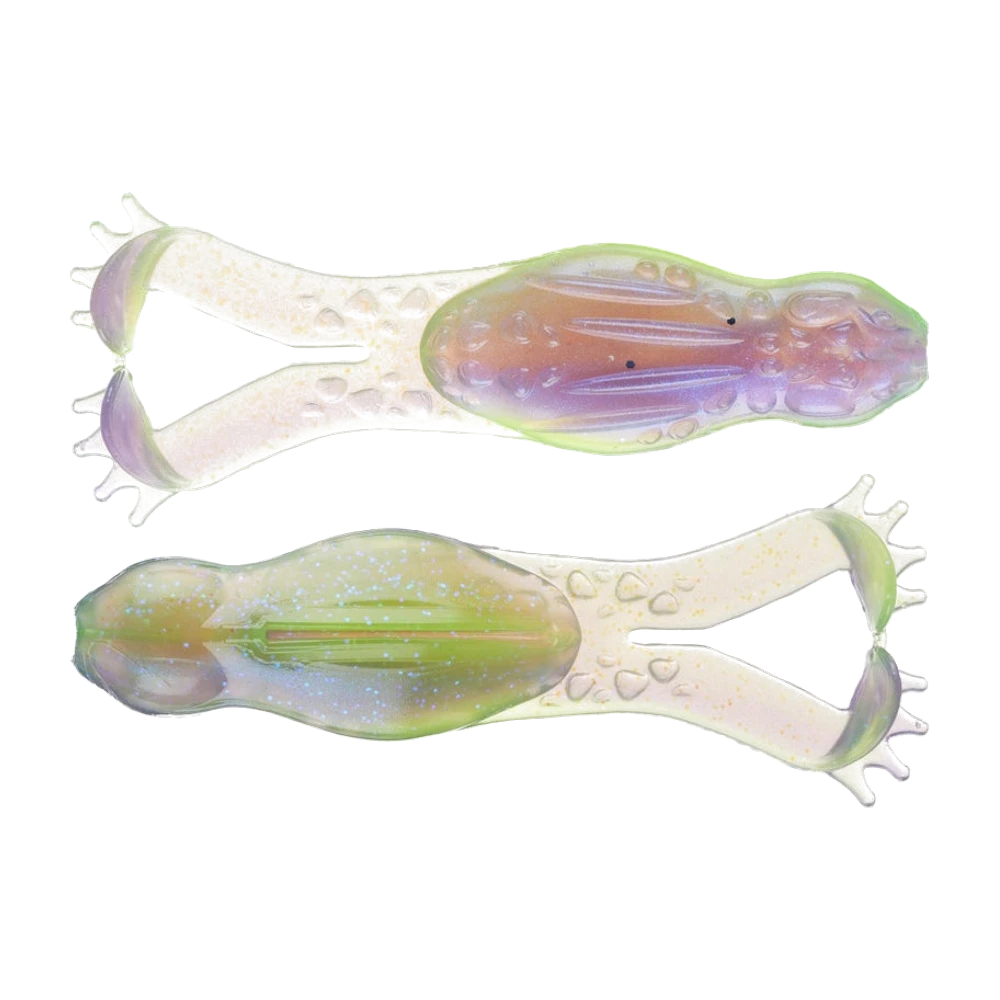
The Goat Toadz body is bulky but streamlined: Z-Man claims over a year of development to reconcile a thick profile, which appeals to big fish, with a shape slim enough to cast a long way and skip under docks. Two long legs run off that body, each ending in a paddle-shaped foot.
Those paddles do all the work. At a steady retrieve they rotate independently, clash against each other now and then and generate a clatter you can hear several metres away, backed by a continuous bubble trail behind the lure. For a fish holding under the mat, that trail is as strong a visual cue as the noise: it tracks the line of bubbles, not a silhouette it can barely make out against the sky.
The back of the bait carries longitudinal dorsal ridges. They serve two stated purposes: adding realistic relief, and above all creating a channel that shields the point of a single hook or a double. The belly half is cut with a hook slot, so on the strike the body collapses into that groove instead of acting as a buffer, and the point comes through. That is the difference between a hookset that sticks and one that slides off solid plastic.
Finding the floor speed
Start reeling before the bait lands, rod tip high, then slow down gradually until the leg clatter becomes irregular. Nudge it back up one notch: you have just found the slowest speed at which this lure stays convincing, and it is almost always the one that catches the most fish.
Three rigs with three different jobs
Texas EWG, the default
A 4/0 to 5/0 wide-gap hook, nose-pinned, brought back out and tucked point-up into the dorsal ridge. Nothing sticks out and the bait slides over leaves and stems. Braid in the 40 to 50 lb range is mandatory, with no fluorocarbon leader: you need to haul the fish out of the mat, not negotiate with it.
As a buzzbait trailer
Z-Man explicitly presents the Goat Toadz as a buzzbait companion, and the pairing holds up. Rigged behind the blade it adds bulk, a second sound source offset by half a beat from the blade itself, and enough lift to keep the buzzbait on top from the first turn of the handle. On a Booyah Buzz worked slowly along a grass edge, the difference in bite count is obvious.
Double frog hook
The dorsal ridges also take a wide-gap double, the kind normally run on a hollow-body frog. That is the call when you are fishing thick duckweed or pondweed mats: two points instead of one, better spread, for a hookset driven through a wad of vegetation.
Where and when to use it
The Goat Toadz is a summer search bait. Pad fields, submerged weed that reaches the surface, reed edges, deadfall along the bank: anywhere an open-hook lure would cost you a bait per cast. Across Europe, ponds and the backwaters of large rivers offer exactly this kind of cover from June to September.
Bass is the obvious target. Pike also eat these baits, but on a bare Texas rig you will lose most of them and risk a bite-off: if there is pike on the spot, move to a heavy fluorocarbon leader of 0.60 to 0.80 mm at the very least.
The classic mistake
Setting on the sound. The surface blow-up is spectacular, your hand goes on its own, and nine times out of ten the fish does not have the bait in its mouth yet. Keep reeling at the same rhythm until you feel the weight load the rod, then set sideways rather than skyward. On a bait this buoyant the temptation to swing early is even stronger, because the toad stays visible after the blow-up.
Not sure what to tie on?
Photograph your spot: CarnaFish reads the scene, cross-checks the conditions and gives you the zone, the lure and the retrieve. Free on iOS and Android.
Colors by water clarity
Z-Man does not publish a color list for this bait: the description simply mentions a range. So reason in families of shades rather than trade names.
- Clear water, bright sky: translucent pearl finishes like the one in the photo — milky body shot with purple and green, a chartreuse edge, gold and blue flake. Seen from below, that translucency lets light through and gives a diffuse outline, close to a real frog backlit against the sky.
- Low light, dawn or heavy overcast: a solid dark back, black or deep brown. It is not the color the fish sees, it is the contrast of the silhouette against the sky.
- Stained or green water: a chartreuse or hard white belly, readable at short range when visibility drops below a metre.
Next to hollow-body frogs
A toad and a hollow-body frog do not do the same job. A hollow-body frog crosses the thickest mats and is worked in place, walking the dog over a specific hole. The Goat Toadz is a search bait: it covers water fast, it makes noise, it finds the active fish. The logical sequence is to search with the toad, then come back over the productive zone with a hollow-body frog. A Z-Man Chatterbait JackHammer also fills that follow-up role just under the surface when fish keep rising without committing.
Knowing which lure to tie on matters less than knowing where to cast it, and that is the whole point of CarnaFish: take a photo of the spot and the AI suggests the zone, the depth and the lure family that match the conditions of the day. To build the groundwork on topwater fishing and the tackle that goes with it, our beginner guide to bass fishing covers the rest.
What to remember
- Elaztech buoyancy lowers the floor speed: you can slow down, or even pause briefly, without the toad sinking.
- The belly slot and the dorsal ridges are built for a clean hookset, with a single hook or a double.
- As a buzzbait trailer it adds bulk, a second noise and useful lift.
- Set on the weight you feel, never on the sound: that is the mistake that costs the most fish on this kind of bait.
FAQ
What hook should I use with the Goat Toadz?
A 4/0 to 5/0 wide-gap EWG Texas rigged, point tucked into the dorsal ridge, covers most situations. The ridges also accept a frog double, which suits very dense vegetation mats better.
Does the Goat Toadz really float at rest?
Z-Man describes the material as extremely buoyant, and the observed behaviour backs that up as long as the bait is rigged bare on an unweighted hook. Add a weighted hook or a jighead and most of that lift disappears.
What size is it and how many come in a pack?
The bait measures 4 in, roughly 10.2 cm, and the pack contains 3. Z-Man does not publish a unit weight for this model.
Can you catch pike on it?
Yes, pike readily attack a toad worked on the surface, but a bare Texas rig on straight braid produces a lot of missed hooksets and exposes you to bite-offs. Add a heavy fluorocarbon leader at minimum if you know there is pike on the spot.
Why does my toad slide down the hook shank?
That is a property of Elaztech, which is slicker than standard plastisol. A screw-lock keeper, or a piece of heat-shrink tubing over the hook eye, locks the body in position for the day.
Can I store it with my other soft plastics?
No. Elaztech reacts on contact with PVC plastisol and ruins both baits. Keep Z-Man softs in their own bag or a dedicated compartment.
The full bass lure guideSeason-by-season strategy: which family of lure, when, and why.Go from theory to fish
CarnaFish reads your spot from a photo and gives you the game plan: zone, lure, retrieve. Free on iOS and Android.