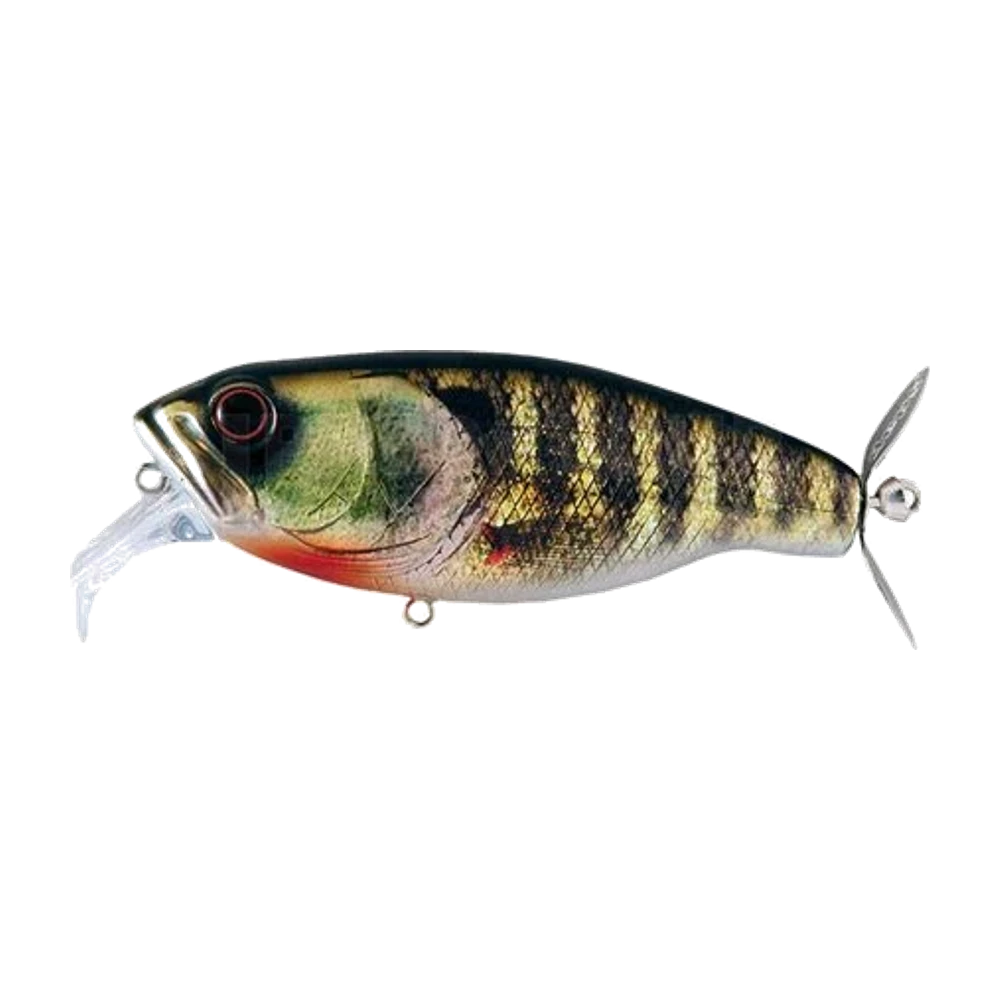
Deps BuzzJet: the prop bait you can stop dead mid-retrieve
Before tying this one on, it helps to know if the spot actually calls for it. CarnaFish reads the scene from a photo.
Two days running on the same lily pad edge, with the same plopper. The first day, four fish. The second, two follows and nothing else. The steady, continuous noise of a jointed rear prop is deadly — right up until the fish has heard it once too often.
The prop bait answers that problem with something a plopper cannot do: it can stop without dying. A plopper at rest is an inert piece of plastic, because its tail only turns while it is moving. A stopped BuzzJet is still a silhouette sitting on the surface, with two props that keep glinting at the slightest ripple, and from which a brutal signal restarts the moment you give it a twitch of the rod tip. That silence in the middle of the noise is exactly what decides a fish that has seen everything.
Two props, two distinct signals
The BuzzJet carries a prop at the front and one at the back, and they do not play the same role.
- The front prop churns and aerates the water ahead of the body. It generates a continuous hiss and a trail of micro-bubbles that extends the lure's silhouette. That is the searching signal, the one that brings fish in from a distance.
- The rear prop cracks more sharply and throws water backwards on every acceleration. That is the trigger signal, the one that provokes the strike once the fish is close.
Between the two, the body stays fairly horizontal and does not dig in. The result: a noisy lure that never produces a popper's big plop, and that works just as well on a slow travel as on twitches in one place.
Three rhythms depending on the fish's mood
- The searching rhythm. A slow, constant straight retrieve, just fast enough to keep both props turning continuously. You cover ground and locate the active zones.
- The provoking rhythm. Two or three fast turns, then a dead stop of two to three seconds, then a single sharp twitch to make the rear prop crack. Repeat. This is the rhythm that converts followers.
- The precision rhythm. On a tiny spot — a hole in the lilies, the shade under a jetty — you drop the lure in, wait five seconds doing nothing, then give two twitches on the spot and wait again. You barely recover any line at all.
You move from one to the other within the same session: start searching, and as soon as a fish follows without taking, come back over the same place thirty seconds later in provoking mode.
On the water: when a fish misses the lure on the surface — and that happens a lot on a prop bait — whatever you do, do not reel in to recast. Leave the lure exactly where it is for five seconds, then give one tiny twitch. The conversion rate on that second attempt is very high, whereas a fresh cast to the same place almost never produces.
Tuning the props and the tackle
This is a lure you tune, and two minutes of preparation change how it behaves.
| Setting | Effect | When to apply it |
|---|---|---|
| Props clear and free to turn | Maximum signal, instant start-up | Standard use |
| Blades closed slightly with pliers | Harder rotation, duller sound | Wary fish, very clear water |
| Blades opened slightly | Easier rotation at low speed | Very slow retrieve |
| Bead washer added under the prop | Extra clicking | Stained water, wind, poor visibility |
On tackle, two points matter. First, braid straight through: a topwater lure is fished on a line that floats and transmits no stretch, otherwise your hookset goes into thin air. Second, for pike, a heavy leader is mandatory — 0.70 to 0.90 mm fluorocarbon or titanium, short, or a surface strike ends in a clean cut.
And as with any topwater lure: do not set the hook on what you see. Wait until you feel the weight in the rod. A hookset triggered by the visual explosion rips the lure away before the fish really has it in its mouth.
Not sure what to tie on?
Photograph your spot: CarnaFish reads the scene, cross-checks the conditions and gives you the zone, the lure and the retrieve. Free on iOS and Android.
Where it excels, where it has no business
Its windows:
- Summer and early autumn, on warm water, early morning and late in the day.
- Vegetated margins: lilies, reed beds, fallen trees, where the fish sits high and waiting.
- Calm to lightly rippled water. A mirror-flat surface makes fish wary; a light ripple is ideal.
- Spots already fished with a plopper, where the change of signal makes all the difference.
Its limits:
- Marked chop and strong wind. The signal gets lost in the background noise of the surface.
- Cold water. Below about fifteen degrees the fish rarely comes up, and the prop bait has no place.
- Dense weed mats. The props collect vegetation; a frog will suit better.
- Deep water with no structure. With no reason for the fish to come up, the surface produces nothing.
BuzzJet, plopper or glidebait
The commonest confusion is with ploppers. The River2Sea Whopper Plopper 130 and the Berkley Choppo work through a jointed tail that turns continuously: they put out a steady, powerful signal that calls from a long way off. Their strength is searching, their weakness uniformity — they are almost always fished at the same rhythm, and a fish that has refused them will refuse them again. The BuzzJet covers less ground per hour, but it gives you control: stop, restart, twitch on the spot, change of intensity. On a heavily fished water, it is the lure for the second pass.
Nor should it be confused with the Deps Slide Swimmer 250, which belongs to the same brand but to a completely different category: a large-format glidebait that works below the surface in wide lateral sweeps, for sight fishing big fish at a low cadence with heavy tackle. The two never overlap in a box, for the same reasons: the Slide Swimmer hunts one specific fish with its profile, the BuzzJet combs a margin with noise.
Our beginner's guide to bass fishing sets out the times of day when topwater beats everything else. And if you are torn between a plopper and a prop bait as you stand in front of a margin, CarnaFish analyses a photo of the spot and answers.
Key takeaways
- Unlike a plopper, it stays interesting at a standstill: that is its trump card.
- Front prop to call from a distance, rear prop to trigger the strike up close.
- Three rhythms to alternate within the same session: searching, provoking, precision.
- After a surface miss, do not recast: leave the lure in place for five seconds and give another twitch.
- Useless in cold water, in strong wind and over dense weed mats.
FAQ
What is the difference between a prop bait and a plopper?
A plopper has a jointed tail that turns as soon as it moves forward and produces a continuous signal, very good for searching. A prop bait carries fixed props and stays usable at a standstill, which lets you break the rhythm on wary fish.
How do I work the Deps BuzzJet?
Three rhythms: a slow straight retrieve to search, two or three fast turns followed by a two to three second stop to provoke, and twitches on the spot with long pauses over a precise target.
Do I need a wire leader for pike?
Yes, or 0.70 to 0.90 mm fluorocarbon. A pike's surface strike comes in from the side, and a plain knot on braid or a thin fluoro leader is cut through immediately.
When should I set the hook on a surface strike?
When you feel the weight in the rod, not when you see the explosion. Setting on sight rips the lure away before the fish really has it, and it is the commonest mistake with this kind of lure.
Can the props be tuned?
Yes. Closing the blades slightly with pliers stiffens the rotation and dulls the sound, which helps on wary fish. Opening them a little makes them start more easily at very low speed.
What time of year should I use it?
From late spring to early autumn, on warm water, mainly early in the morning and late in the day. Below about fifteen degrees the fish rarely comes up and the surface stops paying.
The full bass lure guideSeason-by-season strategy: which family of lure, when, and why.Go from theory to fish
CarnaFish reads your spot from a photo and gives you the game plan: zone, lure, retrieve. Free on iOS and Android.