Big Bite Baits FAFO: the flipping beaver with a splittable tail
The right lure in the wrong spot still catches nothing. CarnaFish spots the zone that works, from a single photo.
There comes a point in a summer day when bass simply stop showing themselves. They quit feeding along the edges, tuck under a pad field or deep into a sunken bush, and wait for the light to drop. A bait swimming two metres away means nothing to them: you have to put something within a foot of their nose, and that something has to get through the vegetation without hanging up. That is exactly the job description of the Big Bite Baits FAFO, a 4 in beaver designed by MLF pro Fletcher Shryock for flipping heavy cover.
Why the beaver shape won
A beaver is a deliberate compromise between a craw and a thick worm. The body is flat and compact, with nothing sticking out to the sides at the moment the bait punches through a layer of vegetation — that is what lets it get through a duckweed mat or a reed edge where a craw with big flapping claws just sits on top, never reaching the fish. Once it is through, the appendages go back to work normally. The Reaction Innovations Sweet Beaver established this profile twenty years ago and nobody has seriously questioned it since.
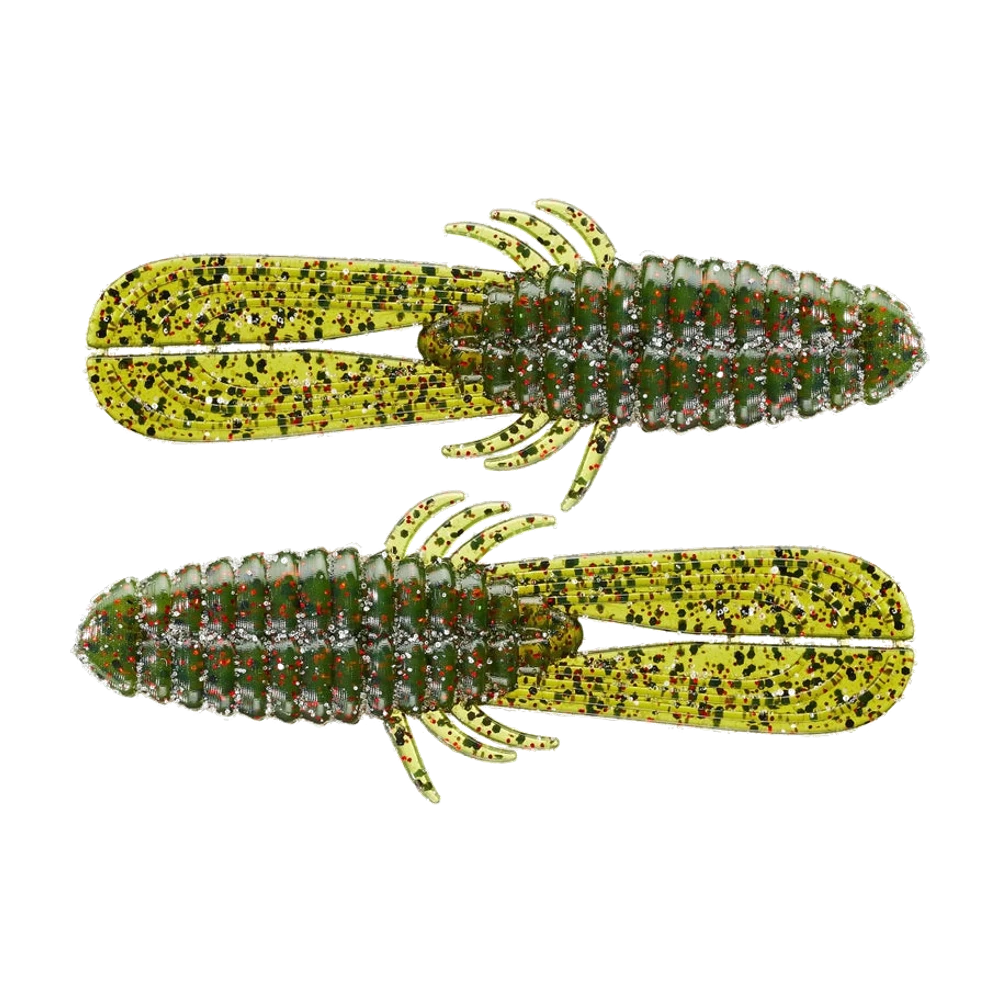
The FAFO takes that template at 10.2 cm and adds two things. First, a fully ribbed body: the ribs displace more water on the drop and form a natural channel to bury the hook point, which makes the rig genuinely weedless without having to bite into the bait's back. Second, a pair of small side appendages that make no noise but keep a subtle vibration going for the whole descent. The individual weight is not published by the manufacturer, which matters little here: the bullet weight ahead of the bait controls the fall rate.
The splittable flapper, the real quirk
Straight out of the bag, the FAFO has a one-piece tail: a wide flat flapper that gives a compact silhouette and a slow, almost gliding fall. That is the setup for cold water, for sluggish fish, and for shallow water where you want the bait to stay inside the bass's window as long as possible.
But the flapper is built to be separated. One cut with scissors — or just a thumbnail along the centre rib, which is already moulded for it — and you get two independent blades that move on their own. The effect is obvious: the fall slows further and gets less stable, and each blade starts undulating the moment it meets any current. That is the warm water setup, the one for active fish, and above all the one for shaking the bait in place without moving it.
One piece or split, how to choose
The call comes down to one question: are you trying to make the bait go down, or make it stay? One-piece flapper, the FAFO punches through vegetation more decisively and reaches bottom faster. Split flapper, it loses penetration but gains hang time: on a laydown where you know a fish is sitting, that extra second of fall is often enough to force a decision.
Split the flapper on one bait, not on the whole pack. There is no going back, and you will spend the day switching between the two versions as the cover thickens or thins. Keep them in separate compartments and you will save real time.
The rig: weighted Texas, and little else
Flipping and pitching
This is what the bait was drawn for. A 3/0 to 4/0 wide gap hook, a 7 to 14 g / 1/4 to 1/2 oz tungsten bullet for medium vegetation, up to 21 g / 3/4 oz to punch a genuinely compact mat. Peg the weight against the nose with a bobber stop when you want the whole thing to drop as a single unit; leave it free when you are on a clean bottom and want the bait to glide a fraction of a second longer after the weight lands. Braid in the 30 to 40 lb range, straight through, no fluorocarbon leader: in heavy cover, stealth matters far less than the ability to pull a fish out of its hole.
Tungsten is not a gimmick here: denser, so more compact for a given weight, it slips between stems more easily and transmits bottom composition far better.
As a jig trailer
The FAFO also makes an honest trailer on a 10 to 18 g / 3/8 to 5/8 oz flipping jig. Thread it nose-first onto the shank, flapper intact, and you get a compact package that keeps a craw profile without adding drag.
Where and when to pull it out
In Europe, the FAFO finds its water on pad-covered gravel pits, river backwaters cluttered with deadfall, and the reed edges of canals and ponds. The window runs from spring, when bass move onto the flats to spawn and turn aggressive on anything resembling a crawfish, through late summer when they hole up in the shade of the vegetation.
Work it slowly. One pitch, a watched fall on a semi-tight line, two or three small hops in place, then start again a metre further along: a good flipping stretch is covered in twenty or thirty close-range pitches, not three long casts. Most bites come on the first fall, and they show up as line moving sideways rather than a sharp knock in the rod.
The mistake that costs fish
Setting the hook immediately. A bass that inhales a beaver under a mat often takes it sideways and needs a second to turn it. Set on first contact and you pull back a chewed bait and nothing else. Reel down gently, wait until you feel the weight of the fish, and only then sweep the rod up in one long continuous motion. Second common error: going too light on the weight out of fear of spooking fish. In heavy cover, a weight that cannot get through the vegetation catches nothing at all, which is far more costly than a slightly heavy one.
Not sure what to tie on?
Photograph your spot: CarnaFish reads the scene, cross-checks the conditions and gives you the zone, the lure and the retrieve. Free on iOS and Android.
Colour by water clarity
- Clear water: Green Pumpkin, the tone that best imitates a crawfish over gravel and vegetation. The default colour, the one to keep when in doubt.
- Lightly stained water: Candy Craw or any green flake laced with red, which keeps a natural base while catching what little light there is — that is the colour in the photo above.
- Dark water, under a thick mat or at last light: Black Blue. Under heavy cover the fish sees a silhouette backlit from above, not a colour; a dark bait stands out far better than a pale one.
A situational tool, not a swiss army knife
The FAFO is not a search bait. If you need to cover a hundred metres of bank to find fish, a Big Bite Baits B2 Worm rigged wacky or a swimbait will do it far faster. The beaver is for the exact moment when you have already identified the cover and need to get inside it. It is a surgical tool and should not be asked for anything else.
Reading a mat or a laydown — where the fish is holding, which side to approach from, what depth it has settled at — counts as much as the lure choice. That is exactly what CarnaFish makes easier: a photo of the spot, and the app suggests the zone and the presentation that fit the day's conditions. To build tackle and spot-reading fundamentals, our beginner's guide to bass fishing is a good starting point.
Key takeaways
- A 10.2 cm beaver built for one thing: getting into dense cover and coming back out with a fish.
- The tail flapper splits in two to slow the fall and add action; it is irreversible, so test it on one bait before the whole pack.
- Tungsten bullet weight from 7 to 21 g depending on cover density, braid straight through, 3/0 to 4/0 wide gap hook.
- The bite almost always comes on the first fall, and you must feel the weight of the fish before setting.
FAQ
Do I have to split the FAFO's flapper?
No, the bait fishes perfectly well stock, flapper intact — that is actually the better setup in cold water or for punching a compact mat. Splitting the flapper slows the fall and adds undulation, which mostly helps in warm water on active fish.
What weight should I rig ahead of it?
7 to 14 g for medium vegetation or a laydown, up to 21 g to get through a genuinely dense mat. The deciding factor is not depth but cover density: if the bait will not go through, it is too light.
Does the FAFO work for pike?
That is not what it is for. A pike may hit it along a reed edge, but a Texas rig without a wire leader is no match for its teeth, and a 10 cm soft plastic with no metal in it does not forgive. For pike, use a bait and a rig designed for them.
How many fish does one bait last?
Like every soft plastic beaver, it shreds after a few fish. A pack of eight goes quickly over a day of flipping.
How is it different from a standard craw?
A craw like the Strike King Rage Craw has big claws that beat hard and send a strong signal. The beaver relies on a compact profile, a clean fall and subtle vibration. On wary or heavily pressured fish, the beaver's restraint often gets further.
The full bass lure guideSeason-by-season strategy: which family of lure, when, and why.Go from theory to fish
CarnaFish reads your spot from a photo and gives you the game plan: zone, lure, retrieve. Free on iOS and Android.