Yum Wooly Bug: the ribbed creature bait built for flipping
This lure shines under specific conditions. CarnaFish tells you in 10 seconds if today is one of them.
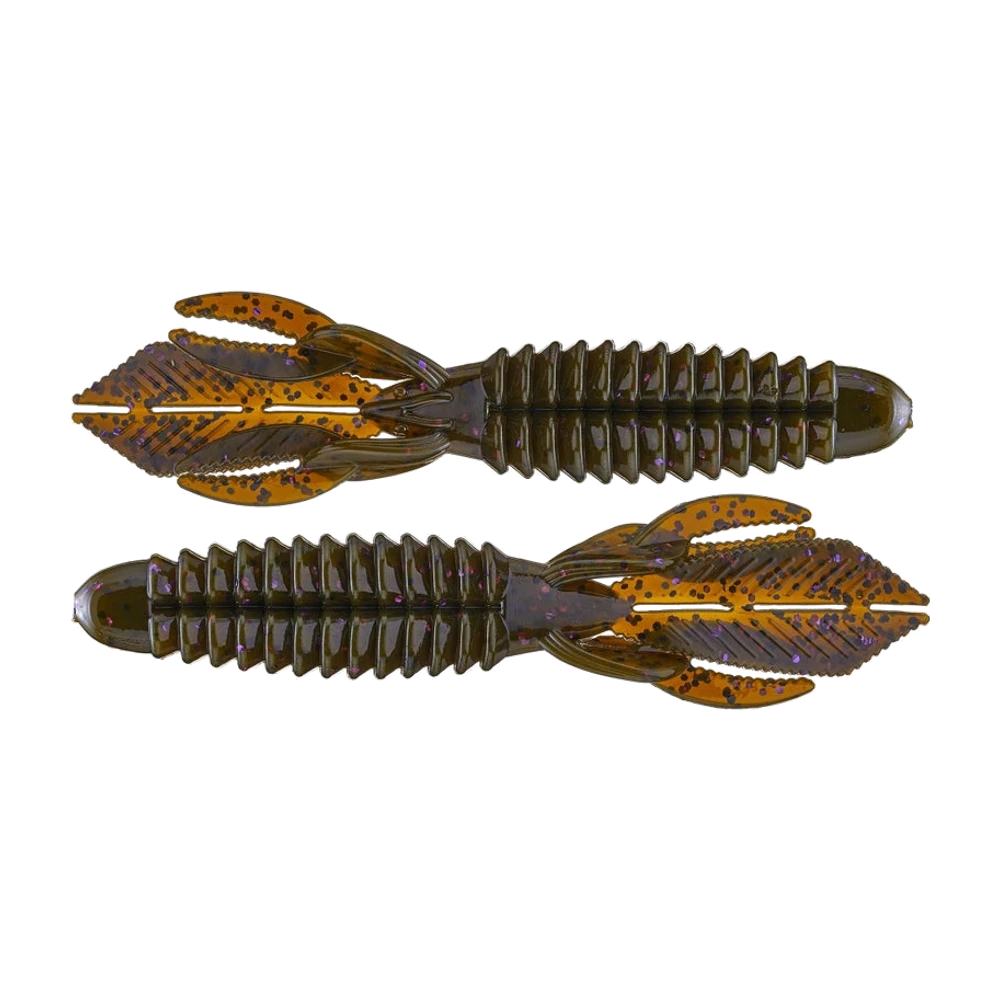
There are two ways to make a bass tucked under a stump react: slip something discreet past its nose, or send in a bait that takes up enough space to be impossible to ignore. The Wooly Bug belongs firmly to the second school. Its heavily ribbed body is not a styling choice: it is working surface, meant to make the bait exist in cluttered water where sight counts for very little.
Two sizes, two jobs
Yum offers the Wooly Bug in two versions: 3.25 in, roughly 8.3 cm, in packs of 10, and 4.25 in, roughly 10.8 cm, in packs of 8. Read the maker's table carefully: the second figure on each line is a bait count per bag, not a weight. The Wooly Bug is a bare soft plastic, and its finished weight depends entirely on the sinker or jig you put in front of it.
The two sizes do not serve the same fishing. The 8.3 cm stays an all-rounder, usable as a jig trailer or on a Texas rig for fish that are not especially big. The 10.8 cm is a genuine selection tool: it puts off small fish and concentrates bites on bass willing to take a large mouthful. The manufacturer owns that bias, presenting the bait as one for the big-fish angler.
The ribbed body does the work
This is the central feature. The rings covering the full length of the body multiply the edges that grab water. Every small move therefore sends out a much broader pressure wave than a smooth body of the same volume would. In practice, you can shake the Wooly Bug on the spot without moving it a centimetre and still have it detectable by a fish holding a metre away in the grass.
The rings have a second, less discussed effect: they slow the drop slightly compared with a smooth body, by multiplying the surfaces working against the fall. Fishing vertically in a hole among the pads, that extra second or two gives a fish time to come and look.
The pinchers and the flat tail
Up front sit two flat ribbed pinchers, flanked by small appendages. They do not beat like the claws of a swimming craw: their job is to complete the outline and come alive the moment you shake the rod. This is a shaking bait, not a retrieve bait.
At the rear, the body ends in a rounded, flattened tip that Yum calls a beavertail and presents as the part that brings a new action to the bait. The description says no more than that, and honesty is worth more than filler here: without watching it underwater, nobody can state precisely what it produces. What you can observe on the water is that the flat mass at the back steadies the fall and stops the bait spinning when you drop it on a tight line.
Do not judge the Wooly Bug on the next cast. It is a bait to let soak: flip it into the gap, let it settle, shake it on the spot for five to ten seconds before lifting. The bite often comes after the moment you would have reeled in.
The heavy Texas rig
This is the rig the bait was designed around. Wide gap hook, 3/0 or 4/0 for the 8.3 cm, 4/0 to 5/0 for the 10.8 cm, set in the back with the point tucked in. Bullet weight pegged or free depending on cover density, from 7 g for a sparse edge to 21 g to punch a mat.
One useful detail: with a body this ribbed, the Texas rig threads through cover less easily than a smooth bait. The edges catch vegetation. If you are punching a dense mat, go heavier than usual on the weight, or pick a slimmer profile such as the Yum Spine Craw.
The jig trailer
The other obvious use. The Wooly Bug adds bulk and water movement to a skirted jig, and the 8.3 cm version balances nicely behind a 10 to 14 g jig. Keep in mind that the rings brake the fall: a jig that dropped straight will now sink more slowly and flatter with this trailer, which is often an advantage in shallow water.
The classic mistake
Fishing the Wooly Bug too fast, as if it were a search bait. Its action lives on shaking and pausing, not on travel. Reel it steadily and you turn a creature bait into an inert lump of plastic, losing exactly what sets it apart from a worm. The other mistake is undersizing the hook: with a thick body, a short point will not come through on the hookset.
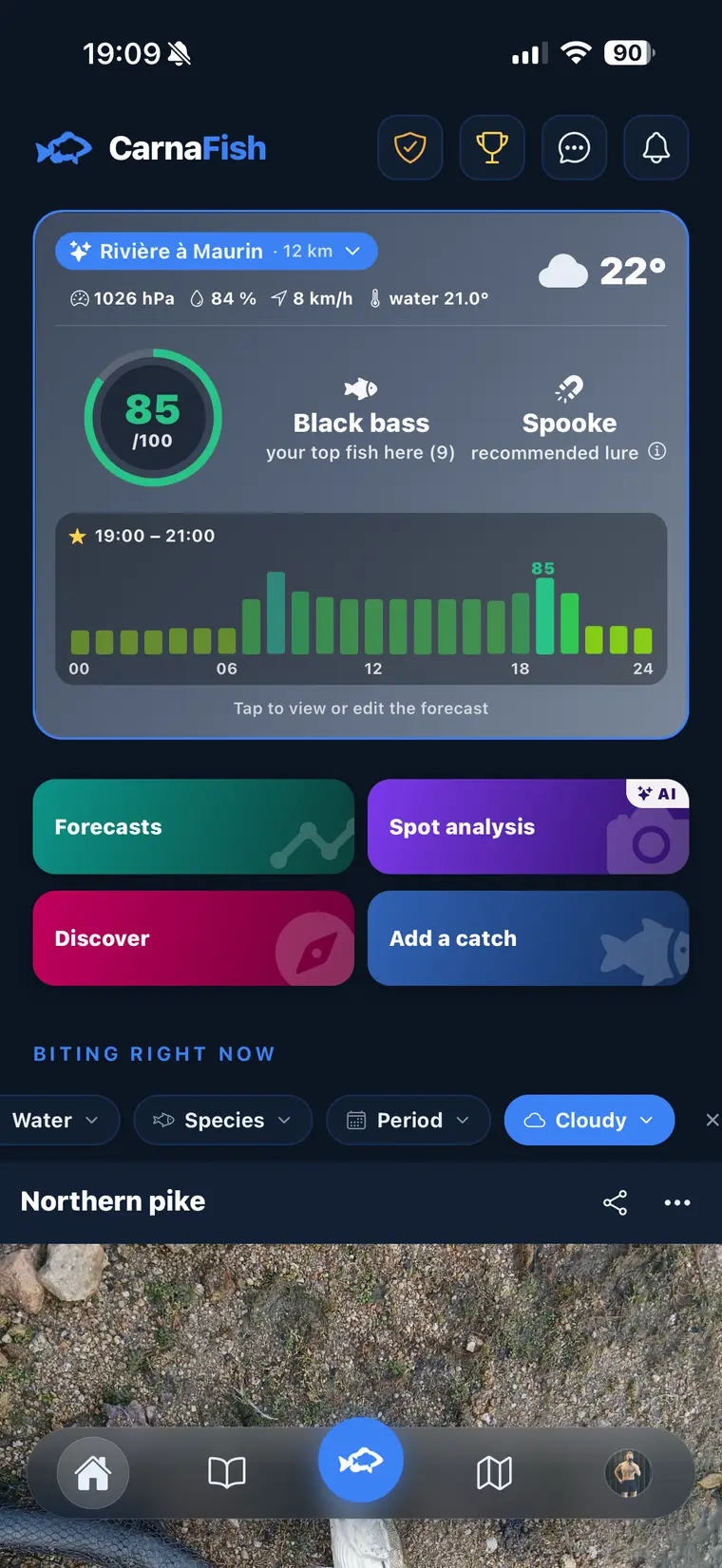
Not sure what to tie on?
Photograph your spot: CarnaFish reads the scene, cross-checks the conditions and gives you the zone, the lure and the retrieve. Free on iOS and Android.
LPT technology, and what we actually know
Yum links the Wooly Bug to its LPT technology, for Live Prey Technology. The manufacturer's description simply cites the acronym without explaining the principle or giving measured effects. Better to say so plainly: we cannot tell you what this technology genuinely adds, because the source does not. Treat it as a brand claim until you have something firmer, and judge the bait on what is verifiable — its profile, its rings, its two sizes.
Colours and water clarity
No colour name appears anywhere in the description. So we work by families, starting from the olive brown and orange two-tone in the photo, a classic crawfish shade.
- Gravel bottoms, lightly stained water: the brown and orange family with flake, the one pictured here, matching the coat of a crawfish in moult.
- Clear water: the green pumpkin family, more discreet, worth favouring on fish that have already been fished for.
- Dark water, dense mats, low light: the black and blue family, which works as a silhouette rather than a colour.
Choosing the size and the weight starts with what you are facing: depth, cover density, bottom type. That is exactly the call CarnaFish helps you make from a single photo of the swim, suggesting a zone and a presentation to match. For the broader picture on the species, our guide to getting started with bass fishing is still the right way in.
Key takeaways
- Two sizes: 8.3 cm in packs of 10 and 10.8 cm in packs of 8 — the second figure is a pack count, not a weight.
- The heavily ribbed body moves a lot of water, which keeps the bait detectable even while shaking on the spot.
- It is a shake-and-pause bait on a heavy Texas rig, not a steady retrieve bait.
- The rings catch vegetation: plan on a heavier weight than usual to punch through a mat.
FAQ
Which sizes does the Wooly Bug come in?
Two: 3.25 in (about 8.3 cm) in packs of 10, and 4.25 in (about 10.8 cm) in packs of 8. The metric figures are conversions of round imperial values, so treat them as orders of magnitude.
How much does a Wooly Bug weigh?
The manufacturer publishes no weight for this bait, which makes sense as it is sold bare. The mass of the whole rig comes from the Texas weight or the jig head in front, anywhere from 7 to 21 g depending on cover density.
Does the Wooly Bug float or sink?
The manufacturer gives no density rating, so we will not call it. Rigged Texas style or as a trailer, the weight governs the drop anyway, and the rings slow it slightly compared with a smooth body.
What hook size should I use?
A wide gap hook in 3/0 or 4/0 for the 8.3 cm version, and 4/0 to 5/0 for the 10.8 cm. With a thick body, go generous: too short a point will not clear the plastic on the hookset.
Is it any good for pike or perch?
It is a bass bait, designed for slow fishing inside cover. A big perch may take the short version as a small jig trailer, but pike call for something else: a shad or swimbait of the same length will do far more.
What is the LPT technology Yum advertises?
The manufacturer cites the Live Prey Technology acronym without explaining the principle in its description. We cannot honestly tell you more. Judge the bait on what is verifiable — its profile, its ribbed body and its two sizes — exactly as you would a Berkley Chigger Craw or any other competing creature bait.
The full bass lure guideSeason-by-season strategy: which family of lure, when, and why.Go from theory to fish
CarnaFish reads your spot from a photo and gives you the game plan: zone, lure, retrieve. Free on iOS and Android.