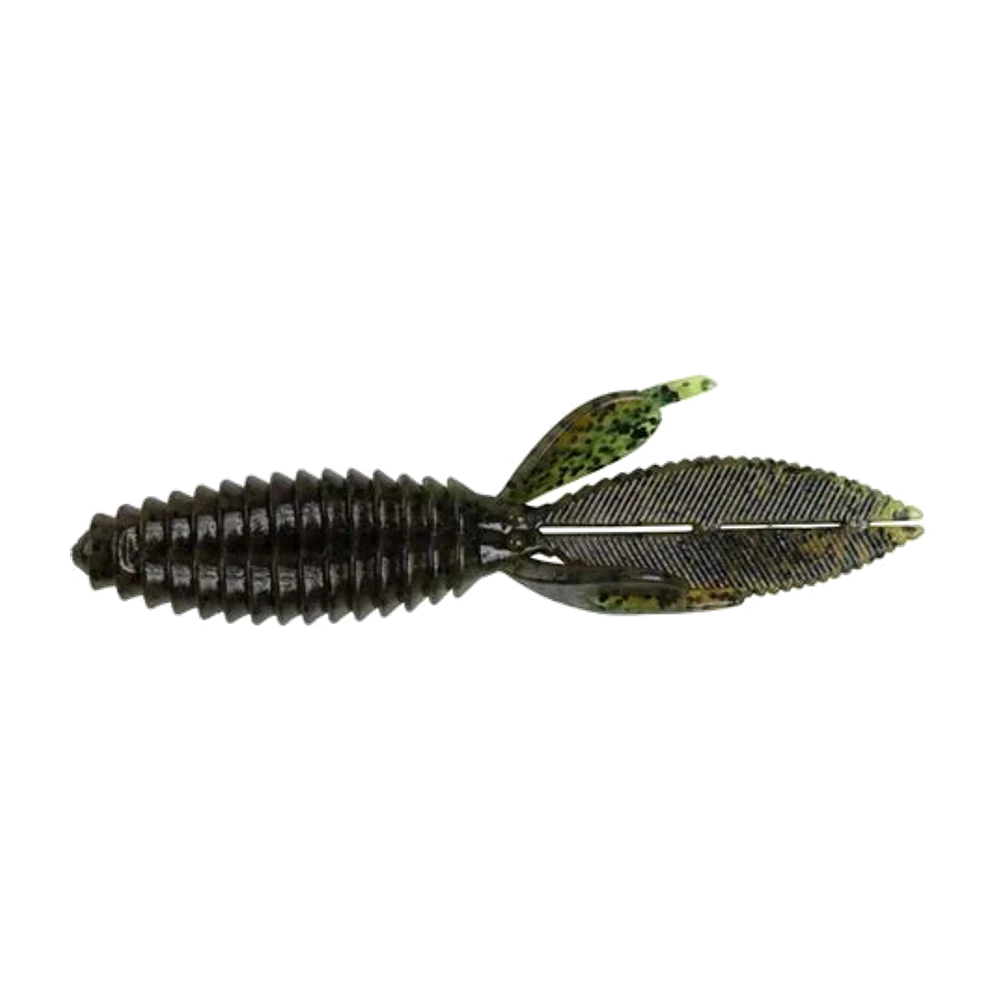
Reaction Innovations Sweet Beaver: the profile that punches through the mat
Before tying this one on, it helps to know if the spot actually calls for it. CarnaFish reads the scene from a photo.
A mat of duckweed or lily pads is a ceiling. Underneath it the water is cool, shaded and full of invertebrates, and bass settle there for the whole day at the height of summer. The problem is not finding them: it is getting anything down to them.
Nine lures out of ten bounce off that ceiling, or worse, stop halfway and stay stuck in the vegetation. Every failure moves the mat over two metres and warns everything living below it.
The Sweet Beaver solves that problem through shape. It is a deliberately smooth, compact, streamlined creature whose main asset is not what it does in the water but the way it gets through what separates it from the fish.
A silhouette built for penetration
Look at the lure head on rather than side on: the section is oval, solid, with nothing sticking out. The two lateral appendages are short, flat, and pinned against the body the moment the weight pulls downwards. There are no claws, no antennae, no ribbon tail — nothing that can wrap around a stem.
That geometry produces a specific behaviour: Texas rigged with a tungsten bullet pegged against the head, the whole thing forms a continuous cone that parts the vegetation instead of catching in it. The lure goes through, the wound in the mat closes behind it, and the noise it makes stays local.
The second effect is less obvious: once through the mat, the Sweet Beaver slows down sharply. The tungsten keeps dropping, the wide body brakes, and the lure glides through the last fifty centimetres instead of falling like a stone. That short phase is the one the fish sees.
The action is the one you give it
You have to accept this from the start: outside moving water, the Sweet Beaver does almost nothing on its own. Its appendages do not flap the way a wide-clawed creature's do. It puts out no low-frequency thump on the way down.
That is a choice, and it stands up for two reasons.
Under a mat, the fish only sees a silhouette. The light is filtered and visibility is cut to a few tens of centimetres. What matters is that an object of the right size appears abruptly in its field of view at short range, not that it vibrates.
A motionless object is a reassuring one. On heavily pressured fish, in full heat, the creature that flails is often the one that gets refused. A Beaver that falls, settles and stops moving looks like a startled crawfish, not like a lure.
Punching, step by step
- Find the holes and the hard edges of the mat. They are the natural entry points, and they concentrate fish.
- Pitch vertically, rod high, so the weight arrives on the mat at close to 90 degrees. An angled cast slides across the vegetation instead of piercing it.
- Let it run on a slack line as soon as the lure is through. A tight line at that moment shortens the glide phase, which is the lure's only active phase.
- Count five seconds on the bottom, without moving. It is the most productive pause in this style of fishing.
- One sharp lift, then another free fall. Two passes are enough.
- Lift the lure out vertically and move two metres. Next hole.
On the water: when a bite comes under a mat, do not set the hook upwards. Set it sideways, rod low, towards the side away from the thickest cover — you pull the fish out of the vegetation instead of packing it in, and you halve your lost fish.
Weights: the lightest that gets through
The punching weight rule is easy to state and hard to stick to: take the lightest weight that pierces the mat first time, and not a gram more.
| Cover density | Tungsten bullet |
|---|---|
| Scattered pads, loose weed | 14 to 18 g |
| Thin duckweed mat | 18 to 24 g |
| Dense mat, two layers | 24 to 30 g |
| Very thick or old mat | 30 to 35 g |
Why not simply go heavier? Because every extra gram shortens the glide phase under the mat, and that is exactly when the fish decides. Too heavy a weight has you on the bottom before the bass has turned its head.
The rest of the rig is not much debated: 0.45 to 0.55 mm braid, a 4/0 heavy wire hook, a bobber stop pegged hard against the head, a powerful rod and a short line. The general Texas rig principle is covered in our Texas rig page; here you apply it in its most muscular form.
Not sure what to tie on?
Photograph your spot: CarnaFish reads the scene, cross-checks the conditions and gives you the zone, the lure and the retrieve. Free on iOS and Android.
Where it excels, where it is pointless
Its window is narrow and very profitable: June to September, dense vegetation mats, middle of the day, full sun. The hotter it is and the thicker the cover, the more the Sweet Beaver takes the lead. It also works very well flipping conventional reed margins and as a compact jig trailer.
Conversely, it is of no interest in open water, over bare bottom or when searching. With no cover to get through, its discretion becomes an absence of signal, and any creature with active appendages will outfish it. It is equally beside the point in very cold water, where you want slimmer profiles and slower presentations still, and on other freshwater predators.
Sweet Beaver or D Bomb
These two creatures look alike in photos and do not do the same job on the water.
The Missile Baits D Bomb is a signal lure: a ribbed body that brakes, appendages that flap throughout the fall, built to be seen from a distance in a sunken tree or a stump. The Sweet Beaver is a passage lure: smooth, compact, built to arrive intact under a vegetation ceiling where the D Bomb stops halfway.
The test is easy: if the cover is vertical and open, take the D Bomb; if it is horizontal and closed over your head, take the Beaver. To cover those same weed beds on a retrieve rather than vertically, the Reaction Innovations Skinny Dipper is the logical companion from the same maker.
The periods when this style takes precedence over everything else are covered in our beginner's guide to bass fishing. And if you are unsure what weight to tie on in front of a mat you do not know, CarnaFish analyses a photo of the spot and answers.
Key takeaways
- Smooth, compact profile: the lure is built to get through cover, not to vibrate.
- Take the lightest weight that pierces first time, never more.
- Slack line after it goes through: the glide under the mat is the only active phase.
- Five seconds still on the bottom, then one lift, then move to the next hole.
- Excellent from June to September under mats, useless in open water.
FAQ
What weight should I use for punching a Sweet Beaver?
From 14 to 18 g over loose weed, 18 to 24 g through a duckweed mat, and 24 to 35 g through a dense mat. The right value is always the lightest that gets through first time, because too heavy a weight removes the glide phase under the mat.
What hook and line should I use?
A 4/0 heavy wire Texas hook and braid of 0.45 to 0.55 mm, with no fluorocarbon leader. Under a mat, visibility is poor and line stealth matters far less than being able to extract the fish.
Does the Sweet Beaver move on its own?
Very little, and that is deliberate. Its short, pinned appendages produce no marked vibration: the lure works on a compact silhouette appearing abruptly at close range, then on stillness.
Should the tungsten bullet be pegged?
Yes, for punching. A bullet pegged against the head of the lure forms a continuous cone that parts the vegetation. A free-running bobber stop would destroy all penetration, even though it is useful for conventional flipping outside cover.
Can it be used as a jig trailer?
Yes, its compact profile makes it a good trailer for a flipping jig, particularly when you want to add bulk without adding drag. You can trim the head to adjust overall length.
How does it differ from a classic creature like the Brush Hog?
A creature with long appendages produces far more movement but catches vegetation and falls less straight. The Sweet Beaver trades action for penetration: it is the right choice only when there is a vegetation ceiling to pierce.
The full bass lure guideSeason-by-season strategy: which family of lure, when, and why.Go from theory to fish
CarnaFish reads your spot from a photo and gives you the game plan: zone, lure, retrieve. Free on iOS and Android.