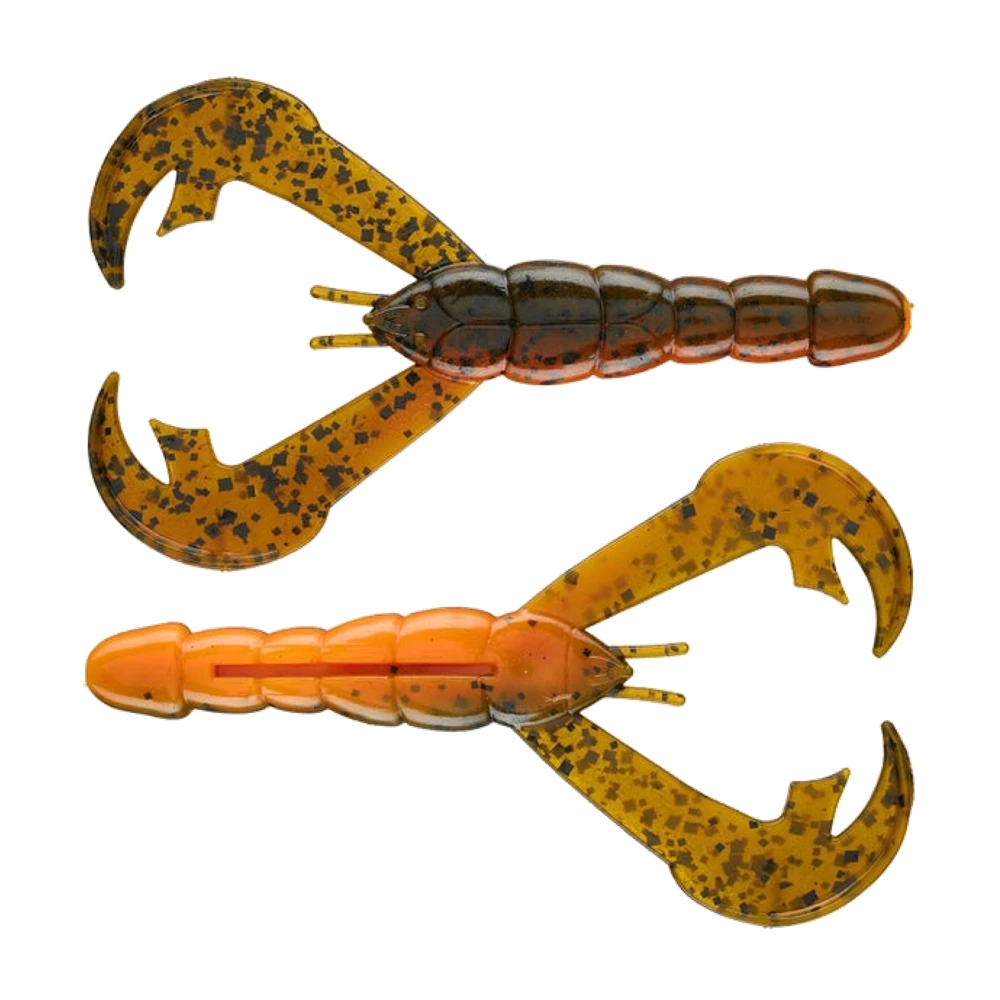
Strike King Rage Craw: the craw that kicks even on a straight retrieve
Rather not fish it blind? Photograph your spot — CarnaFish cross-checks the conditions and points you the right way.
Most soft craws only move on the fall: sitting on bottom or pulled in a straight line, their claws stay dead still. The Rage Craw breaks that rule thanks to its Rage Tail claws, built to kick continuously, including on a standard straight retrieve — which completely changes how you can use it depending on the type of cover you're fishing.
What sets it apart: movement that never stops
The Rage Craw's two realistic pincers sit on a slim, elongated body designed to generate turbulence at even a slow speed. The result: unlike a classic craw that needs small rod twitches to get the appendages moving, the Rage Craw's claws keep kicking even pulled in a straight line. That's what lets you fish it both slow and stationary, or as a faster search bait across a larger area.
On rock: the jig trailer
Over rocky bottom or a rock-strewn break, the Rage Craw as a jig trailer remains the most natural rig: the slow fall between rocks perfectly mimics a crawfish looking for shelter, and the claws' continuous kick keeps holding attention even while the jig sits still for a moment.
On submerged wood: the Texas rig that goes anywhere
Facing stumps or brush, a Texas rig with the hook tucked inside the body becomes essential for flipping or pitching straight into the cover without snagging on every cast. The Rage Craw's slim body slides between branches well, unlike bulkier soft plastics that catch on every snag point.
In weeds: the Carolina rig for covering ground
Along a weedline or over a large vegetated flat, a Carolina rig — a sliding weight up the main line, a longer leader down to the lure — lets you cover a lot of ground while keeping the Rage Craw near bottom without it burying into dense vegetation. It's the rig to reach for when you need to search fast before committing to a specific spot.
Field rule: if the claws stop kicking during the retrieve, check that the body isn't twisted on the hook — a misaligned Rage Craw loses most of its effect.

Not sure what to tie on?
Photograph your spot: CarnaFish reads the scene, cross-checks the conditions and gives you the zone, the lure and the retrieve. Free on iOS and Android.
Three rigs, one principle
Whether Texas-rigged, Carolina-rigged or fished as a jig trailer, the principle stays the same: keep the Rage Craw in bottom contact for as long as possible, where its claws keep working even without any input from the angler. Patience pays off more than retrieve speed with this style of lure.
Colour by water clarity
In clear water, green pumpkin remains the standard: subtle, it closely matches a common crawfish without ever overselling it. In stained water, switch to black/blue for sharp contrast, or red, a colour that carries well in slightly murky water and stays associated with crawfish in a bass's search image.
Where another craw does better
On a spot where fish watch a long time before biting, the more static, defensive presentation of the Molix Vindex Craw, with claws that rise at a dead stop, can pull fish that the Rage Craw's constant motion didn't convince. The two complement each other rather than replace one another, depending on the day's mood.
Choosing between rock, wood or weeds still means reading the spot correctly before tying anything on — exactly what CarnaFish simplifies by reading a photo of your spot and handing you a matching zone and technique. For a full approach to bass fishing, the beginner's guide to bass fishing is a solid starting point.
FAQ
What rig works best for the Strike King Rage Craw over rocky bottom?
A jig trailer remains the most natural: the slow fall between rocks mimics a crawfish looking for shelter, and the claws' continuous kick keeps holding attention even at rest.
How do you fish the Rage Craw around submerged wood?
Texas-rigged, hook tucked inside the body, for flipping or pitching straight into stumps and brush without snagging on every cast. The lure's slim body slides between obstacles well.
Does the Rage Craw work on a fast retrieve?
Yes, and it's exactly what sets it apart from classic craws: its Rage Tail claws keep kicking on a straight retrieve, not just on the fall, allowing faster ground coverage than a standard craw.
What rig should you use to search a large weed flat?
A Carolina rig, with a sliding weight up the main line and a longer leader to the lure, lets you cover a lot of ground while keeping the Rage Craw near bottom without burying it in vegetation.
Why have my Rage Craw's claws stopped kicking during the retrieve?
Check whether the body got twisted or misaligned on the hook after a bad cast — even a slight offset is enough to block the claws' natural movement.
What colour Rage Craw works in clear water?
Green pumpkin remains the standard: subtle and natural, it closely matches common crawfish without drawing excessive attention from a wary fish.
The full bass lure guideSeason-by-season strategy: which family of lure, when, and why.Go from theory to fish
CarnaFish reads your spot from a photo and gives you the game plan: zone, lure, retrieve. Free on iOS and Android.