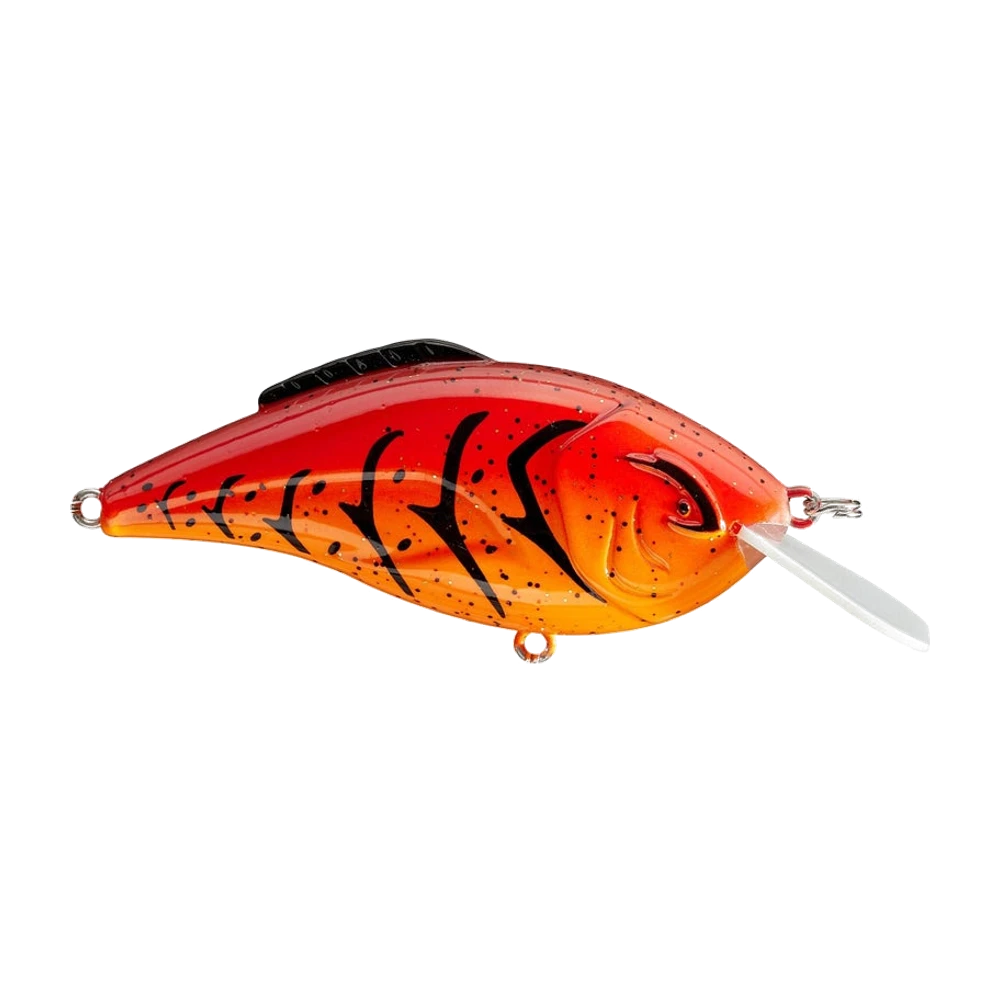
Bill Lewis Hammer Flat Crank: the flat-sided bait for cold water
One lure, endless conditions. CarnaFish reads your spot from a photo so you are not just guessing.
March, twelve degrees in the water, a riprap bank catching the afternoon sun. You tie on your usual crankbait, the round-bodied one with the wide roll, and nothing happens for two hours. It's the most ordinary situation in cold-water fishing, and it's also what gave rise to an entire lure category: flat sides, crankbaits with flattened flanks that buzz fast and tight instead of rolling wide. The Hammer Flat Crank belongs to that family, and understanding it keeps you from judging it on the wrong criteria.
What flat sides actually change
A round-bodied crankbait moves water generously: it rolls on its long axis, the back tipping one way then the other, and that motion produces a low-frequency vibration a fish picks up from a distance. That's what you want in summer, in warm water, when fish are active and happy to cover several metres to intercept something.
A flat side does the opposite. Flattened flanks offer little lateral purchase on the water, so the body barely rolls. The energy goes into a tight, fast beat — a high-frequency vibration that travels less far but stays far more convincing at close range. In cold water, when a fish won't move and only hits what passes within half a metre, that's exactly the right signal.
The Hammer Flat Crank measures 2.4 in, or 6.1 cm, for 3/8 oz, 10.6 g, and Bill Lewis state an approximate running depth of 5 ft — 1.5 m. That compact format and the relatively high weight for the size give you a bait that casts well, which is not a given on a flat side: flat bodies tend to plane and helicopter in flight.
The circuit-board lip is not a detail
The Hammer Flat Crank's lip is made from circuit-board material. It's a very thin, very rigid plate, and above all a far harder one than injection-moulded polycarbonate of the same thickness.
Two concrete consequences. First, the thinness cuts drag: the lip meets less resistance, the bait digs with less effort and the body's vibration isn't damped. Second, the rigidity transmits straight to the rod tip whatever the lip touches. You can tell gravel from rock from a stump, which is valuable when you're fishing a riprap bank blind.
That lip also has a limitation worth knowing: thin and rigid, it breaks more readily than a thick one on a head-on hit against something hard. If you fish angular boulders, inspect it regularly.
On a flat side, a bite often announces itself as the vibration simply stopping rather than as a thump. If you feel the lure quit buzzing without having touched anything, set the hook. Cold-water fish frequently inhale a crank without pulling on it.
The internal knocker, and why it's deep-toned
Bill Lewis specify an internal knocker in the Hammer Flat Crank. That means one single ball of decent diameter, as opposed to the multi-shot chambers of conventional lipless baits. A single ball produces a deep, irregular sound — a knock rather than a rattle.
There's logic to it: in cold clear water a high, continuous rattle saturates fast and puts fish on the defensive, whereas an isolated knock reads like a crawfish bolting or a baitfish bumping bottom. To compare the two philosophies inside the same range, the Bill Lewis Hammer Trap runs a three-frequency sound chamber instead, built to call fish from a distance in stained water.
How to work it
On a straight retrieve
That's the baseline and the lure's whole purpose. Steady retrieve, medium to brisk — faster than instinct suggests in cold water. Unlike a round crank, a flat side doesn't lose its action when you speed up, it tightens it. Plenty of anglers slow right down by reflex in March and end up with a lure that isn't working at all.
In contact with riprap
Target the stone edge, cast parallel rather than perpendicular, and retrieve so the lip scrapes rock through three-quarters of the retrieve. Deflections off that contact are the number one source of bites on this bait.
The classic mistake
Fishing it too deep. At a stated 1.5 m, the Hammer Flat Crank is a shallow-layer bait: banks, the tops of breaks, shallow flats. Many anglers cast it over 4 or 5 m of water hoping it will get down, and it simply swims well above the fish. If you need 3 m or more, a 6th Sense Crush Flat 75X or a long-billed crankbait makes far more sense.
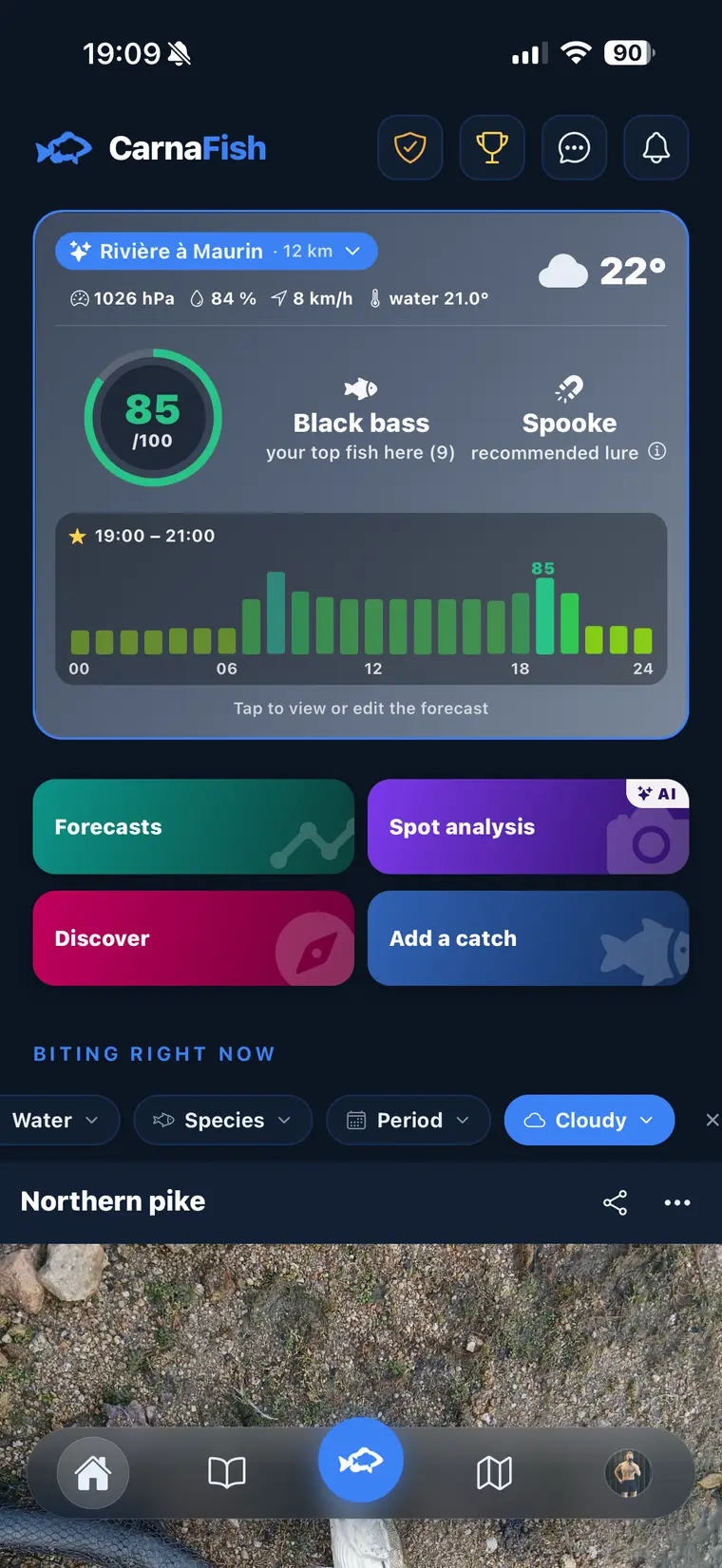
Not sure what to tie on?
Photograph your spot: CarnaFish reads the scene, cross-checks the conditions and gives you the zone, the lure and the retrieve. Free on iOS and Android.
Colors by season and water
- Early spring, cold water: red craw, exactly the finish in the photo. Crawfish come out of dormancy with a reddish cast, and they're the dominant forage over hard bottom at that time of year.
- Clear water, late spring: a natural silver shad, more discreet once the water warms and baitfish take over again.
- Stained water: black-backed chartreuse, a contrast that stays readable once visibility drops under a metre.
A seasonal lure, not an everyday one
The Hammer Flat Crank doesn't try to be versatile, and that's its strength. It covers a precise window — cold to temperate water, shallow, hard bottom — and inside that window it beats a round crank. Outside it, it's simply less relevant than a round-bodied model like the Lucky Craft Flat CB or a faster search bait. Tying on the right lure for the right point in the year usually matters more than the colour detail.
That's precisely the judgement call CarnaFish aims to simplify: photograph the spot and the AI suggests the zone, the depth and the lure type that fit the day's conditions, water temperature included. To build the foundations of bass fishing spot by spot, our beginner's guide to bass fishing is still the best way in.
The short version
- 6.1 cm for 10.6 g and about 1.5 m of depth: a shallow-edge crankbait, not a diver.
- Flat sides produce a tight, high-frequency vibration that reads more convincingly than a wide roll when the water is cold.
- The circuit-board lip transmits bottom superbly but stays fragile on head-on impacts with angular rock.
- In cold water, speed up rather than slow down: a flat side tightens its action with speed instead of losing it.
FAQ
What's the difference between a flat side and a regular crankbait?
Flat sides limit body roll and convert the energy into a tight, fast vibration. A round crank rolls more widely and puts out a low-frequency signal that carries further. The flat side is more discreet and more convincing at close range, which makes it better in cold, clear water.
How deep does the Hammer Flat Crank run?
Bill Lewis state approximately 5 ft, about 1.5 m. In practice line diameter and cast length shift that figure by 20 to 30 cm either way.
Can you fish it in summer?
Yes, but it isn't its best window. In warm water fish respond well to wider vibrations and higher speeds, and a round-bodied crank usually takes the edge. Keep the flat side for cold water, high-pressure days and educated fish.
Does it need a specific leader?
A 25-30 lb fluorocarbon leader covers most situations. It sinks slightly, which helps the bait hold depth, and it absorbs abrasion against rock. Avoid bulky snaps, which weigh the nose down and choke the lip.
Is the circuit-board lip fragile?
More so than a thick polycarbonate lip, yes. It's very thin and very rigid, which gives excellent transmission but leaves it sensitive to head-on impacts against angular boulders. Check it now and then, especially after a session on riprap.
Does this lure suit perch?
Absolutely. In Europe, along a harbour wall or a canal riprap, a 6 cm crankbait with a tight vibration is a very good perch bait, particularly in late winter when the shoals are still pinned to hard bottom and reluctant to chase.
The full bass lure guideSeason-by-season strategy: which family of lure, when, and why.Go from theory to fish
CarnaFish reads your spot from a photo and gives you the game plan: zone, lure, retrieve. Free on iOS and Android.