Bill Lewis Hammer Trap: the lipless with a three-tone sound chamber
One lure, endless conditions. CarnaFish reads your spot from a photo so you are not just guessing.
A water you don't know, three hours ahead of you, and no idea where the fish are. That's the situation the lipless crankbait was invented for: a lure you cast a long way, wind back fast, and which tells you inside twenty minutes whether a zone is worth staying on. The Hammer Trap comes from Bill Lewis, meaning the house that produced the Rat-L-Trap, and it sits in that lineage with a very specific focus on sound.
Two sizes, both of them sinking
Bill Lewis list two versions and classify both as sinking. The first measures 2.5 in, 6.4 cm, for 3/8 oz, 10.6 g. The second measures 3 in, 7.6 cm, for 5/8 oz, 17.7 g.
That sinking classification isn't a footnote: it determines everything else. A sinking lipless has no running depth of its own, unlike a billed crankbait that tops out at a set figure. Its depth depends entirely on three things you control: the countdown before you start winding, the retrieve speed and the rod angle. In practice the same lure fishes 50 cm under the surface or 6 m down depending on what you decide.
Choosing between the two sizes follows a simple logic. The 6.4 cm covers most European situations, particularly for perch and zander where the forage is rarely large. The 7.6 cm at 17.7 g takes over as soon as there's wind, current or depth to reach: the extra mass buys casting distance and lets you hold a deep layer without winding too fast.
The tri-tone sound chamber
This is the Hammer Trap's real signature. Where a conventional lipless carries same-diameter shot producing a single frequency, Bill Lewis specify a tri-tone chamber emitting three different tonal frequencies. In practice that means balls of distinct sizes or densities, whose impacts overlap instead of synchronising.
The payoff is twofold. First, a composite sound carries differently depending on water clarity and temperature — when one frequency gets absorbed, the others still travel. Second, an irregular sound resembles a shoal of baitfish more than a single object: three overlapping tones suggest several small fish milling about, not one isolated lure.
That's a choice aimed squarely at long-distance calling, in stained water or over big flats. If you want the opposite — a single deep tone, discreet, suited to cold clear water — the Bill Lewis Hammer Flat Crank from the same brand is built around a single knocker.
The flutter on the pause is the key
Bill Lewis stress one point: the Hammer Trap flutters erratically on the pause. That's exactly what separates a good lipless from a bad one. A vibrating bait that sinks straight and flat when you stop interests nobody; one that rolls onto its side and slides down off-balance mimics a wounded baitfish losing control, and that's precisely when the strike comes.
That property underpins the lure's most productive technique.
The yo-yo
Cast, count the lure down to bottom, then sweep the rod upward — 60 cm to a metre — and let the bait fall back on a controlled line. Pick up the slack and repeat. The lure rises vibrating, drops back fluttering, and ninety percent of the bites land during the fall.
It's the king technique in cold water, February through April, when fish are pinned to bottom and refuse to chase. On European zander in particular, a slow yo-yo over a 4 or 5 m flat is one of the few ways to get apathetic fish to react.
The straight retrieve
Faster, pure search mode, to cover maximum water over shallow flats. Keep the rod low and wind steadily: the vibration should be continuously present in the handle. If you stop feeling it, the lure has picked something up or you're winding too slowly.
The classic mistake
Striking at every contact. On a lipless worked yo-yo style you touch a lot of things: bottom, weed, a branch. Swinging at nothing every time pulls the lure off its path and tires your arm. The good habit is to hold for half a second, feel whether it's pulling or merely resisting, and set the hook only in the first case.
In low weed, never pull hard when the lure catches a stem. Go completely slack for one second: a sinking lipless noses down and often frees itself. If you force it, you drive the treble deeper into the vegetation and wind in a green salad.
Rigging and leader
The Hammer Trap ships armed with two Mustad Triple Grip trebles. You tie to the dorsal ring, either directly with a loop knot or with a small snap — handy if you swap often between the two sizes.
A 30-40 lb fluorocarbon leader covers most uses. In Europe, as soon as there's pike on the zone, switch to steel or titanium: a vibrating bait fluttering slowly on a pause is typically what a pike takes across the body, and a cut-off on this kind of fishing comes quickly.
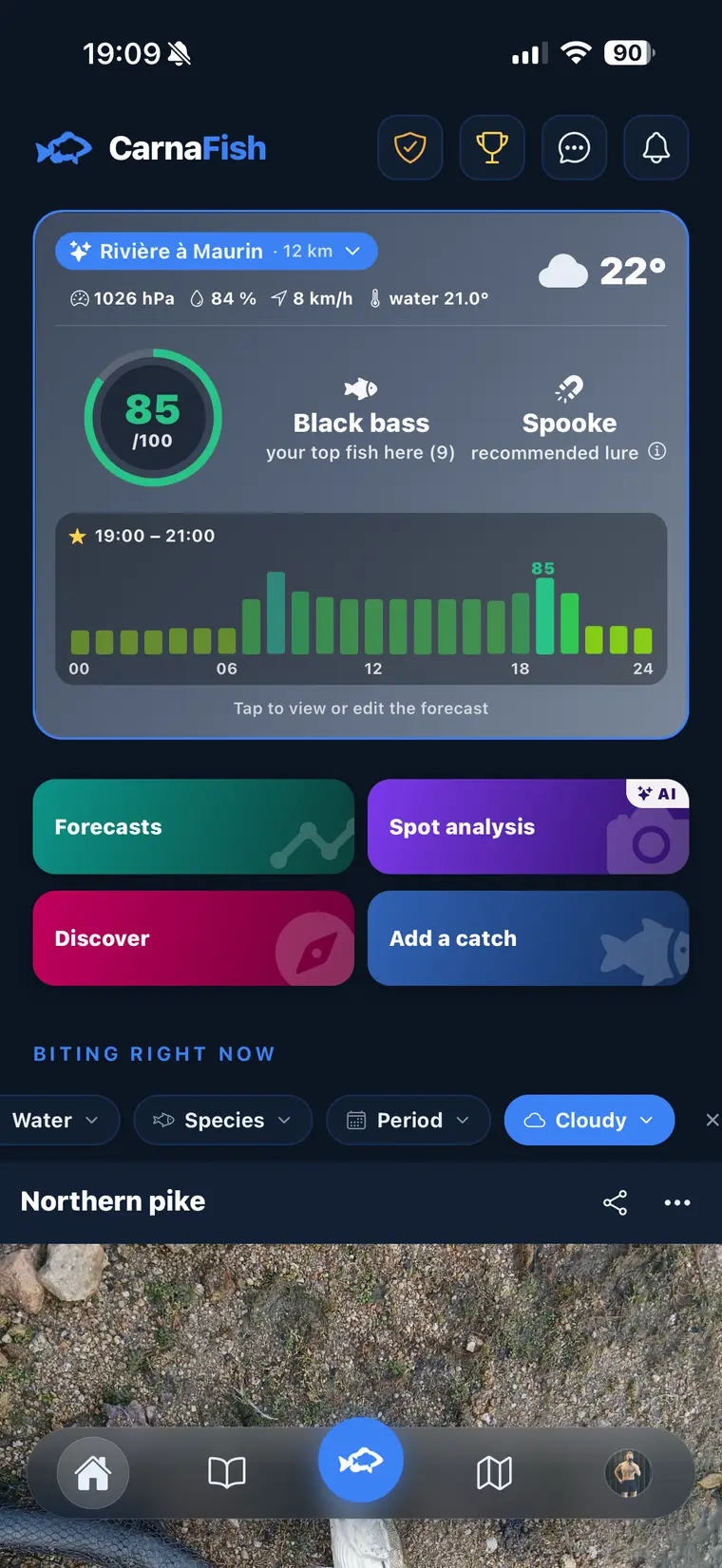
Not sure what to tie on?
Photograph your spot: CarnaFish reads the scene, cross-checks the conditions and gives you the zone, the lure and the retrieve. Free on iOS and Android.
Colors by season
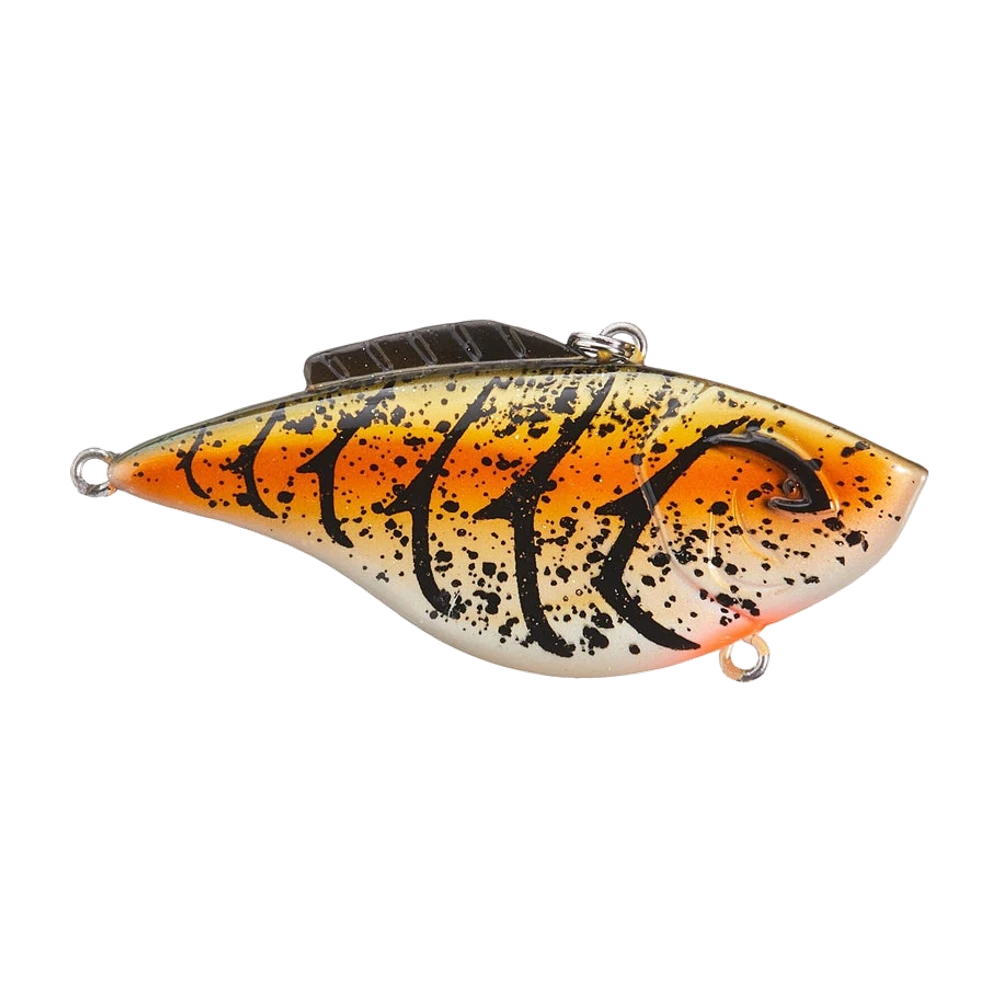
- Spring, hard bottom: orange craw, the color in the photo. That's when crawfish are active and predators hunt them over rocky flats.
- Clear water, summer: a natural silver shad, the pick when baitfish dominate and fish can see well.
- Dirty water or flood: black-backed chartreuse, which adds visual contrast to the sound signal once visibility falls under 50 cm.
A search bait first and foremost
The Hammer Trap doesn't replace finesse fishing: it exists to eliminate water fast and find active fish. Once the zone is identified, switching to a slower presentation usually produces more fish. Within the same family, the 6th Sense Quake and the Rapala Rippin' Rap fill a comparable role with different sound signatures — carrying two with distinct acoustic profiles and alternating when a zone stays quiet is no bad habit.
Identifying the zone worth searching before the first cast is the job CarnaFish sets itself: photograph the spot and the AI suggests the zone, the depth and the lure type that fit current conditions. To go further on zander-specific spots and rhythms, our beginner's guide to lure fishing for zander covers the other families worth knowing.
The short version
- Two sinking versions: 6.4 cm at 10.6 g, and 7.6 cm at 17.7 g when you need distance or need to hold bottom.
- A sinking lipless has no running depth of its own: the countdown and the retrieve speed decide which layer you fish.
- The tri-tone chamber targets long-distance calling in stained water, where a single knocker plays the discretion card.
- The yo-yo is the main technique, and the bite almost always lands during the falling phase.
FAQ
Does the Hammer Trap sink or float?
It sinks, in both sizes, and Bill Lewis state so explicitly. That's what allows the bottom yo-yo and lets you control depth through the countdown rather than through a bill.
Which size, 6.4 or 7.6 cm?
The 6.4 cm for all-round use, particularly on perch and zander where forage stays modest. The 7.6 cm at 17.7 g as soon as you need casting distance, have to fight wind, or want to hold a deep layer without speeding the retrieve up.
How deep does a lipless fish?
At whatever depth you decide. With no bill, the lure has no set running figure: you count the seconds down after the splashdown to reach the layer you want, then set the speed to hold it there. That's both its flexibility and the part that takes some getting used to.
Can you fish it in weed?
In low, sparse vegetation yes, by exploiting the release: when the lure catches, go slack for a second instead of pulling. In dense weed two free-swinging trebles collect everything and the lure becomes unfishable.
Do I need a wire leader?
In Europe, yes as soon as there's pike on the zone. A lipless fluttering slowly on a pause is exactly the presentation a pike takes across the body, and the line parts right above the lure.
What season does this lure work best in?
From early spring into early summer, and again in autumn when baitfish gather up. In deep winter a very slow yo-yo still works on zander and bass, but you have to accept retrieves far slower than the lure's own character suggests.
The full bass lure guideSeason-by-season strategy: which family of lure, when, and why.Go from theory to fish
CarnaFish reads your spot from a photo and gives you the game plan: zone, lure, retrieve. Free on iOS and Android.