Bill Lewis SB-57: the squarebill built to deflect, not snag
Rather not fish it blind? Photograph your spot — CarnaFish cross-checks the conditions and points you the right way.
A squarebill isn't fished like a regular crankbait. The point isn't a clean swim through open water, it's getting into stumps, rock and dock pilings, bouncing off them and kicking away sideways. The SB-57 was designed with Mark Daniels Jr., a Bass Pro Tour angler who specialises in shallow water, and every one of its features points the same way: this bait is built to hit things, not to avoid them.
A thin honeycomb shell, and what that does in the water
The SB-57 body is built with very thin walls around an internal honeycomb structure. That's not a factory detail: a body that's light for its volume starts working earlier, at lower speed, and reacts far more violently when the bill touches something. The lure runs a fast, wide wobble with a tendency to wander off line on its own — the hunting action — a slight instability that fish read as panicking prey.
The manufacturer lists one size only: 5.7 cm for around 11 g, that is 2.25 in and 3/8 oz. The quoted running range is 0.9-1.8 m (3-6 ft). It's a compact bait, noticeably smaller than most American squarebills, which makes it immediately interesting on European water where bass tend to run smaller and where perch will happily take a crank of this size.
The coffin lip is the key part
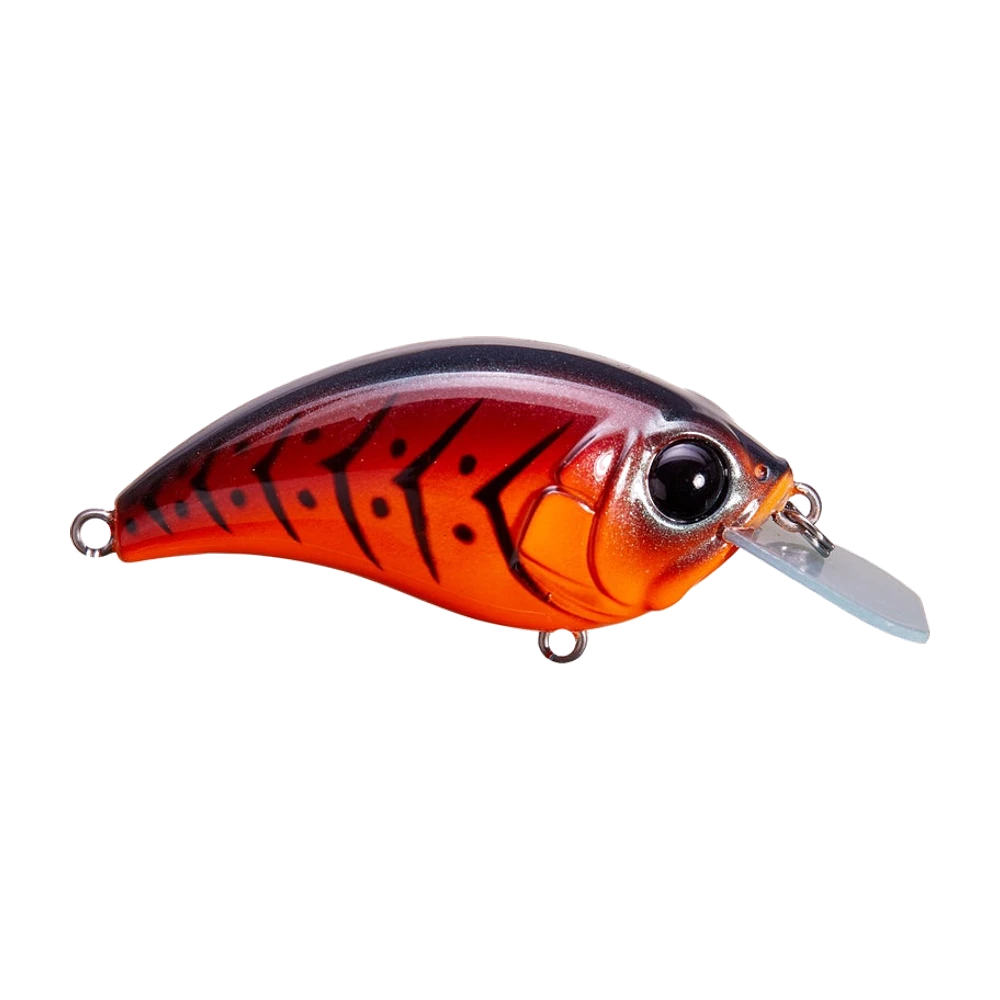
The bill isn't standard moulded polycarbonate but a so-called hybrid coffin lip, trapezoidal in shape, cut from circuit board. That has two practical consequences.
The first is sensitivity. Circuit board is stiff and thin, and it telegraphs through the rod what kind of bottom you're touching: you can tell gravel from deadwood from solid rock. With a bit of practice it becomes a contact sounder, and you know exactly when to slow down.
The second is impact behaviour. A square lip jamming against cover pivots the bait hard onto its side before releasing it. That sharp kick, not the retrieve, is what triggers the strike. A squarebill that touches nothing for a whole retrieve is a squarebill being used wrong.
One knock rather than a maraca
The SB-57 carries a single-knocker rattle system that produces a low, spaced-out knock rather than the high-pitched chatter of a multi-bead bait. The manufacturer owns the choice: neither too loud nor too quiet. It's a useful compromise, because a very noisy crankbait turns counterproductive on pressured or very clear water, while staying essential in dirty water and low light.
In practice, if you're torn between a silent model and this one on clear, well-fished water, the single knock is the right middle ground. On a brown river arm after rain you might instead want something genuinely loud like a Bill Lewis Rat-L-Trap, which carries much further.
A slow rise that stretches the strike window
The SB-57 is weighted so that it rises slowly when you stop winding. It's a feature people consistently underrate: after a deflection off a stump, a bait that shoots toward the surface is out of the zone in a second, whereas a slow riser stays in it two or three seconds longer. On a hesitant fish, that extra delay is often the difference between a follow and a bite.
How to actually use that pause
Wind at medium speed until you feel the first contact. On the impact, stop the reel dead for one to two seconds with the rod at eleven o'clock. The bait tips over, barely climbs, and that's when you need to pay attention: the bite on that dead time is usually just a heaviness in the line, not a clean thump. Then take two or three turns and start again.
Fish a squarebill on a glass rod or a parabolic action, never on a fast carbon blank. A crank hanging on small trebles comes off at the first head shake if the rod sends the shock straight back. With a parabolic you'll lose fewer fish and, oddly, get more bites too: the bait deflects more naturally when the tip absorbs the impact.
The classic mistake
Fishing a squarebill away from the bank and away from cover, out of fear of snagging. That throws away the whole point. An SB-57 run through open water at 1.5 m is just another small crankbait; run tight along a laydown, it works like nothing else. Accept losing one now and then — that's the price of the spot, not an angling error.

Not sure what to tie on?
Photograph your spot: CarnaFish reads the scene, cross-checks the conditions and gives you the zone, the lure and the retrieve. Free on iOS and Android.
Rigging and hooks
The SB-57 comes armed with two Mustad Triple Grip trebles, hooks with a slightly turned-in point that hold a head-shaking fish well. There's nothing to change out of the box, which isn't that common at this price. Tie it on a quick snap or a loop knot: a knot cinched tight to the nose eye chokes the bill and kills the wobble amplitude, exactly as it does on a Rapala Shad Rap.
For line, 25 to 30/100 fluorocarbon is the right compromise. It sinks slightly, which helps the bait hold its depth, and it takes abrasion on deadwood. On straight braid the swim stays fine but you'll pull more hooks for lack of stretch.
Colors by water clarity
- Cold or stained water over rock: Red Craw and the red crawfish patterns. In spring a red crankbait run over rock reads as a dislodged crayfish, and it's often the only thing that works.
- Clear water on a baitfish spot: Sexy Shad or equivalent, a grey-silver flank that raises no suspicion.
- Dirty water after rain: Chartreuse/Black, the most readable contrast once visibility drops to forty centimetres.
Lure choice always comes after reading the spot: finding the laydown, the rock edge or the break matters more than the colour. That's exactly what CarnaFish does from a single photo of the water, handing you the zone and the depth to work. To compare this compact format against a more conventional squarebill, the Strike King KVD Squarebill sheet lays out a different set of choices, and our beginner's guide to bass fishing puts the whole picture back in order.
The short version
- One size only, 5.7 cm for around 11 g, with a quoted running range of 0.9-1.8 m.
- Coffin circuit-board lip: plenty of bottom feedback and hard, clean deflections off cover.
- The slow rise on the pause keeps the bait in the zone two or three extra seconds after each deflection.
- A parabolic rod isn't optional unless you enjoy losing half your fish off small trebles.
FAQ
How deep does the SB-57 run?
The manufacturer quotes 0.9-1.8 m, that is 3-6 ft. In practice you'll hold the top of that range with thin fluorocarbon and long casts, and the bottom of it with braid and a short cast.
Does the SB-57 float?
It rises slowly at rest, which is a claimed feature of how it's weighted. That doesn't make it a true floater like a balsa crankbait, but it's enough to lift it off cover when you stop winding.
What size of fish is this bait for?
It's a small crankbait: 5.7 cm stays an average-bass and big-perch size. To target bigger fish, move up to a 6.5 to 7.5 cm squarebill, which filters out more of the small ones.
Should I change the stock hooks?
No. The two factory Mustad Triple Grip trebles are good quality and their turned-in point holds a shaking fish well. Just check the split rings for opening after a few trips in the wood.
Why does my squarebill keep snagging?
Usually because you're winding too slowly. A square lip only does its deflecting job if the bait arrives at the obstacle with speed; at a crawl it settles onto it and the trebles bury. Speed up on contact rather than slowing down.
Can you catch perch on the SB-57?
Yes, the 5.7 cm size suits it perfectly, especially along riprap and reed edges in about a metre of water. A slightly faster retrieve than you'd use for bass generally produces better on active perch.
The full bass lure guideSeason-by-season strategy: which family of lure, when, and why.Go from theory to fish
CarnaFish reads your spot from a photo and gives you the game plan: zone, lure, retrieve. Free on iOS and Android.