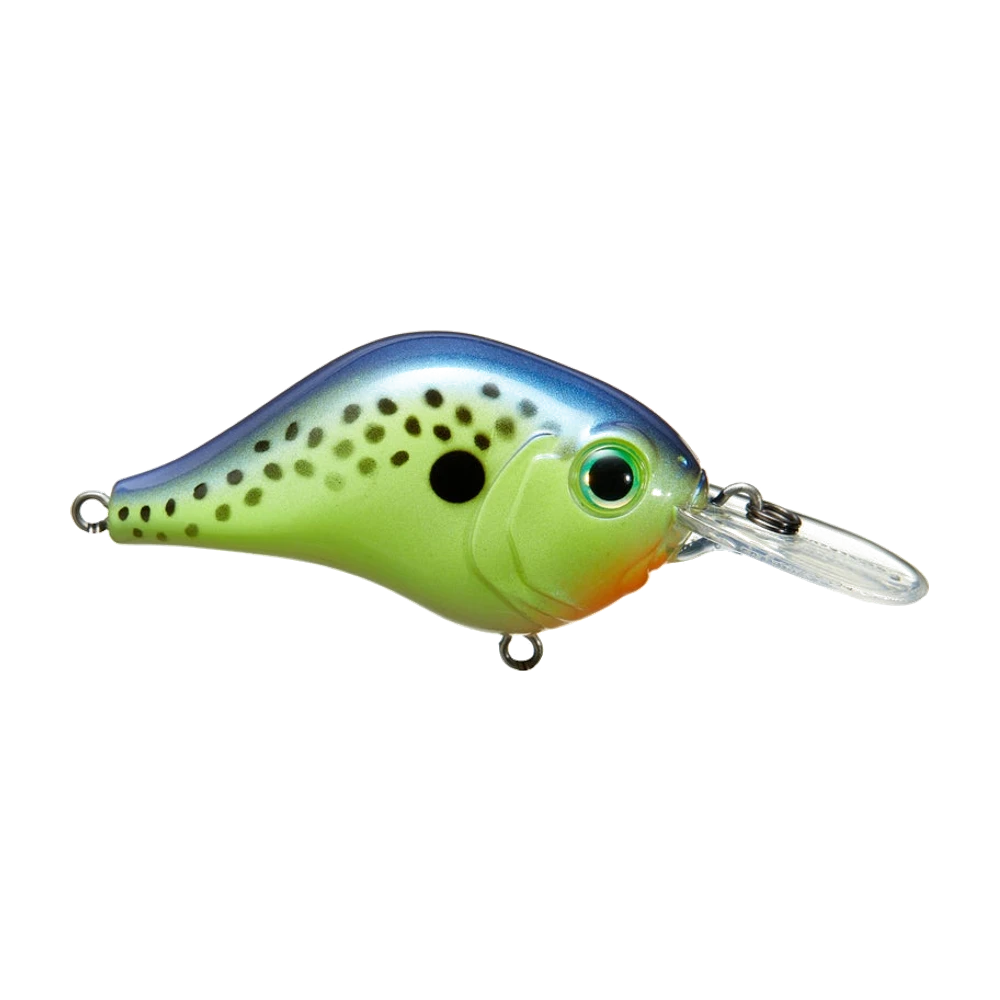
Bill Lewis MR-6: the crankbait built for the 1.8 m layer
The right lure in the wrong spot still catches nothing. CarnaFish spots the zone that works, from a single photo.
Most anglers own a shallow crankbait and a deep crankbait, and nothing in between. That's a shame, because on the vast majority of European waters the most productive layer sits precisely between one and a half and two metres: the top of a break, weedy flats, the edge of a rock pile just before it drops. The MR-6 was drawn for that layer and nothing else, and the name says so — MR for medium runner, 6 for the six feet it targets.
A lure designed around a single depth
The MR-6 measures 2.25 in, 5.7 cm, for 1/2 oz, 14.2 g, and Bill Lewis state a 6 ft running depth, roughly 1.8 m. It was developed with Elite Series pro Mark Daniels Jr. around a single objective: a lure that hits that figure quickly and holds it for most of the retrieve.
That size-to-weight ratio is worth a pause. Fourteen grams for 5.7 cm is a lot — a crankbait of the same length often weighs around 10 g. The extra mass does two things. It buys casting distance, which is the first condition for ever reaching 1.8 m: a crankbait only hits its maximum depth after several metres of retrieve, so a short cast is a cast where the lure fishes too high. And it makes room for an internal weight transfer system, a sliding ball that moves back on the cast to stabilise the flight, then returns to its running position.
Flattened sides and a tapered tail
Bill Lewis describe a body with flattened sides extended by a tapered tail. That combination produces a specific behaviour: strong vibration but a tight wiggle, meaning plenty of energy without much lateral amplitude.
Flat sides limit body roll, as on the Bill Lewis Hammer Flat Crank from the same brand. The tapered tail reduces rear surface and stops the lure from rearing up when you speed up. The result: you can retrieve fairly briskly without the bait blowing out of its track or climbing, which is exactly what you want from a crank in this layer.
Bill Lewis also specify that the MR-6 rises slowly on the pause. That's a decisive property. A crankbait that rises fast leaves its layer the moment you stop, so a pause becomes wasted time. One that rises slowly stays at fish level throughout the pause, and that's precisely where the bites come from a fish that was following without committing.
When the bill ticks bottom or a stump, stop winding for a full second, not half a second. On the MR-6 that second counts: the lure stays almost in place, barely rising, and a bass that was following has time to make up its mind. That's the difference between ten follows and three fish.
The low-pitched knock, and what it's for
Bill Lewis state the MR-6 produces a low-pitched knock on the retrieve. A low tone travels better in dirty water than a high one, which dissipates faster and blends into the background noise of a wind-stirred lake. That's why the MR-6 is explicitly presented as a dirty-water bait.
Don't overrate that parameter though. In clear water a deep, repetitive knock can just as easily put fish on alert, and a silent version or a more discreet bait will often take the edge. Sound is a conditions tool, not an absolute virtue.
Two size 4 trebles, and why that's spelled out
Bill Lewis push one point you rarely see highlighted: the MR-6's lengthened body allows two Mustad Triple Grip trebles in size 4, where a crankbait of comparable length has to settle for size 6.
That's not a detail. On a short crankbait the two trebles sit close together and tangle easily; going too big creates hook-to-hook catches that ruin the action. Being able to run size 4 without that problem means a wider hook gap, so cleaner hook-ups on a fish that hits from the side, which is the norm on a crankbait.
The classic mistake
Fishing the MR-6 over four or five metres of water hoping "it'll get down a bit further". It won't. A crankbait reaches its figure and holds it, full stop. If your fish is at 3.5 m you need a longer-billed model like a Rapala DT6 or a Bandit 300 — not an MR-6 wound more slowly.
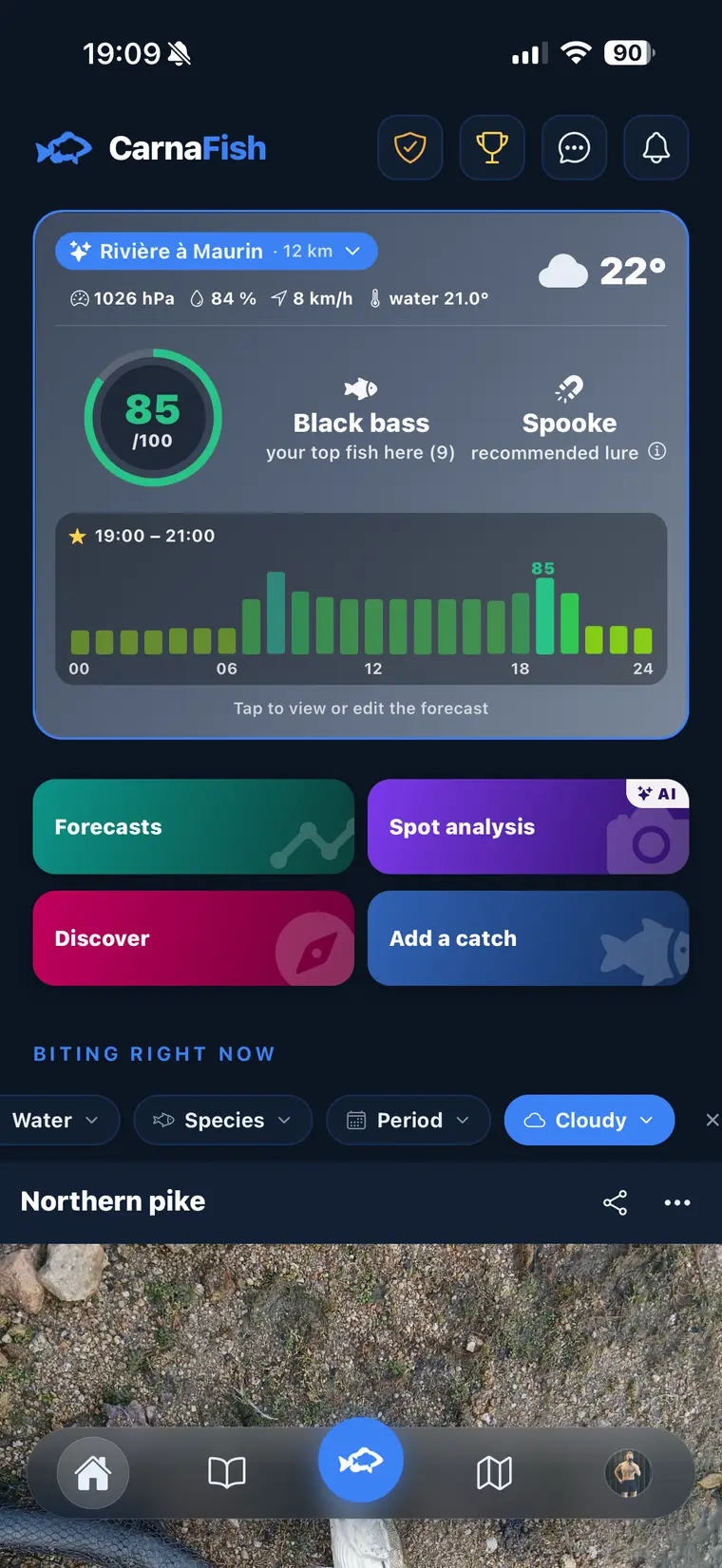
Not sure what to tie on?
Photograph your spot: CarnaFish reads the scene, cross-checks the conditions and gives you the zone, the lure and the retrieve. Free on iOS and Android.
How to actually use it
Cast past the target zone, by a good ten metres if you can, so the lure has time to get down before it arrives on the spot. Retrieve at a steady medium pace until first contact. From there the whole animation is alternating retrieve and one-second pauses at every touch of bottom or cover.
On a break, the ideal is to cast from the shallow side downward, so the lure descends with the slope and stays in contact with the substrate as long as possible. Casting the other way pulls the bait up the slope and out of the layer within a few turns of the handle.
Colors by water
- Lightly stained water: the blue and chartreuse of the photo, a contrast that stays readable without being garish, and works well when baitfish dominate.
- Rocky bottom, spring: a brown craw, matching the prey actually present on that substrate while the water is still cool.
- Clear water: a natural silver roach, more discreet, and the one to switch to as soon as fish follow without biting.
A layer lure, not an everything lure
The MR-6 does one thing properly: covering the 1.5-2 m band efficiently. Outside it, it's less relevant than a model designed for the depth you're after. Owning three crankbaits that cover three distinct layers beats owning ten that all dive to the same figure, and that's probably the most useful advice anyone can give about this family of lures.
What remains is knowing which layer to fish, which depends on the spot far more than on the lure. That's exactly what CarnaFish sets out to make simple: photograph the spot and the AI suggests the zone, the depth and the lure type that suit the day's conditions. To learn to spot a break or a flat with the naked eye, our guide to reading a fishing spot lays out the basic markers.
The short version
- 5.7 cm for 14.2 g running around 1.8 m: a mid-layer crankbait calibrated for one depth band.
- The high weight for the size serves the long cast, the condition for the lure to actually reach its figure before it arrives on the spot.
- The slow rise on the pause is its main asset: it allows genuine one-second stops without leaving the running layer.
- The lengthened body accepts two size 4 trebles, a wider hook gap than an equivalent short crankbait allows.
FAQ
How deep does the MR-6 really run?
Bill Lewis state 6 ft, roughly 1.8 m. That figure assumes a long cast and thin line: with thick fluorocarbon and short casts, expect closer to 1.4-1.5 m in practice.
Why is it so heavy for its size?
The 14.2 g serve two ends: casting distance, which is essential for a crankbait to reach its figure before arriving on the zone, and housing an internal weight transfer system that stabilises the lure in flight.
Does the MR-6 float on the pause?
It rises, but slowly — Bill Lewis say so explicitly. That's what allows genuine one-second pauses without the lure leaving its running layer, unlike a very buoyant crankbait that climbs immediately.
Is it any good for perch?
Yes, it's a very good size for European perch on gravel pit breaks or reservoir flats. The strong vibration pulls shoals in from a distance, and a 5.7 cm bait stays within the prey size a good perch takes without hesitation.
Should I upgrade the stock hooks?
No. The size 4 Mustad Triple Grips fitted at the factory match the lure's balance, and the body was dimensioned to accept them. Going bigger would create tangles between the two trebles.
In what conditions does this lure work best?
In lightly to clearly stained water, over hard bottom, between one and two metres down. Its low knock carries better than high-pitched rattles in those conditions. In very clear water, a silent crankbait or a more discreet bait will often have the edge.
The full bass lure guideSeason-by-season strategy: which family of lure, when, and why.Go from theory to fish
CarnaFish reads your spot from a photo and gives you the game plan: zone, lure, retrieve. Free on iOS and Android.