SPRO Hunter 65 Squarebill: the crank built to deflect off wood
This lure shines under specific conditions. CarnaFish tells you in 10 seconds if today is one of them.
A laydown in a metre of water, mid-April, the water up two degrees in three days. At that moment you don't need a bait that swims prettily in open water: you need one that will hit the wood, veer off sideways, and start swimming again by itself. That's the entire job description of a squarebill crankbait, and it's exactly the slot SPRO is aiming at with the Hunter 65 from its Essential range.
A square lip, and a swim that veers off line
A square lip isn't there to dig deep: it's there to bounce. Wide, short and set almost horizontally under the nose, it strikes cover instead of sliding under it, which kicks the bait sideways before it recovers its line. That involuntary veer is the trigger. A bass sitting tight to a stump ignores a bait that passes cleanly a foot away; it reacts to the bait that just hit its wood and spun off.
SPRO describes this model as having a wide, erratic hunting action plus a loud knocking sound. That's the maker's own wording, not a measurement: take from it that this is not a tight, discreet flat-sided crank but a noisy bait that refuses to track perfectly straight. The two go together — a tall, stubby body that hunts left and right is harder for a fish to read than the steady signal of a thin lip.
The numbers, read off the maker's table
SPRO's table gives three columns and a single version: 2.5 in, which is 6.5 cm, half an ounce or roughly 14 g, and a stated running depth of 3-5 ft, so 0.9-1.5 m. The 65 in the name does correspond to the length in millimetres, which removes any confusion with ranges where the number stands for depth instead.
Fourteen grams on a 6.5 cm body is a high density for a crankbait that size. In practice it means the bait flies well into a headwind and loads a medium rod cleanly: you won't have to switch to braid to reach a laydown on the far side of a pocket.
What the table doesn't say matters too. There is no class column, and nothing in the maker's prose mentions buoyancy. So we won't tell you this crank floats back up on the pause. Almost every squarebill does, but until it's written down that's a likelihood, not a spec — and the difference completely changes how you get the bait through cover.
A test that costs nothing: on your first cast, crank two turns then stop dead, rod low, watching the slack. If the bait rises, you'll clear branches simply by pausing. If it sits or sinks, you'll have to speed up instead to free the lip. Ten seconds of checking, three baits saved over a day.
Where and when to pull it out
The maker points it at rock and timber in shallow water, and that's genuinely where a squarebill earns its place. In Europe that means canal and dam riprap, reservoir banks cluttered with stumps, river logjams, and dock pilings. The best window runs from late spring into early autumn, peaking when bass move up onto shallow flats to feed.
Over riprap, perch take this bait as readily as bass, especially when you retrieve across the slope rather than straight into it. On pike water, though, 6.5 cm at a metre down is a profile that gets bitten off. If the venue holds them, a short length of heavy fluorocarbon or soft titanium costs a little swim amplitude and keeps your bait.
Working it: contact before speed
The retrieve is medium and steady, but it isn't what earns bites. The impact is. So don't try to avoid cover: aim at it. Run the bait into the rock, through the branches, along the concrete. Every time you feel the lip stall, let off for a fraction of a second — the bait kicks aside, lifts slightly, and that half-second is very often when the rod loads.
A second rhythm works well on sluggish fish: four or five turns, a two-second stop, then a sharp restart. The abrupt acceleration reads as an escape to any fish that has been following.
The classic mistake
Slowing down to "feel the bottom better." That's the reflex of an angler used to soft plastics, and it backfires here. Below a certain speed a square lip stops deflecting: it slides under the branch and wedges there. A squarebill needs a minimum speed for an impact to produce a clean kick rather than a snag. If you fish slowly on principle, change baits rather than rhythm — a round-lipped crank such as the SPRO Fat Papa tolerates a crawl far better.

Not sure what to tie on?
Photograph your spot: CarnaFish reads the scene, cross-checks the conditions and gives you the zone, the lure and the retrieve. Free on iOS and Android.
Rigging and hooks
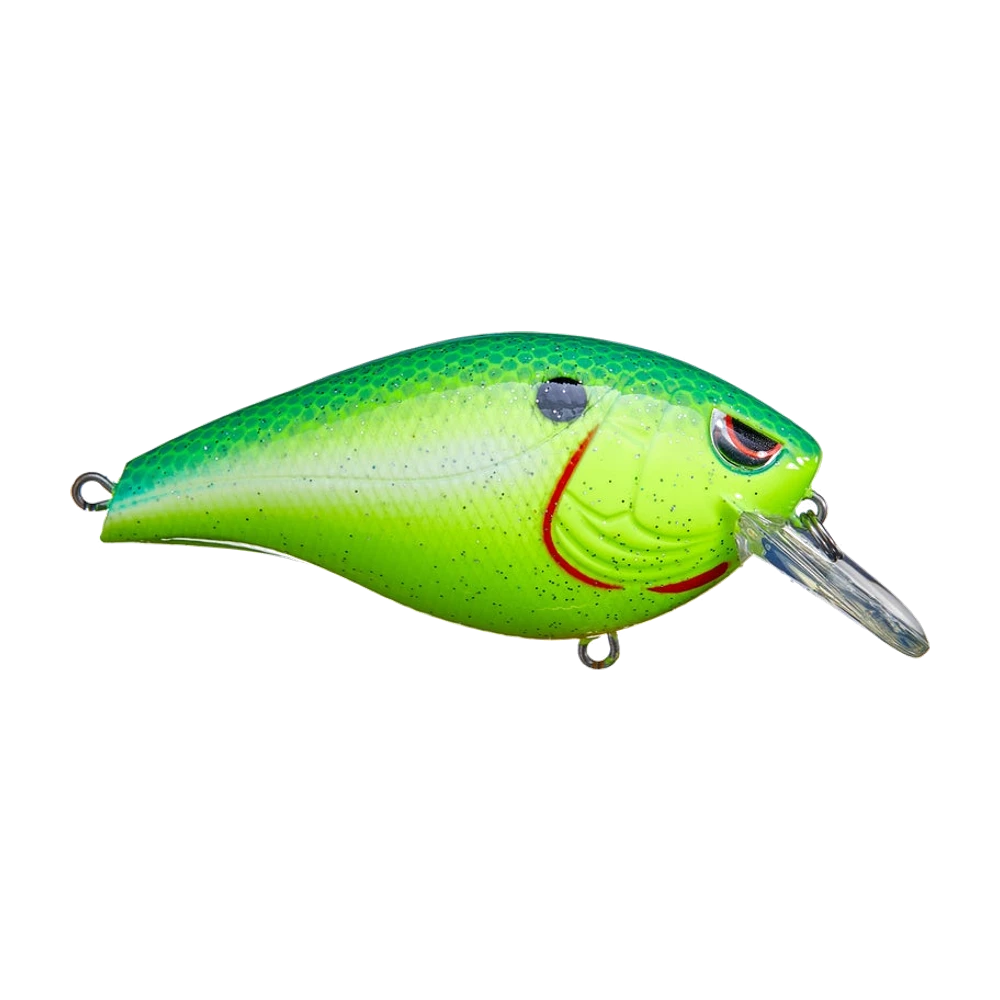
SPRO states the bait comes armed with premium Gamakatsu trebles in size 4. The maker does not say how many; the product photo shows two hangers, one belly and one tail, but the bait is pictured bare with no trebles fitted at all — that is an observation from a product photo, not a specification. Factory Gamakatsu size 4 trebles are, at this price level, well above average; the retailer still offers an upgrade straight away, which is a shop sales line rather than an observed weakness.
A rod of 1.95-2.10 m, medium power, moderate action: with trebles, a stiff blank tears the bait out of the fish's mouth early in the fight. Fluorocarbon of 0.25-0.30 mm, roughly 10-14 lb, or monofilament if you want even more cushion. For the connection, a small snap or a loop knot leaves the nose free; a knot cinched straight onto the eye chokes the lip and flattens the swim, exactly as it does on a Rapala Shad Rap.
Colour by water clarity
- Lightly stained water: the pattern photographed here, silver-flaked chartreuse flanks over a scaled green back with red gill slashes. It reads as a startled sunfish or small perch, visible without being garish.
- Clear water: a natural roach or silver shiner pattern with a grey-green back. Where a fish can see two metres, the deflection does the triggering and the colour only has to avoid spooking.
- Dirty water after rain: black-back chartreuse, or an orange craw pattern in spring. Here contrast and rattle do the work, not realism.
Picking the right crankbait is worthless if you throw it in the wrong place: a squarebill with nothing to hit is just an average crank. That's exactly what CarnaFish saves you — a photo of the spot, and the app suggests a zone, a depth and a lure family that match the day's conditions. To build the tackle and spot-reading basics, our beginner's guide to bass fishing covers it from scratch.
Key takeaways
- 6.5 cm for roughly 14 g with a stated 0.9-1.5 m running depth: a cluttered-margin bait, not an open-water one.
- Deflection off cover is the trigger; aim at stumps and rock instead of steering around them.
- The maker states no buoyancy class: check how it behaves on the pause before you fish it into wood.
- Factory Gamakatsu size 4 trebles are rare at this price point — keep them as long as they stay sharp.
FAQ
How deep does the SPRO Hunter 65 run?
The maker states 3-5 ft, so roughly 0.9-1.5 m. In practice you'll sit at the deep end of that range with thin line and a long cast, and at the shallow end with heavy mono and a short one.
Does this crankbait float on the pause?
SPRO's spec table has no buoyancy column and the prose says nothing about it, so it can't be claimed. Run the test at the bank before fishing wood: stop the retrieve and watch whether the bait rises.
What's the difference with a round-lipped crankbait?
A square lip deflects off cover instead of sliding under it, and runs shallower. A round-lipped model such as the SPRO Fat Papa digs deeper and takes a much slower retrieve, but hangs up more in timber.
Should I upgrade the factory hooks?
Not as a matter of course. SPRO fits Gamakatsu size 4 trebles, which are already a good standard. Replace them when a point has rolled or opened on rock, not on principle.
Is it a good perch bait?
Yes, over riprap and hard margins, provided you retrieve across the slope. A 6.5 cm profile stays within reach of a decent perch, and the rattle counts for a lot with that species.
What do I do if it snags constantly?
Speed up. A squarebill that keeps hanging up is almost always a squarebill retrieved too slowly: below a certain speed the lip wedges under the branch instead of bouncing off it. If it persists, the spot calls for a weedless bait, not a crankbait.
The full bass lure guideSeason-by-season strategy: which family of lure, when, and why.Go from theory to fish
CarnaFish reads your spot from a photo and gives you the game plan: zone, lure, retrieve. Free on iOS and Android.