Bill Lewis ATV Squarebill 1.5: a crankbait built to bump wood
One lure, endless conditions. CarnaFish reads your spot from a photo so you are not just guessing.
A squarebill crankbait is useless in open water. Its whole reason to exist is to go into the places you would not dare send a round-lipped bait: drowned branches, a rock bottom, an edge of deadwood. Bill Lewis built the ATV Squarebill 1.5 around that idea, with a lip designed to send the bait where it would not previously have gone — hence the name, borrowed from an all-terrain vehicle.
The numbers, and what they imply
Bill Lewis publishes three figures for the ATV Squarebill 1.5: 2 1/4 in long, which is 5.7 cm; 1/2 oz, roughly 14.2 g; and a running depth of 3 to 6 ft, that is 0.9 to 1.8 m.
That ratio deserves a pause. Fourteen grams on 5.7 cm is heavy for the size — heavier than most squarebills of comparable build. Two direct consequences. First, the bait casts far and, more importantly, accurately, even in a crosswind; on a shoreline pattern where you are aiming at a square metre under a branch, that is decisive. Second, it reaches running depth in two or three turns of the handle, so you do not waste half the cast getting down.
The 0.9-1.8 m band, on the other hand, is what it is: a shallow range. Beyond two metres this bait has no business being in the water; you want a long-lipped crank instead.
A manufacturer's stated depth always assumes thin line and a long cast. With heavy fluorocarbon and a short cast, take twenty to thirty centimetres off the claim. That is true of the ATV and of every crank on the market.
The square lip, and why it beats cover
A square lip does two things a round one does not. First, it produces a wider, more erratic swim, because a flat surface generates irregular turbulence. Second, and this is the key point, when a corner of the lip hits a branch it pivots the bait sideways rather than driving it into the obstacle.
That deflection is the whole game in squarebill fishing. The bait hits, kicks out, changes direction over ten centimetres — and it is in that second, not during the steady retrieve, that a bass commits. A crankbait that has touched nothing all cast is a crankbait with almost no chance.
Bill Lewis emphasises the particular design of this lip, presented as able to take the bait into zones anglers previously hesitated to fish. In practice that does not make it snag-proof — no crankbait hanging two trebles ever is. It means it forgives more, and that you can reasonably run it through moderate wood without donating a lure at every target.
Sonic vibration, the house signature
Bill Lewis is historically the lipless-with-rattles brand, and the ATV carries that sonic register over. The bait puts out a strong low-frequency signal you can feel in the rod from the first turn of the handle.
For the angler that is a control tool as much as a selling point. As long as you feel the steady thump, the bait is tracking straight. The moment it stops, something has happened: a leaf on the lip, a treble fouled on the line tie, a piece of cover. You know immediately, without reeling in to check.
For the fish, that signal matters most in stained or coloured water, where a bass finds the bait with its lateral line before it sees it. In very clear water the same signal can alert a wary fish instead: slow right down, or switch to something quieter.
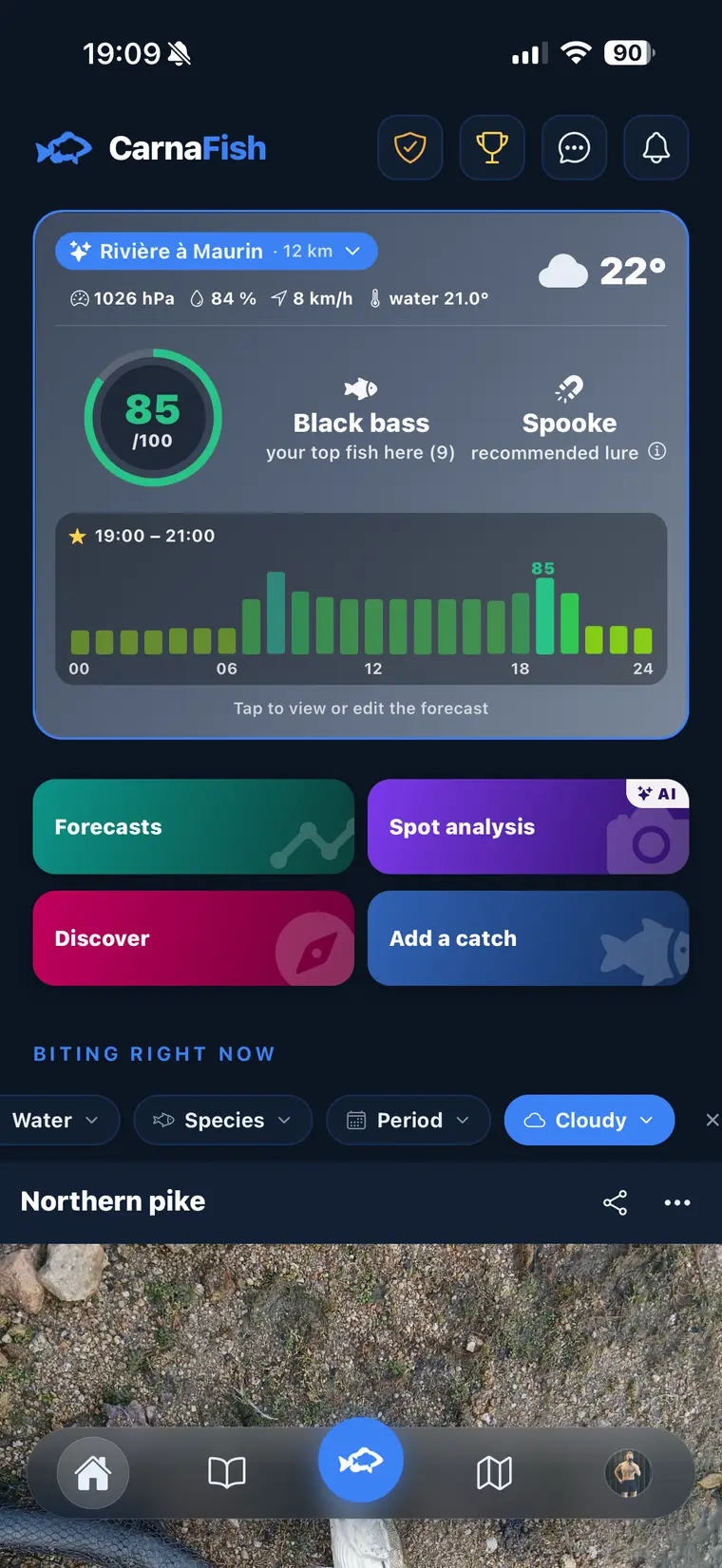
Not sure what to tie on?
Photograph your spot: CarnaFish reads the scene, cross-checks the conditions and gives you the zone, the lure and the retrieve. Free on iOS and Android.
Rigging and hooks
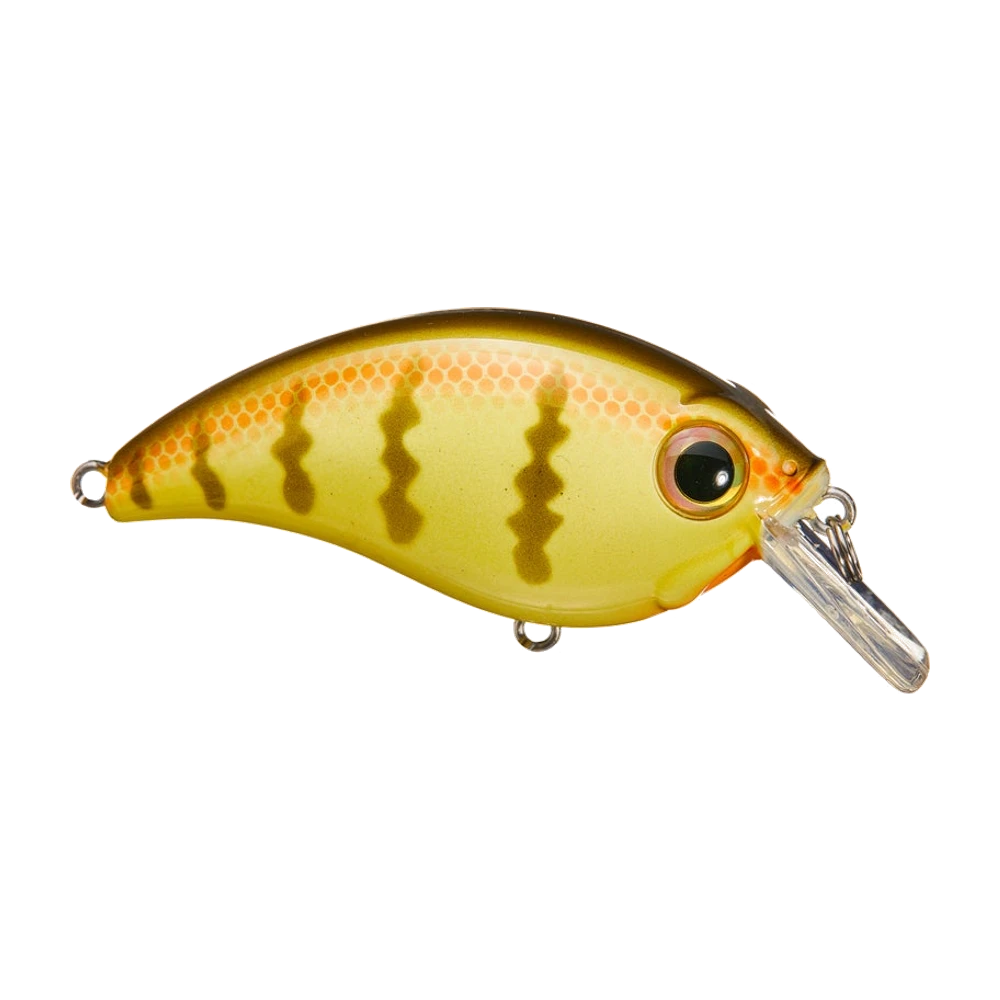
The bait comes with Mustad Triple Grip trebles, a pattern with slightly turned-in points that limits lost fish during jumps. In the photo on this page, the ATV is shown bare, with no trebles fitted: only the belly hanger and the tail eye are visible. Keep that in mind when comparing images of this crankbait, since the bait looks quite different once armed.
The knot, again
A square-lipped crankbait needs a free head. A knot tightened directly against the split ring restricts the lip and cuts the swing of the swim, exactly as on a long-lipped crank. Snap or loop knot, no exceptions.
The line
Thin braid with a 0.30-0.35 mm fluorocarbon leader is a good compromise: braid gives distance and detection, fluoro brings the abrasion resistance you need when scraping wood. Avoid straight braid to the lure, though: with no stretch, you will tear the treble out of the fish's mouth on the first jump.
The rod
A moderate-action casting rod, not a stiff fast-tip tool. A crankbait is fished without setting the hook: the fish pins itself against the resistance of the bait, and a softer blank stops you pulling it free. That is the single most common mistake with this type of lure — a violent set that throws the treble.
Colour by water clarity
- Over weed and on light bottom: the yellow and orange perch pattern shown here, imitating a juvenile perch, a major forage fish for bass and big perch alike in Europe.
- Clear water over baitfish schools: Sexy Shad, a silver-grey with a dark back that disappears into the crowd.
- Muddy water, flood or back of an arm: Chartreuse with a black back, the only register that stays readable under thirty centimetres of visibility.
A squarebill only earns its place over the right cover and at the right depth: too deep it ploughs, too shallow it surfaces. That is exactly what CarnaFish simplifies — a photo of the spot, and the app suggests the zone and the presentation matched to the day. For the perch side of the method, since perch take this crankbait size readily, our guide to lure fishing for perch breaks down the rhythms and the spots.
If you are comparing, the Strike King KVD Squarebill remains the yardstick of the category, the Bomber Square A is the historic budget option, and the 6th Sense Crush Squarebill 50X drops a size for very clear water. Along clean banks, the Bandit 100 Series takes over with a round lip.
Key takeaways
- 5.7 cm for 14.2 g: a heavy ratio that buys casting accuracy and an immediate start to the swim.
- A running band of 0.9 to 1.8 m, strictly a shallow-water bait.
- The square lip deflects off cover; with no contact, the bait loses most of its effectiveness.
- Moderate rod, no hookset, and a loop knot or snap so the lip is not restricted.
FAQ
How deep does the ATV Squarebill 1.5 run?
Bill Lewis states 3 to 6 ft, that is 0.9 to 1.8 m. That band assumes thin line and a long cast; with heavy fluorocarbon or a short cast, expect a little less.
Does this crankbait float?
The manufacturer's description does not state the buoyancy of this model, and we will not claim it without a source. Check it on your first cast by stopping the retrieve near the bank: that is the information that governs how you free it from a snag.
Why does my squarebill still hang up?
Because no squarebill is snag-proof: the lip deflects but does not shield the trebles. Slow down on contact, and if the wood is genuinely dense, switch to a weedless Texas-rigged soft plastic.
Should I set the hook on a crankbait bite?
No. The fish pins itself against the resistance of the bait. Simply keep reeling and raise the rod progressively. A sharp set often throws the treble, especially with no-stretch braid.
What size of fish is this crankbait aimed at?
The 5.7 cm size interests average bass as readily as big perch. It is one of the few genuinely cross-species crankbait sizes in Europe.
How does it differ from a lipless by the same brand?
A lipless has no lip, sinks, and is fished as a fast search bait through the whole column. The squarebill is confined by its lip to a narrow depth band, 0.9 to 1.8 m here, and draws most of its effectiveness from contact with cover.
The full bass lure guideSeason-by-season strategy: which family of lure, when, and why.Go from theory to fish
CarnaFish reads your spot from a photo and gives you the game plan: zone, lure, retrieve. Free on iOS and Android.