Imakatsu Lazy Swimmer: the big soft swimbait built for crawling speed
Not sure this lure fits YOUR spot today? CarnaFish tells you in 10 seconds, from a photo.
There are days when the fish are right there, marked on the sonar or sitting under the boat, and nothing gets a reaction. You have already slowed down, you have already downsized, and it changes nothing. One direction is left that few anglers really explore: slow down further still, to a speed where most lures simply stop swimming. That is exactly the window Imakatsu built the Lazy Swimmer for — a soft swimbait whose entire design serves one goal, staying alive when you are barely moving.
A tail that works like a pendulum
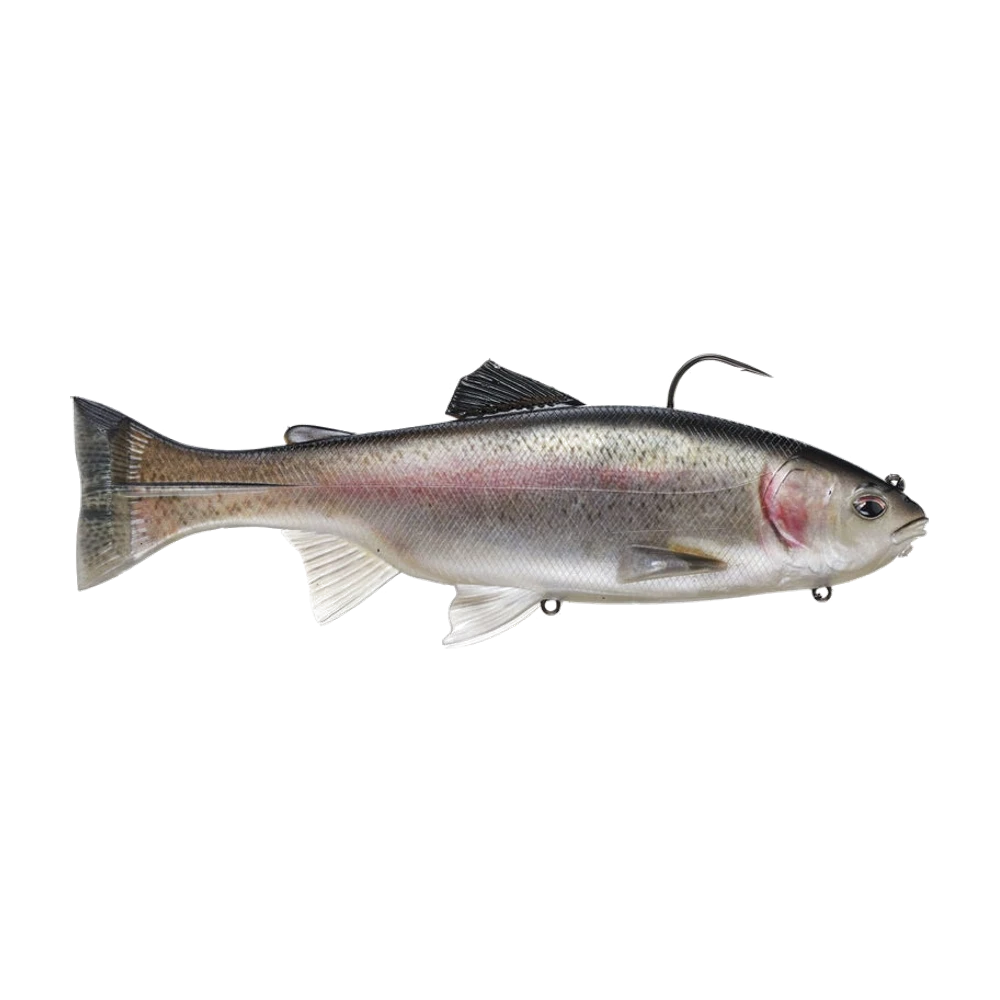
The centrepiece is the tail. Imakatsu calls it a "demon tail" and describes it as an appendage that sweeps from side to side like a pendulum, pushing a heavy volume of water. That is a different mechanism from a conventional boot tail: a boot tail needs a minimum of speed for water resistance to make it kick, whereas a pendulum sweep triggers on the slightest movement and carries on by inertia between impulses.
In practice, that means the bait keeps a detectable signature at speeds where an ordinary shad goes inert. And that signal is not only about visible swim: a wide tail pushing water sends out a pressure wave the fish picks up through its lateral line long before it sees the bait. That is precisely what matters in stained water or at the end of the day.
The flip side is just as clear: a bait designed for crawling speed does not like being rushed. Reel it in fast out of habit and you cancel the only thing that sets it apart, dragging 50 g of soft plastic for nothing.
Three sizes, and a table worth reading twice
Imakatsu offers the Lazy Swimmer in three lengths, and the maker's table deserves close attention:
- 6 in, 15.2 cm, listed at 1.75 oz, around 50 g, in the slow-sinking class.
- 7 in, 17.8 cm, listed at 1.7 oz, around 48 g, also slow-sinking.
- 9 in, 22.9 cm, listed at 5.5 oz, around 156 g, in the floating class.
Two honest remarks. First, the 7 in is given as lighter than the 6 in, by two grams. A longer, lighter bait is possible if the volume changes, but the way those two figures line up looks more like a typo in the table than a manufacturing reality. Treat both as the same order of magnitude — around 50 g — rather than as a reliable ranking, and check the label on the pack you buy.
Second, the class changes from one size to the next: the two smaller models sink slowly, the big one is listed as floating. That is not a catalogue footnote, it decides how you fish. A floating 9 in works on or just under the surface, rises on every pause and never crawls the bottom; the 6 and 7 in go down on their own and settle. Two very different lures under one name.
Two hook options, both in the box
The Lazy Swimmer ships with several rigging options, and that choice matters as much as the size does.
The single back hook
A big, stout single hook sits in the back, point up. It is the most defensive option: nothing hangs below the belly, so nothing snags. Imakatsu presents it as the pick for crawling along the bottom, and that is indeed where it earns its keep — over hard bottom, a rocky flat, a gravel edge, you can let the bait touch and move on without spending the day unhooking weeds. A single hook that size forgives very few soft hooksets: you need a rod that transmits and a firm strike, not a trout-style lift.
The belly treble harness
The second supplied option is a removable harness that clips under the belly and carries a treble. Its purpose lies elsewhere, and Imakatsu says so plainly — mid-column fishing, fishing near the surface, and above all fish that short-strike. A bass nipping at the back without committing slips past a single back hook nine times out of ten; the belly treble converts a good share of those. In exchange, you give up the ability to set the bait on the bottom without snagging.
The practical rule is simple: single back hook when you fish the bottom and cover, belly harness when you fish the column and the bites are soft.
Fit the belly harness on the day you are counting missed bites, not before. A treble under the belly of a 50 g swimbait turns every weed stem and every branch into a snag, and you will cover half as much water for a handful of extra bites. It is a tuning rig, not a default one.
Splitting the tail: the modification the maker plans for
Imakatsu states that the tail can be cut in half horizontally, along the lateral line. The result is not a damaged tail but a softer one, which kicks harder and faster and lets you retrieve more quickly while keeping the bait high in the water.
It is a one-way change: you will not glue that tail back. Save it for the day you have worked out that the fish want a fast bait near the surface, or do it on your second one. With one intact Lazy Swimmer and one split Lazy Swimmer in the same box, you cover two very different rhythms without changing models.
Not sure what to tie on?
Photograph your spot: CarnaFish reads the scene, cross-checks the conditions and gives you the zone, the lure and the retrieve. Free on iOS and Android.
Where and when to use a bait like this
A 15 to 23 cm swimbait does not fish everywhere. It needs water that holds big fish and where the dominant prey is itself bulky: trout reservoirs, large ponds with adult baitfish, deep river arms. On a small perch canal it has no business being tied on.
The most favourable season is cool to temperate water, when big bass feed on few prey items but large ones — late autumn, a mild winter, the very start of spring. It is also the period when a very slow presentation naturally outperforms fast searching. Across Europe, the pre-spawn window on southern reservoirs suits this kind of presentation particularly well.
On tackle, let us be blunt: a dedicated swimbait outfit is required. An extra-heavy casting rod of 7'6" to 8', a sturdy reel, 50 to 65 lb braid. Throwing 50 g all day on a medium-heavy rod means breaking the rod or wrecking your shoulder. For the 9 in at 156 g the question does not even arise: that is specialist gear.
Colour by conditions
- Clear water: the rainbow trout livery shown in the photo, with the speckled olive back and the pink flank stripe. On water where trout are genuinely present, that is the obvious pick.
- Stained water: a version with a dark back sharply contrasted against the belly, which keeps a readable silhouette once visibility drops below a metre.
- Low light: a pale, pearly tone that stands out in backlight when viewed from below, where a natural pattern merges into the bottom.
An unapologetic specialist
The Lazy Swimmer does not replace a search swimbait like the Megabass Magdraft, which you wind steadily without thinking. It is closer in intent to a Huddleston 8 Trout: imitate one large prey item precisely and move it slowly. If you want the same family in a far more accessible size, the Imakatsu Gillroid Minnie sits at the other end of the brand's catalogue.
Tying on a 50 g lure assumes you are reasonably sure there are big fish in front of you — otherwise it is an expensive blank in terms of energy spent. That is what CarnaFish helps settle: a photo of the spot, and the app suggests a zone and a presentation consistent with what the water shows. To build an outfit that can handle these baits without breaking the bank, our guide to predator tackle on a budget gives the right ballpark.
Key takeaways
- Built for a very slow retrieve: the pendulum tail works at speeds where a conventional boot tail goes dead.
- Three sizes, two behaviours: 15.2 and 17.8 cm slow-sinking, 22.9 cm listed as floating — check the class before buying.
- Two hook options supplied: single back hook to crawl the bottom snag-free, belly treble harness for the column and soft bites.
- The tail can be split horizontally for a sharper kick and a higher retrieve, but the change is permanent.
FAQ
Which Lazy Swimmer size should I start with?
The 6 in (15.2 cm, around 50 g) is the sensible choice: it casts on a standard swimbait outfit and it sinks slowly, which covers most situations. The 9 in needs specialist tackle and water holding genuinely big fish.
Why is the 7 in listed as lighter than the 6 in?
The maker's table gives 1.75 oz for the 6 in and 1.7 oz for the 7 in, which is counter-intuitive. Simply treat both sizes as the same order of magnitude, around 50 g, and trust the label on the packaging.
Should the belly treble always be fitted?
No. The single back hook is enough as soon as you fish the bottom or cover, and it snags far less. Keep the treble harness for days when fish hit from behind without committing.
How fast should this swimbait be retrieved?
As slowly as you can while keeping the tail moving. It runs against the usual instinct: wind it at crankbait speed and you cancel the point of the bait. If you want to fish fast, split the tail.
Can the Lazy Swimmer be fished for pike?
The bait is built for bass, but its bulk obviously appeals to a pike. In that case a steel or titanium leader becomes essential: a soft swimbait at this price does not survive pike teeth on bare line.
What tackle is needed to throw a 50 g lure all day?
An extra-heavy casting rod of 7'6" to 8', a sturdy reel and 50 to 65 lb braid. Below that, a broken rod is not a hypothesis but a matter of time, and arm fatigue arrives well before the first fish.
The full bass lure guideSeason-by-season strategy: which family of lure, when, and why.Go from theory to fish
CarnaFish reads your spot from a photo and gives you the game plan: zone, lure, retrieve. Free on iOS and Android.