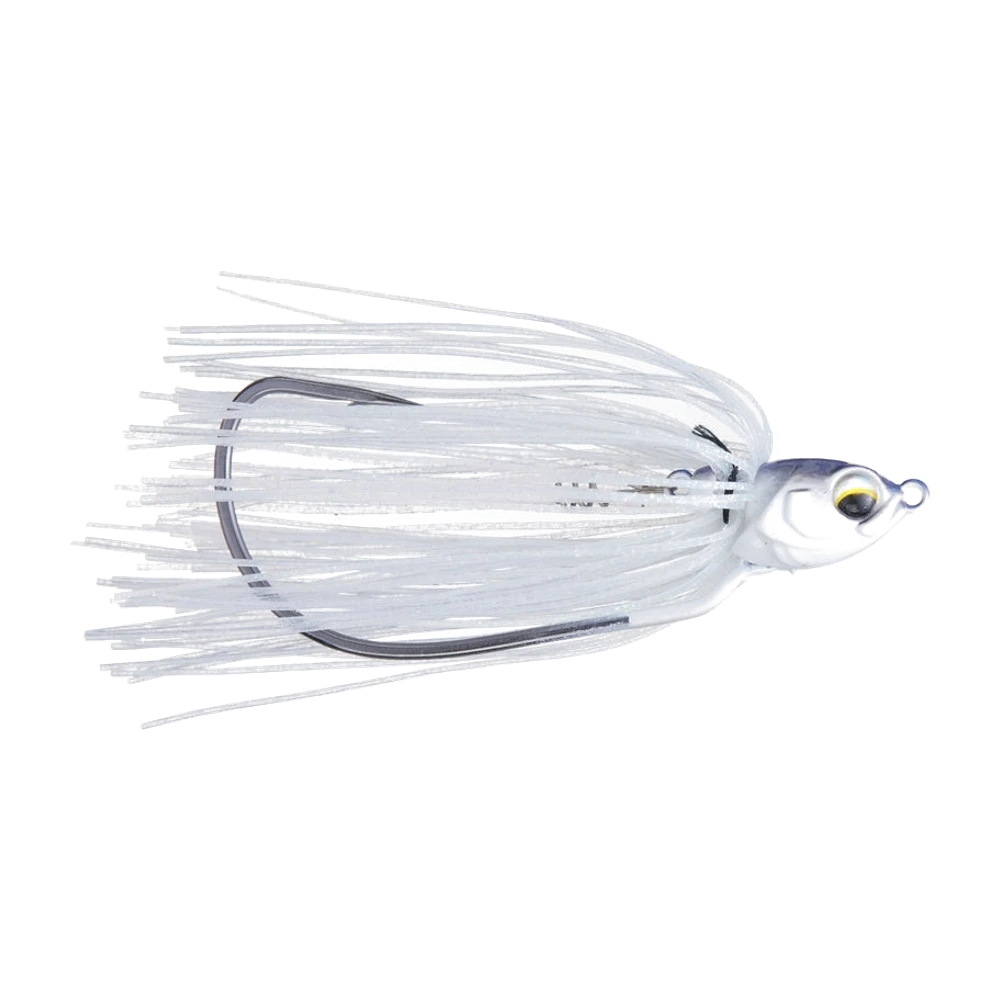
6th Sense Axle Swinging Swim Jig: the swim jig that is genuinely weedless
Before tying this one on, it helps to know if the spot actually calls for it. CarnaFish reads the scene from a photo.
There's one precise moment where a conventional swim jig stops fishing: when the head wedges between two limbs of a drowned tree and you have to snap the rod to free it. The fish that was following felt that jolt, and it's gone. The 6th Sense Axle Swinging Swim Jig goes after that problem with a fully articulating extra wide gap hook mounted on a free-swinging screw lock keeper, and no fibre weedguard at all.
What the articulation actually changes
On a traditional swim jig the hook is cast into the lead of the head: the whole thing is one rigid block, and a tuft of nylon fibres is all that protects the point. That weedguard works, but it fights you on the hookset — the denser it is, the better it shields, and the less hook goes in.
The Axle comes at it from the other end. The point is tex-posed into the soft trailer, buried in the plastic and brought back out just under the skin, flush: no exposed metal left, so no need for fibres. And because the hook swings freely on its axle, the head can bump a limb, pivot up and over it and carry on while the hook trails behind without cocking sideways. There's a second, less obvious effect: with no rigid lever arm between the lead and the point, a bass shaking its head can no longer use the weight of the head against the hook.
Head, skirt and finish
The heads are powder-painted. On a lure whose entire job is scrubbing against wood and concrete that isn't cosmetic — powder paint holds up far better than a sprayed lacquer. Add 3D gill rakers, natural 3D eyes and a quality silicone skirt. And while what triggers a strike is the silhouette and the pulse of the skirt rather than the detail of the gill rakers, a good skirt at least keeps its volume after a dozen fish.
How to work it
A swim jig gets retrieved, full stop. A medium, steady straight retrieve, quick enough that the skirt pulses and the trailer kicks, slow enough to hold between 30 cm and 1.5 m / 1 and 5 ft, which is where bass hunt along cover. Cast parallel to the cover, never across it: you want to run the length of the dock for ten metres, not cross it in one.
Deliberate contact with cover
Instead of dodging the obstacle, you aim at it. Hit the dock piling, snag the limb on purpose, let the head pivot up and over it, then give half a second of slack before winding again — that deflection followed by a short fall is the main trigger. A weedguard swim jig makes you hesitate at every obstacle; this one lets you fish right into it, and that is where the difference in bites comes from, not from the color.
Check where the trailer sits every ten casts. The free-swinging screw keeper is what makes the rig weedless, but it's also what lets the trailer creep a millimetre or two after a missed bite. A trailer that has slipped means an exposed point — and a snag on the very next limb.
Rigging, trailers and leader
The trailer does half the work. A paddle tail like the Keitech Swing Impact 4 or the Strike King Rage Swimmer gives you a baitfish profile and a crisp kick; a flat-clawed craw trailer slows the fall and suits long pauses on a dock better. Either way, thread it on straight over the screw keeper, then tex-pose the point without burying it: it has to sit under the skin of the plastic, not in the middle of it.
Go heavy on line, since this lure takes you into the wood on purpose: braid in the 0.30-0.40 mm range (roughly 50-65 lb) straight through, or heavy fluorocarbon in very clear water, on a medium-heavy to heavy rod. Worth noting: 6th Sense doesn't publish a clear weight chart for this model and doesn't state the hook size. Pick by depth and cover density, and carry two neighbouring weights rather than betting on one.
The classic mistake
Rigging a trailer that's too bulky. A fat creature bait filling the whole bend cancels the advantage of the extra wide gap: the point no longer has room to come out of the plastic on the hookset, and you end up feeling bites you don't convert. Miss two fish in a row and change the trailer before you change the color.
Not sure what to tie on?
Photograph your spot: CarnaFish reads the scene, cross-checks the conditions and gives you the zone, the lure and the retrieve. Free on iOS and Android.
And what about pike
A swim jig retrieved along grass genuinely catches pike in Europe, regularly so in spring along shallow edges. But the lure wasn't built for it: it's designed for bass around trees, docks, grass and brush piles. If pike are present you move to heavy fluorocarbon of 0.60-0.80 mm (roughly 40-65 lb) or to a supple wire leader, otherwise you'll leave the jig in the jaws of the first decent fish. That's a trade-off, not advertised versatility.
Colors by water clarity
6th Sense doesn't publish a confirmed color list for this model. Think in tone families rather than catalog names:
- Clear water: the bluegill or perch family, greens and browns with a hint of orange, close to the prey actually living around the cover.
- Moderately clear water, active forage: the white shad or baitfish family, pearl white with silver flanks, for when bass are tracking fry.
- Stained water or low light: the black and blue family, a clean silhouette for when visibility drops under 50 cm / 20 in.
Against a chatterbait or a cover jig
A Zman ChatterBait Jack Hammer vibrates far harder and covers water faster, but its blade stops it crossing dense wood without hanging up. A classic cover jig gets through anything but fishes slowly, close to bottom. The swim jig retrieves like a chatterbait while passing like a jig: that's its only real argument, and it's enough. The 6th Sense Axle Swinging Hybrid Jig carries the same mechanics over to a slower presentation. Expect around $6 apiece in the US, with the much higher prices most likely covering multi-packs.
A weedless swim jig is no use if you retrieve it ten metres off the right cover. That's exactly what CarnaFish is for: photograph the spot and the AI hands you the zone and the presentation that fit today's conditions. To learn how to spot the edge that actually holds fish before you cast, our guide to reading a fishing spot walks through the clues to look for.
The short version
- Articulating extra wide gap hook and free-swinging screw keeper: the point tex-poses into the trailer, the weedguard disappears and the jig pivots over obstacles.
- The technique is deliberate contact with cover — the deflection off a limb or piling is the trigger.
- An overly bulky trailer cancels the wide gap and costs you hooked fish.
- No weight chart and no hook size published. For pike, heavy fluorocarbon or wire is mandatory.
FAQ
Does this swim jig still need a weedguard?
No, and that's the whole point of the model. The articulating extra wide gap hook tex-poses into the soft trailer, point flush under the plastic. With no metal exposed, fibres become pointless and you get back the hooking potential a dense weedguard was taking from you.
Which head weight should I pick?
There's no chart to give you — 6th Sense doesn't clearly publish the available weights. Work it out from depth and cover density: lighter to run a grass edge under 1 m / 3 ft, heavier for a deep dock or a windy day.
What trailer should I rig on it?
A paddle tail for a baitfish profile on a straight retrieve, like the Keitech Swing Impact 4 or the Strike King Rage Swimmer. A flat-clawed craw trailer slows the fall and suits pauses on an isolated obstacle better.
Does this swim jig catch pike in Europe?
Yes, genuinely, mostly along grass edges in spring and early autumn. But it wasn't designed for that — it's a bass lure. Where pike are present, move to 0.60-0.80 mm fluorocarbon or a supple wire leader, or you'll lose the jig.
How fast should a swim jig be retrieved?
Medium and steady, just quick enough that the skirt pulses and the trailer kicks continuously. Keep the lure between 30 cm and 1.5 m / 1 and 5 ft along the cover, and stall the retrieve for half a second every time the head touches something: the bite comes on the pick-up.
The full bass lure guideSeason-by-season strategy: which family of lure, when, and why.Go from theory to fish
CarnaFish reads your spot from a photo and gives you the game plan: zone, lure, retrieve. Free on iOS and Android.