Queen Tackle Tungsten Swim Jig: the swimming jig that slips through
Rather not fish it blind? Photograph your spot — CarnaFish cross-checks the conditions and points you the right way.
A grass bed breaking the surface, a lily pad edge, and no appetite for a frog because the fish are refusing the top: that is exactly the gap the swim jig moved into. It crosses what most lures go around, it swims mid-depth instead of scraping bottom, and it keeps a compact silhouette a bass can inhale whole. Queen Tackle's Tungsten Swim Jig takes that formula and gives it a tungsten head.
Why tungsten on a lure that does not fish the bottom
The tungsten argument usually belongs to bottom techniques, where density serves to feel the substrate. On a swim jig it does something else: it shrinks the head. Queen Tackle states 97% tungsten and a more compact profile than a lead jig — specifying, on that page, a comparison at the same size. The wording invites confusion: at the same size a tungsten head is in fact heavier, not smaller. The real gain, the one physics guarantees, shows at the same weight, since tungsten is roughly one and a half times denser than lead.
That gain matters precisely on a swim jig. A smaller head for the same weight means a reduced frontal area, so less purchase in the stems. The lure parts the strands instead of collecting them, and you bring back a clean jig where a lead model comes in with a clump hanging off the collar. That is the main reason to pay more for this kind of head.
The brand also claims added sensitivity and the transmission of the subtlest bites. On a swim jig that promise matters less than on a flipping jig: bites almost all come on the pull, lure in motion, and they do not demand extreme detection. What you really gain is feeling the moment the head leaves the vegetation — the exact instant to rip.
A retrieve that is more than a straight wind
A swim jig comes back on a steady straight retrieve, rod tip high, at a speed that holds it in the chosen layer. But a pure straight wind is almost never enough. The strike comes nearly every time on a break: the jig catches a stem, you snap the rod tip to free it, it darts off sideways, and that is where the fish intercepts it.
So turn that break into a technique rather than an accident. Retrieve at a constant speed and, every five or six turns of the handle, give a short sideways twitch before resuming. Over grass, let the jig deliberately touch the top of the stems, then rip it free. The skirt collapses under acceleration then flares open: that flash of volume, not the speed, is what triggers.
The trap with a swim jig is fishing too far from the cover. If you are not brushing a stem at least once every three casts, you are missing the point: aim for contact, not the clear water beside it.
Trailer: the part that decides everything
A swim jig without a trailer does not track straight. The trailer provides lift, attitude and half the silhouette. Two families, two different presentations.
Paddle-tail trailer
A paddle-tail swimbait threaded straight on the shank turns the jig into a baitfish imitation. The tail kicks, adds a steady vibration and holds the lure in its layer. A Keitech Swing Impact Fat 38 fills that role well, provided you thread it perfectly on axis: a twisted trailer makes the whole jig spin, and you only notice when your braid starts to kink.
Craw trailer
A craw or chunk instead gives a wide silhouette and a braked descent. That is the rig for a slower retrieve, on fish hunting crawfish along the edge rather than baitfish in open water. The swim becomes less linear, more erratic, which is no drawback on a fish that has already watched several lures go by.
The classic trailer mistake
Rigging a trailer that is too long out of a desire for bulk. Past the hook bend, every extra centimetre is a centimetre where a fish can nip without getting stuck. If you miss several bites in a row, cut a centimetre off the trailer before changing anything else.
What the photo shows, and what it does not
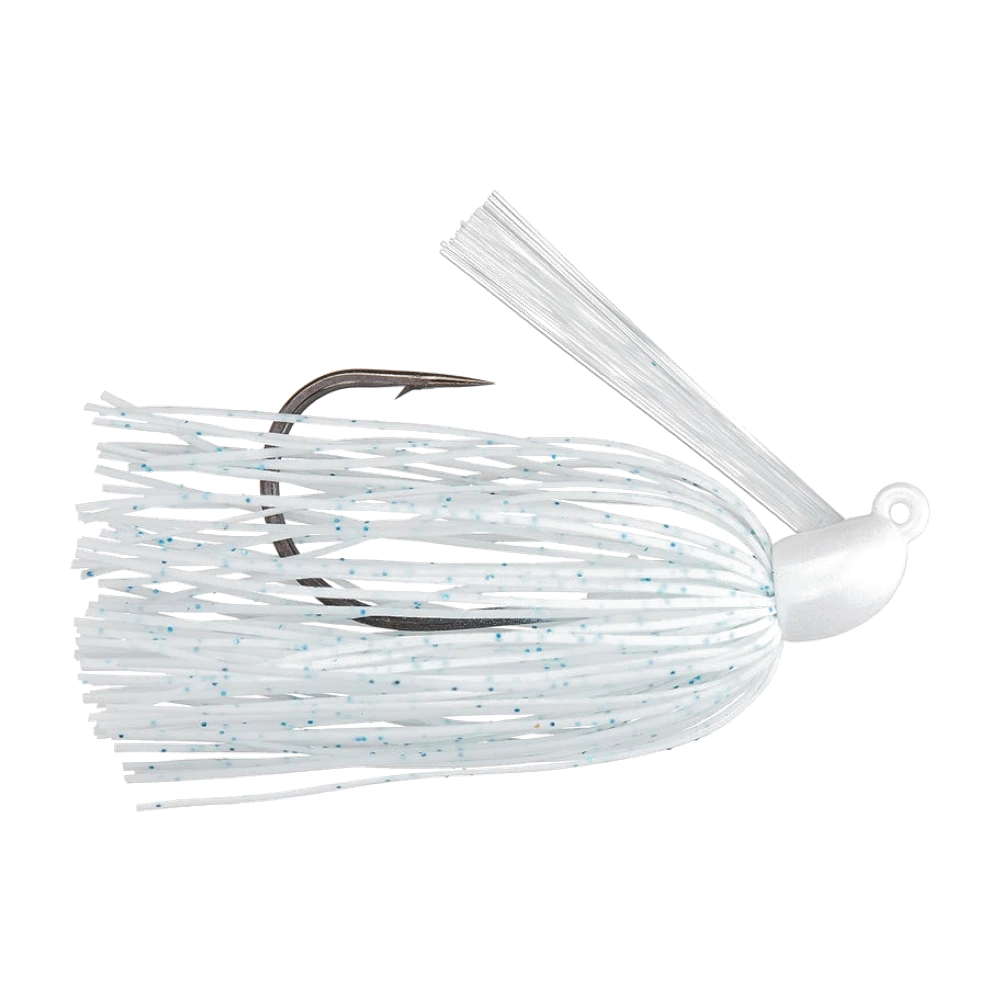
In the product shot the hardware is fully visible: a single hook with an exposed point, and a dense translucent fibre guard standing forward over that point. The head is a rounded cone painted matt white, with the line tie on top. Queen Tackle states a sharp Mustad hook but does not publish the hook size on the source consulted — nor the weight, nor the skirt length. What is described here is therefore an observation from a product photo, not a manufacturer specification.
For line, 0.25-0.35 mm braid and a powerful all-round rod are enough. Anywhere in Europe, if you are fishing a spot where pike move through — and a grass edge is one — add a wire or titanium leader: a white swim jig retrieved mid-depth is exactly what a pike attacks.
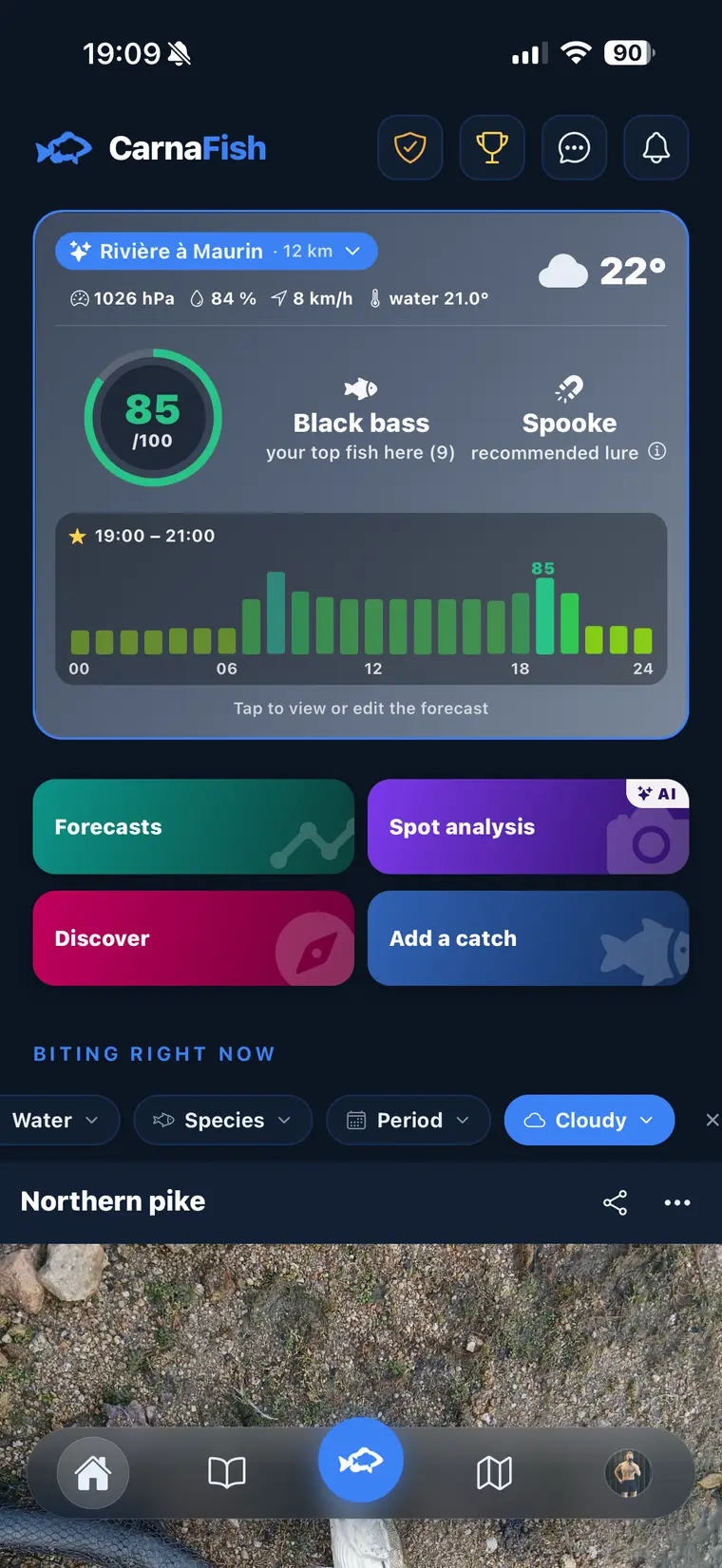
Not sure what to tie on?
Photograph your spot: CarnaFish reads the scene, cross-checks the conditions and gives you the zone, the lure and the retrieve. Free on iOS and Android.
Colour by water and by prey
Queen Tackle advertises lifelike colours without publishing the list on the source consulted. The three families that matter on a swim jig:
- Baitfish, clear to lightly stained water: the blue-flecked white from the photo, imitating a roach or a bleak over a grass bed.
- Crawfish, clear water over hard bottom: green pumpkin, paired with a craw trailer in the same tone.
- Loaded water or heavy cloud: black and blue, which keeps a readable silhouette when visibility drops under a metre.
Where it sits among other swim jigs
Next to a Dirty Jigs Finesse Swim Jig, which is more discreet, or a Booyah Mobster Swim Jig, more conventional in design, the Queen Tackle bets everything on head density. If you fish thick grass, that is a genuine argument. On an open bank a lead swim jig does the same job for less — and the same goes for its stablemate, the Queen Tackle Tungsten Flipping Jig, which targets vertical cover rather than a swimming presentation.
Picking the right jig is pointless if the zone is wrong, and that is where CarnaFish comes in: a photo of the spot, and the app suggests the zone, the depth and the lure family suited to current conditions. For the rest of the fundamentals, our beginner's guide to bass fishing starts from scratch.
Key takeaways
- Head stated at 97% tungsten: for a given weight, a slimmer frontal area that crosses vegetation better.
- The brand compares its profile to a lead jig of the same size; the gain physics actually guarantees is measured at the same weight, not the same size.
- The trailer does half the work: paddle tail to imitate baitfish, craw for a slower, more erratic swim.
- Neither weight nor length is published on this source: read the pack label if you need a precise depth band.
FAQ
How deep does this swim jig run?
Between the surface and around two metres depending on weight and speed, but since the weight is not published on the source consulted, the pack label settles it. Practical rule: the faster you reel with the rod tip high, the higher the jig stays.
What is the difference with a flipping jig?
The head and the job. A swim jig has a streamlined head built to move horizontally, a flipping jig an arched head built to drop straight and settle. Both take a trailer, but they do not fish the same layer or the same kind of spot.
Can you catch pike on a swim jig?
Yes, especially in a white pattern run along a grass edge: that is a path a pike happily intercepts. Add a wire or titanium leader, or you will lose the lure on the first serious bite.
Which trailer should I start with?
A medium paddle-tail swimbait, threaded dead straight on the shank. It is the most forgiving rig: it stabilises the swim, adds a readable vibration and works on most spots. Craw trailers come next, when you want to slow down.
Why does my swim jig spin?
Nine times out of ten the trailer is threaded off-centre and unbalances the whole thing. Pull it off, realign it exactly on the shank axis, and check the tail sits flat. If it persists, slow down: you are fishing past the speed the lure tolerates.
Is tungsten worth the extra cost on a swim jig?
It is worth it if you fish dense grass, where a slimmer head at the same weight changes how many clean retrieves you get. Over open banks or in open water, a lead swim jig does the same job for considerably less.
The full bass lure guideSeason-by-season strategy: which family of lure, when, and why.Go from theory to fish
CarnaFish reads your spot from a photo and gives you the game plan: zone, lure, retrieve. Free on iOS and Android.