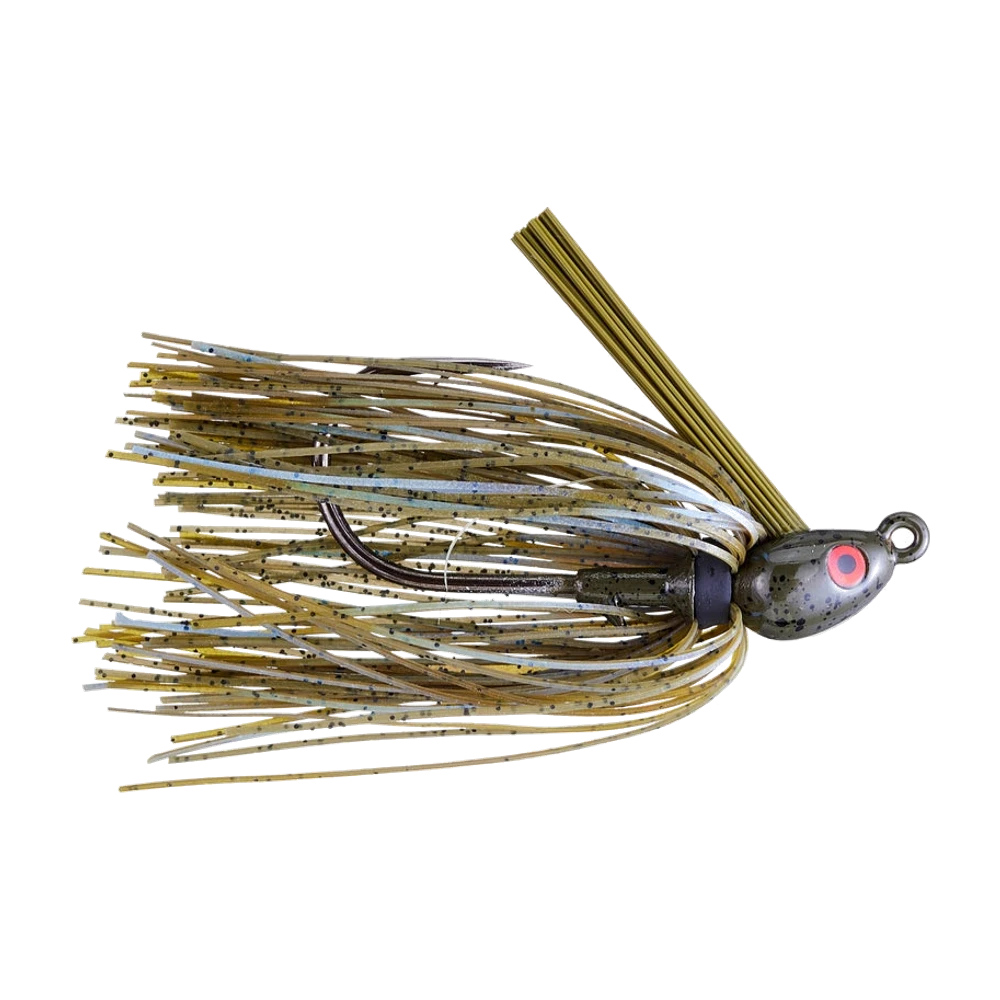
Dirty Jigs No-Jack Swim Jig: a reinforced swim jig for heavy cover
Rather not fish it blind? Photograph your spot — CarnaFish cross-checks the conditions and points you the right way.
A lily pad field in August, barely stained water, and a weed edge running three hundred metres. You cannot fish that with a flipping jig; you would spend the whole day covering twenty metres. What you need is a bait that crosses vegetation at walking pace, keeps a baitfish silhouette, and holds a four-pound bass when it rolls up in the stuff. That is exactly the brief of a swim jig, and the Dirty Jigs No-Jack is the reinforced version of the idea.
A swim jig is not fished like a jig
The confusion is common and it costs blank days. A standard jig works vertically: you drop it, it falls, you lift it. A swim jig works horizontally, on a steady retrieve, a foot or two under the surface or just over a weed bed. It does not replace the jig; it replaces the spinnerbait and the chatterbait when those make too much noise.
Everything follows from the head shape. Dirty Jigs describes a bullet head here, pointed at the front, with a matching fiber weedguard sitting right behind it. Together they form a wedge that parts stems instead of spearing them, and that is what lets you retrieve through vegetation you could never cross with a lipped bait or a bladed one. Against a Molix Compact Blade Jig you lose the vibration that pulls a fish in from a distance, but you gain stealth and the ability to go anywhere.
What the manufacturer spells out
The description leans on three points. The hook first: a Gamakatsu that Dirty Jigs calls the No-Jack and presents as markedly stronger than the hook in their original swim jig. That is the model's whole argument, and it answers a real constraint — a swim jig is set through vegetation, on braid, into a fish already buried in the thick stuff; thin wire opens up.
Then the skirt: fifty strands, so a full skirt giving pronounced bulk rather than a slim silhouette. That is not cosmetic. More bulk slows the swim at equal speed, shows up from further away in coloured water, and imitates a large forage fish better than a sparse skirt.
Finally, under the skirt, a barbed baitkeeper moulded into the lead that locks a soft plastic in place. A swim jig without a properly held trailer means a trailer that slides up the shank on the third cast and a bait that starts spinning.
What the description does not give is the head weight, the overall length or the hook size. No invented numbers here: check the packaging or the retailer listing. As with any swim jig, weight is chosen first from the running depth you want — light to skim the surface and the mats, heavier to swim at a metre and a half along a break.
How to swim it
The retrieve that stays in contact
This is the base presentation, and it is more demanding than it looks. Cast past the zone, rod high, and retrieve at a steady pace just fast enough to keep the skirt flared. The bait should be touching vegetation constantly: stems, pads, a branch. A swim jig swimming through open water in the middle of nothing catches very little.
When the jig hangs on a stem, do not pull slowly to free it. Snap the rod tip: it tears loose and surges forward with a sharp acceleration. That release is the number one trigger on a swim jig, and a lot of fish eat in the second that follows. Fishing weed while deliberately looking for that hang-up is a tactic, not an accident.
Stop and go along hard edges
On a defined edge — a reed wall, a line of docks — alternate three turns of the handle with a one-second pause. During the pause the bait sinks slightly and the skirt collapses, then flares again on the restart. That breathing triggers followers, the fish that track a bait without eating as long as it keeps the same pace.
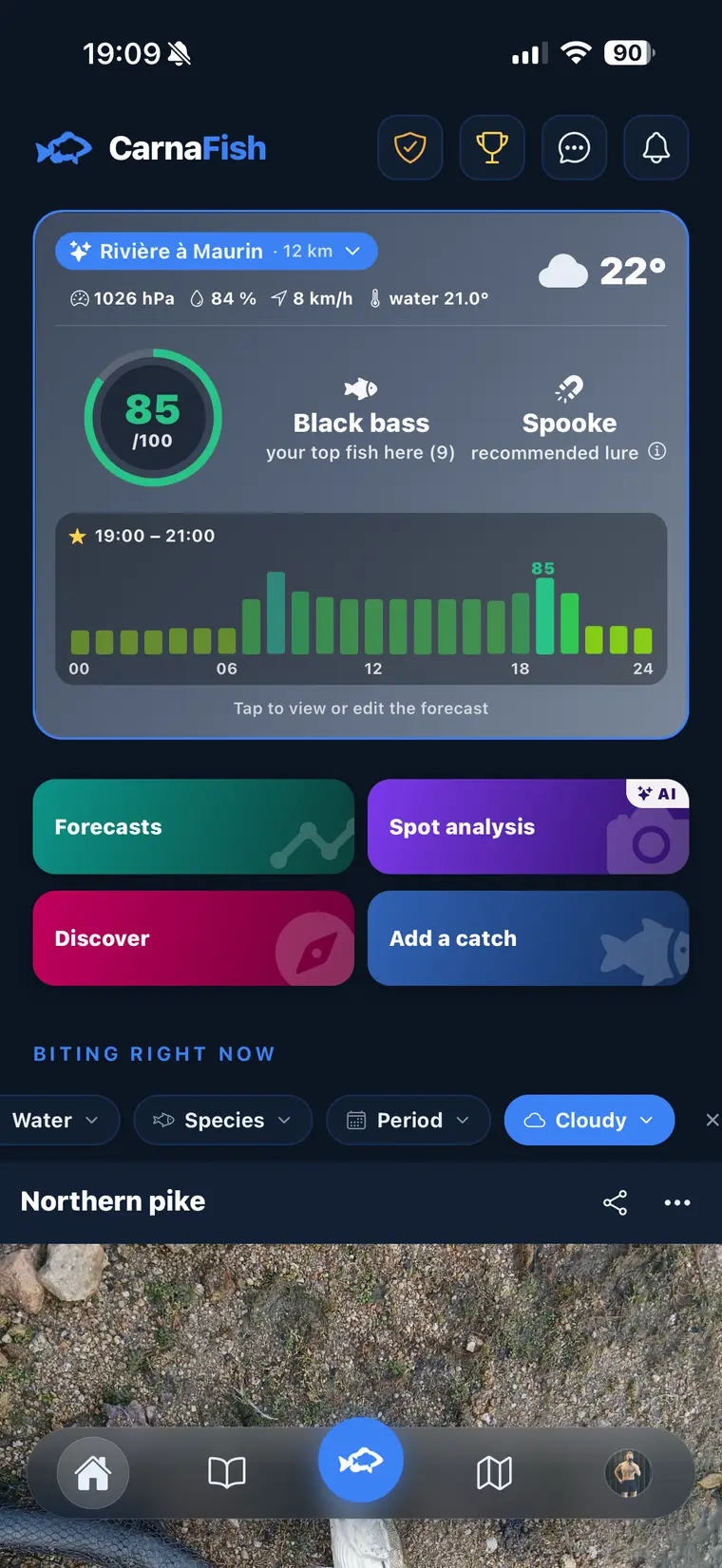
Not sure what to tie on?
Photograph your spot: CarnaFish reads the scene, cross-checks the conditions and gives you the zone, the lure and the retrieve. Free on iOS and Android.
Trailer and leader
The trailer sets both the swim and the speed. A paddle tail shad adds its own vibration and steadies the track — the default choice when fish are on fry. A twin flapping appendage trailer widens the profile and slows the bait, which is better in stained water or on sluggish fish. Either way, thread it on dead straight: a crooked trailer makes the whole jig spin.
For line, 40-50 lb braid is near mandatory as soon as the weed is thick, because you have to winch the fish out without waiting. If you fish water in Europe that holds pike — and a bulky swim jig does attract them — run a thick fluorocarbon or soft titanium leader. A reinforced hook is worthless if the line is cut above it.
The classic mistake
Retrieving too slowly. Out of jig-fishing reflex, many anglers slow down the moment they feel resistance; the swim jig then sinks into the stems and hangs up for good. The opposite is what works: hold a constant speed, even add half a turn as the bait enters the thick stuff. The quieter mistake is neglecting the weedguard — as on any jig, fan the fibers out before fishing.
Colours by water and forage
- Clear water over grass: Bluegill, a green-blue tone matching the small fish that live in vegetation, credible at short range.
- Fish on fry, lightly stained water: White Shad, which reads as a silver silhouette on the move.
- Dirty water or low cloud: Black and Blue, betting on clean contrast rather than a colour actually perceived.
None of this helps if you swim the jig through the wrong grass: the productive beds are the ones edging a depth change, not the ones carpeting a uniform flat. That is exactly what CarnaFish helps you settle — a photo of the bank, and the app suggests the zone, the depth and the kind of presentation that suits the day. For the general method of reading edges, our guide to reading a fishing spot goes further.
Key takeaways
- The bullet head and matching weedguard form a wedge that parts vegetation: that is what makes a straight retrieve in grass possible.
- The No-Jack Gamakatsu hook is stated as stronger than the brand's original swim jig hook, which is the model's reason to exist.
- The 50-strand skirt gives pronounced bulk, useful in coloured water and when fish are on large forage.
- Weight, length and hook size are all absent from the description — check the packaging before ordering.
FAQ
What is the difference between a swim jig and a chatterbait?
A chatterbait carries a blade that generates strong vibration, detectable from a distance, but which stops it crossing dense vegetation. A swim jig is silent and goes anywhere. On pressured water or wary fish, silence is often the advantage.
How deep does it run?
That depends entirely on head weight and retrieve speed, and the description does not state the weight. In practice a swim jig is fished between the surface and two metres: the faster you reel, the higher it stays.
Do I need a trailer on a swim jig?
Yes, almost always. The trailer completes the silhouette, sets the swimming speed and steadies the bait. The barbed keeper moulded into the head exists precisely so it stays put cast after cast.
Is this swim jig suitable for pike?
A bulky swim jig retrieved through grass clearly interests pike in Europe, and the reinforced hook takes the strain. The weak point is not the bait but the line: without a bite-resistant leader you will lose both the jig and the fish.
Why does my swim jig snag constantly?
Two causes in the vast majority of cases: a retrieve that is too slow, letting the bait settle into the stems, and a brand new weedguard still bunched tight. Speed up, and fan the fibers out before you start.
Should I pick this model or a lighter swim jig?
The No-Jack is built for thick cover and big fish. If you fish sparse grass in clear water, a more discreet model like the Booyah Mobster Swim Jig or a finesse swim jig will touch more fish, just smaller ones.
The full bass lure guideSeason-by-season strategy: which family of lure, when, and why.Go from theory to fish
CarnaFish reads your spot from a photo and gives you the game plan: zone, lure, retrieve. Free on iOS and Android.