Jackall Mikey: the big hard swimbait that rolls at low frequency
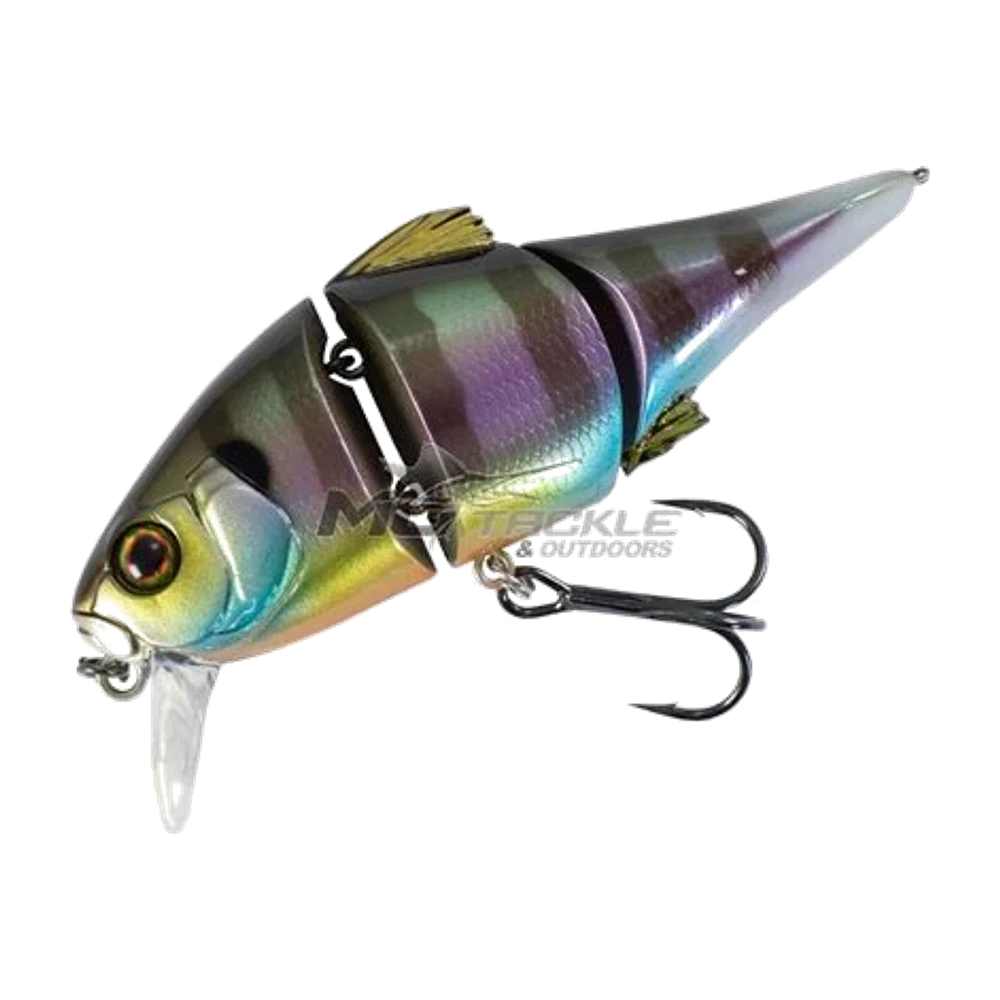
The right lure in the wrong spot still catches nothing. CarnaFish spots the zone that works, from a single photo.
In October, on a large reservoir, adult pike follow the shoals of coarse fish and hold on plateau edges between one and three metres. You can work fifteen centimetre soft swimbaits all day and catch nothing but sixty centimetre fish.
What sorts those fish out is almost never the colour or the subtlety of the presentation. It is the volume of water displaced and how slowly it is displaced. A big pike will not stir for a weak signal, but it also refuses a lure going past too fast.
The Mikey is cut out for that precise point: a hard, jointed, heavy body that rolls widely on its axis at a speed where most lures of that size stop working.
A roll, not a wobble
You have to separate two ways a big lure can move.
Wobble is an oscillation of the head around the vertical axis: it is what a lipped crankbait produces. It creates a fast, fairly high frequency vibration, very effective for calling at medium range.
Roll is a rotation of the body around its long axis. The lure tips from one flank to the other, alternately showing its belly and its back, and produces a slow, broad displacement of water.
The Mikey clearly favours the second. At slow speed the body tips decisively, the joints add sideways travel behind, and the whole thing puts out a low frequency wave that carries a long way, including in coloured water. For a pike sitting five metres away in weed, that signal is detectable well before the lure is visible.
That roll has one consequence for how you fish it: it appears at low speed and disappears if you speed up. Too fast and the body stabilises, the lure runs straight and loses exactly what you bought it for.
The retrieve: slow, and the figure of eight at the bank
- Cast and let the lure sink for one or two seconds depending on the depth you want. Do not start winding before the line is tight.
- A very slow straight retrieve, about half a turn to one turn of the handle per second. You should feel the roll in the handle as a regular sway, not as a vibration.
- Rod at ten o'clock to fish high, pointed at the lure to fish deeper.
- A clean stop every six or seven turns. The lure sinks while holding its posture. That is a classic trigger on a follower.
- Start again immediately after the stop, without speeding up: the slow restart is often the moment of the take.
- At the bank, do a figure of eight. Without lifting the lure out of the water, plunge the rod tip in and describe two or three big figures of eight a metre across, never pausing in the movement.
On the water: the figure of eight is worthless if you make it small and jerky. The radius has to be wide enough for the lure to keep speed through the turns — it is the acceleration out of the bend that commits a following pike. A figure of eight done right at the rod tip, turned limply, misses the fish every time.
The tackle is not optional
A lure of this mass dictates the whole outfit. It is not a preference, it is a question of breakage.
| Item | Usable minimum |
|---|---|
| Rod | 2.10 to 2.40 m, 100 to 200 g, semi-parabolic action |
| Reel | Large casting reel, solid drag, low to medium ratio |
| Braid | 0.40 to 0.55 mm |
| Leader | Wire or titanium 30 cm, or 0.80 mm fluorocarbon |
| Snap | Heavy snap swivel, rated at 30 kg minimum |
Three observations from the bank. A rod that is too stiff pulls the lure out of the fish's mouth on the hookset and multiplies dropped fish with a lure this heavy. A reel ratio that is too high pushes you unconsciously into winding too fast. And an undersized snap is the weak point that lets go: at this lure size, a snap opening is the commonest cause of breakage.
Pack a long pair of pliers and a big net as well: the large trebles of a hard swimbait in the mouth of a ninety centimetre pike are not something you handle bare-handed.
Not sure what to tie on?
Photograph your spot: CarnaFish reads the scene, cross-checks the conditions and gives you the zone, the lure and the retrieve. Free on iOS and Android.
Where it excels, where it is off the point
Its window is clear: late summer through to the close of the season, on adult pike, along plateaux, sharp drop-offs, the edges of large weed beds and river mouths. It works well in choppy water and under cloud, where its low frequency signal beats the visual.
In the smaller version it can also target big bass on waters holding good fish — but that is selective fishing, not contact fishing.
It is unsuited to very cold, very clear water in midwinter, where a slower and more discreet lure has a large advantage. It is equally unsuited to small shallow waters, where it has no room to work, and to any fishing where you are after numbers: at two or three bites a day, you have to accept the principle.
Mikey or a soft swimbait
The Megabass Magdraft is a one-piece soft swimbait: its action is more discreet, it feels more natural in the mouth, and it casts more easily on everyday tackle. It wins on wary fish in clear water. It loses on water displacement and on resistance to teeth.
The Westin Ricky the Roach plays an intermediate register, with a very realistic profile and a steadier action, leaning towards imitation rather than signal.
The Mikey stands apart from both through its hardness and its weight: it moves more water, it holds its action in wind and waves, and it survives a number of takes no soft lure could match. It is the choice when you accept catching few fish and you are after the biggest ones. At the other end of the brand's catalogue, the Jackall Rerange covers exactly the opposite logic — precision, low volume, tight spots.
Our guide to choosing a pike lure sets out the periods when a big bait beats mid-size lures. And if you are hesitating between a big swimbait and something more reasonable on a margin you are seeing for the first time, CarnaFish analyses a photo of the spot and answers.
Key takeaways
- The lure works through a low frequency roll, and that roll only exists at slow speed.
- A clean stop every six or seven turns of the handle, then a slow restart with no acceleration.
- The figure of eight at the bank has to be wide and continuous, or it is pointless.
- Semi-parabolic rod, 0.40-0.55 mm braid, snap and leader generously sized.
- A selective lure for big autumn pike, not a lure for contact.
FAQ
How fast should you retrieve the Mikey?
Very slowly, between half a turn and one turn of the handle per second. The body roll disappears as soon as you speed up and the lure runs straight: if you can no longer feel the sway in the handle, you are going too fast.
What tackle do you need for a lure of this weight?
A rod of 2.10 to 2.40 m rated 100 to 200 g with a semi-parabolic action, a large casting reel, braid of 0.40 to 0.55 mm, and a wire or 0.80 mm fluorocarbon leader. A rod that is too stiff multiplies dropped fish.
What is the figure of eight technique?
Once you reach the bank or the boat, you plunge the rod tip into the water and describe two or three large figures of eight without stopping the lure. That is when a pike that has followed the whole retrieve commits, especially coming out of a turn.
Do you need a wire leader?
Yes for pike, in soft wire or titanium, thirty centimetres long. Fluorocarbon of 0.80 mm can do in very clear water, but it wears quickly and has to be checked after every fish.
How many bites should you expect in a day?
Few: two or three contacts on a good day, sometimes none. It is a selective lure aimed at adult fish, and you have to accept that rhythm before you tie it on.
Is it any good for bass?
In the smaller version and on waters holding big fish, yes, but only when you are hunting specimens. To catch numbers, a mid-size soft swimbait will pay off far better.
The full pike lure guideSeason-by-season strategy: which family of lure, when, and why.Go from theory to fish
CarnaFish reads your spot from a photo and gives you the game plan: zone, lure, retrieve. Free on iOS and Android.