Jackall Gantarel: the jointed swimbait that mimics a bluegill
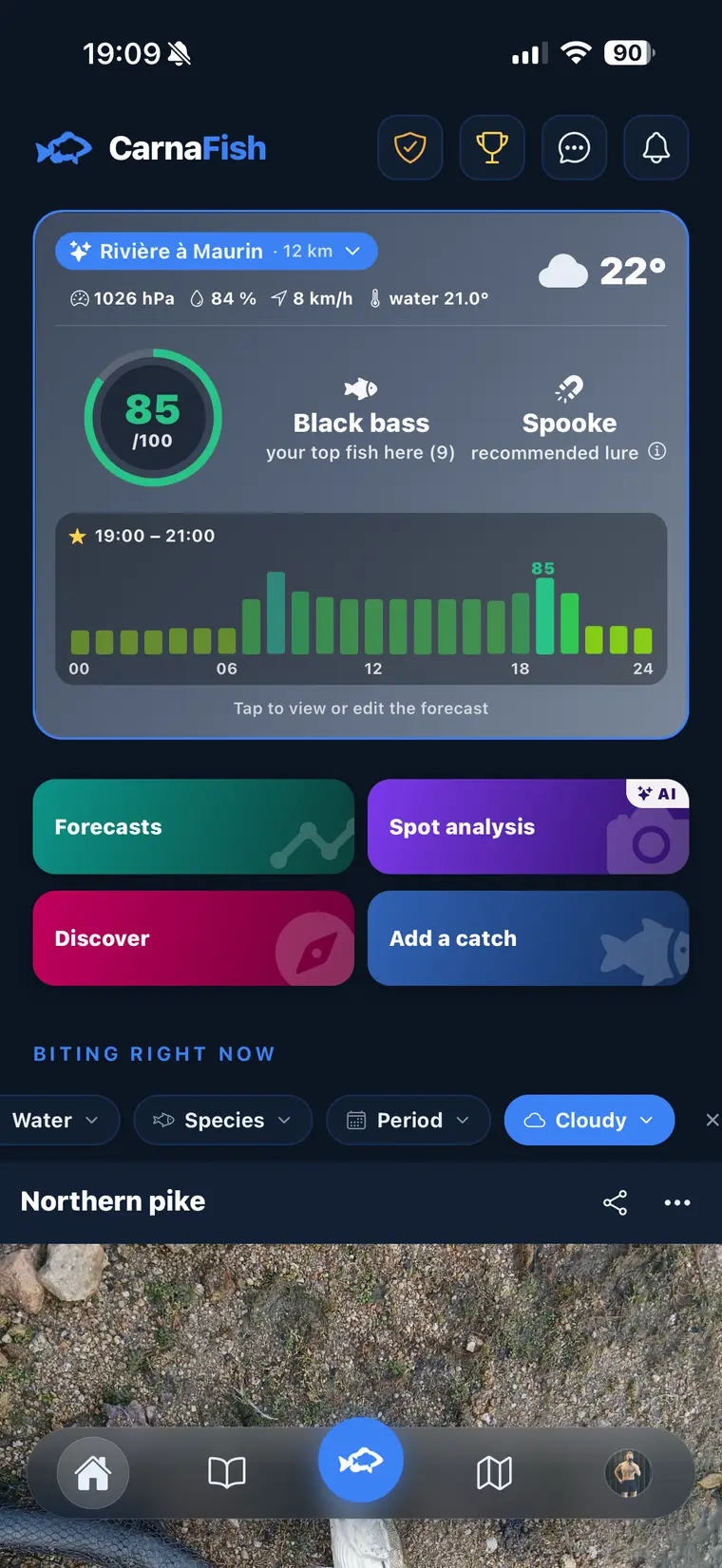
Before tying this one on, it helps to know if the spot actually calls for it. CarnaFish reads the scene from a photo.
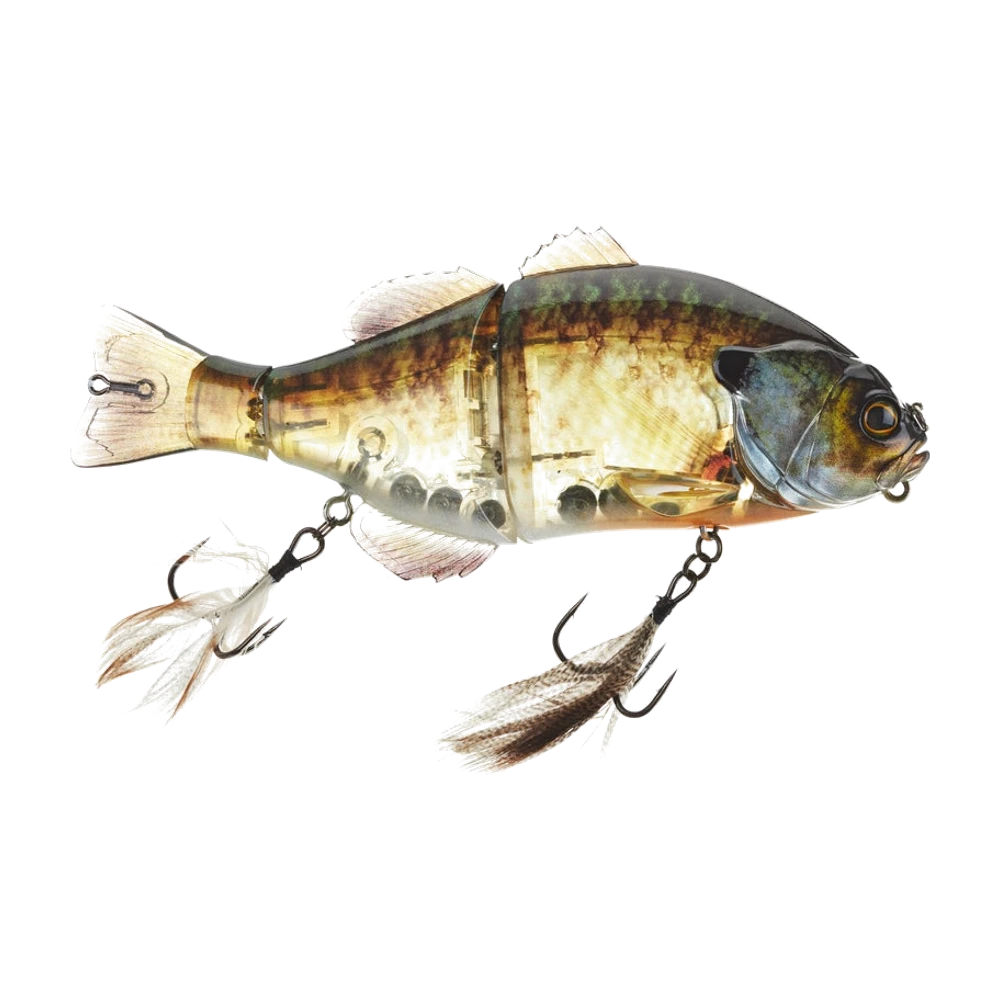
There are summer days when bass simply stop looking at a 10 cm shad. Bluegill crowd the weed edges, the fish gets used to tall, broad prey, and anything slim and silver swims past unnoticed. The Gantarel was drawn for that exact window: a deep-bodied, three-piece body that looks like nothing other than a bluegill loitering in the wrong place. Jackall released it in 2015 around the Bassmasters Classic, and it has never been a search bait — it is a spot tool.
Three segments, two joints, an S-shaped track
The Gantarel measures 15.9 cm / 6-1/4 in for roughly 71 g / 2.5 oz, and those two numbers drive everything else. Two joints split the body into three sections, and that split is what produces the lure's signature path: instead of running straight and rolling on itself like a crankbait, it waves sideways, each segment picking up the previous one's movement a beat later. Seen from above it traces a steady S, exactly what a bluegill does when it cruises without hurrying.
The pectoral fins are molded proud of the body rather than engraved flat: they act as stabilizers and keep the bait from laying over when you speed up. They are also what pulls the Gantarel down — there is no diving lip, and Jackall rates the bait at 0 to 0.9 m / 0-3 ft. In other words your retrieve speed sets the depth within that band, and there is no way to make it work at two metres.
One last design note: the line tie swivels. On a bait that changes direction constantly, a fixed eye twists your line within a few dozen casts; the swivel absorbs that rotation, so you can tie direct without a swiveling snap.
Floating out of the box, sinking if you decide so
Jackall lists the Gantarel as floating. At rest it climbs back toward the surface, and that changes how you work it: every pause costs you depth and brings you closer to the weed ceiling. Over grass topping out at 1 m that is exactly what you want — the bait never buries itself in the mat.
It also carries a chin hanger, designed to take added weight for a slow-sinking presentation. That is a genuine second configuration. Weighted, the Gantarel holds its depth through the pauses instead of rising, which matters on a breakline or along a deep dock when a fish follows a long time before committing. Start with very little lead: too much flattens the segments' wave completely.
The 180-degree turn, the move that triggers
This is the least obvious quality of the bait and the most useful. On a sharp jerk the Gantarel pivots in place and ends up facing you — it turns around almost without moving forward. The classic scenario is the follower: a bass tracks the bait for three metres, sits behind it without ever opening its mouth, and peels off near the boat or the bank.
Instead of speeding up, drop the rod to create slack, snap the tip once, then give line back immediately. The bait spins around and presents itself head-on, stationary, thirty centimetres from the fish's nose. It does not work every other time, but it turns a share of follows into bites — and that is why this bait is fished on sight whenever water clarity allows.
Always keep a metre of slack in your line hand when you see a fish following. Without that slack the jerk drives the bait forward instead of spinning it, and you waste the one move that could have triggered that particular fish.
Where and when to pull it out
The Gantarel is a bank-and-structure bait, not an open-water one. The spots that justify it are the ones where bluegill actually live: weed edges, docks, laydowns, riprap, reed lines. The clearest seasonal window runs from post-spawn to late summer, when bass stay around the spawning flats. A big bass often hits a bluegill out of territorial aggression as much as hunger, and a 16 cm bait crawling a metre off the wood plays straight into that.
In Europe the Gantarel finds a second job its maker never aimed at: pike. A 16 cm jointed bait working between 0 and 1 m along a weed edge ticks every box for a pike strike. If you use it that way, a steel or titanium leader is not negotiable — you do not feed a bait at this price to a set of teeth.
Not sure what to tie on?
Photograph your spot: CarnaFish reads the scene, cross-checks the conditions and gives you the zone, the lure and the retrieve. Free on iOS and Android.
Tackle, rigging and hardware
71 g is not a catalogue detail. You need a swimbait rod, heavy to extra-heavy, built to throw a 2.5 oz bait without punishing the blank or your wrist, plus heavy braid or thick fluorocarbon: at this bait volume, line stealth comes a long way behind the ability to absorb the cast and drive the hooks. Compare that with a soft Megabass Magdraft, which casts on far more ordinary gear.
The Gantarel ships with two swiveling trebles dressed in feathers. The swivel limits the leverage a fish uses to throw the hook; the feathers keep pulsing while the bait sits still, which extends the attraction through pauses. Swap them for bare trebles and you lose that at-rest work — keep the rear hook feathered at the very least.
The tail stinger
An eye is molded into the tail fin to take an extra hook. Do not fit it by default. That third attachment point multiplies snags in vegetation and tangles in the net, and it is only worth it once you log repeated short strikes at the back of the bait. In that case it does convert misses into fish.
The classic mistake
Retrieving too fast. The weight of the bait gives a false impression of resistance, you speed up to feel the swim, and the Gantarel starts tracking straight and loses its wave. The right speed is the one at which you can still see each segment working on its own: when in doubt, slow down to the point where the bait barely seems to move.
Colors by water clarity
Jackall rotates its color runs and the trade names vary between markets, so think in terms of tone families rather than catalogue references.
- Clear water: a bluegill pattern, barred olive back and translucent amber flanks, like the one shown here. That is the register the bait was drawn for, and on a fish that sees a long way, faithful imitation remains the best bet.
- Lightly stained water: a translucent gold or copper finish, which keeps depth of color while catching what little light is available.
- Low light or dark water: a solid dark back. In poor clarity it is the silhouette cut against the sky that works, not the detail of the scales.
A bait this size is not something you cast at random: it asks you to know where the structure is before you even open the bail. That is exactly what CarnaFish does — one photo of the spot, and the AI suggests the zone, the depth and the presentation that suit the day's conditions. To build the groundwork on lure choice and typical lies, our beginner's guide to bass fishing is still the best way in.
Key takeaways
- Three segments, two joints: an S-shaped swim that only holds at slow speed, with the pectoral fins acting as stabilizers and as the diving plane down to 0.9 m.
- Floating out of the box, so it rises on every pause; the chin hanger lets you convert it to slow-sinking and hold the depth band.
- The sharp jerk that spins it 180 degrees is the move to pull out on a fish that follows without biting.
- 71 g for 15.9 cm: a swimbait rod is mandatory, and a steel leader as soon as pike share the spot.
FAQ
Does the Gantarel float or sink?
Jackall rates it floating: at rest it rises toward the surface. A chin hanger is molded underneath to take added weight and produce a slow-sinking version that holds its depth through pauses.
How deep does it run?
0 to 0.9 m / 0-3 ft according to the maker. It has no diving lip: the proud pectoral fins create the dive, so your retrieve speed sets the real depth within that band.
What rod do you need to cast a 71 g bait?
A heavy to extra-heavy swimbait rod rated for 2.5 oz baits and up, in casting. A general-purpose predator rod tires fast and will not let you set the hook firmly at distance with that weight.
What is the tail eye for?
Fitting an optional stinger hook. Only add it if you log repeated short strikes at the back: it improves the hook-up rate but clearly increases snagging in vegetation.
Is the Gantarel any good for pike?
Yes. A 16 cm jointed bait working between 0 and 1 m along a weed edge matches a pike strike well, even though Jackall aims at bass. In that case, run a steel or titanium leader without debate.
How does it differ from a glide bait?
A one-piece glide bait like the Baitsanity Chimera Shad travels in wide lateral sweeps that cover a lot of water. The Gantarel, split into three, stays tighter and waves closer to the spot; it imitates a tall, slow prey rather than a fleeing baitfish. For the same silhouette in a more manageable size, look at the Bucca Baby Bull Gill 3.75.
The full bass lure guideSeason-by-season strategy: which family of lure, when, and why.Go from theory to fish
CarnaFish reads your spot from a photo and gives you the game plan: zone, lure, retrieve. Free on iOS and Android.