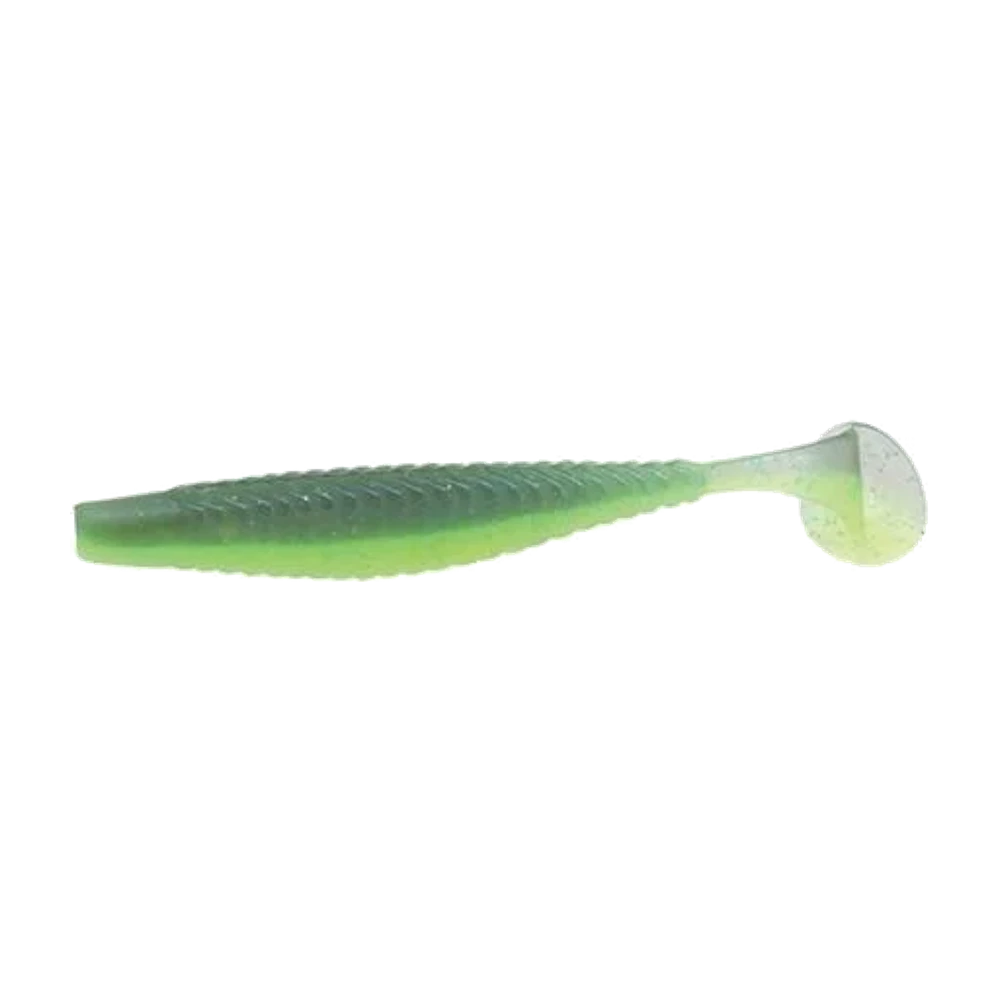
Damiki Armor Shad: the shad that stays horizontal on a vertical drop
Not sure this lure fits YOUR spot today? CarnaFish tells you in 10 seconds, from a photo.
Winter, fifteen metres of water, and a clean mark on the sounder: a group of zander sitting a metre off the bottom, motionless. You drop a shad on a jig head, give it two or three lifts, the marks scatter and then close up again. The fish is there, it can see your lure, and it will not take it.
In those conditions the problem is no longer finding the fish or getting down to the right level. It is that any pronounced vertical movement pushes away a fish that is conserving energy. A fifty-centimetre lift, at 6 °C, represents an effort out of all proportion to the meal you are showing it.
The Armor Shad and the rig that carries the brand's name answer that in a radical way: you drop the lure to the exact level of the fish, it sits perfectly horizontal, and you do nothing more.
A reinforced body to hold its axis
The lure's name is not decoration. The body is moulded with a thickened spine and ribbed flanks, stiffer than on a standard shad of the same size. That stiffness serves one precise purpose and one only: stopping the lure from folding downwards when it hangs still.
An ordinary soft shad on a vertical-eye jig head hangs diagonally, or frankly tail-down, as soon as you stop working it. Seen head-on by a zander sitting at the same depth, that looks like nothing alive.
The Armor Shad, rigged on a horizontal-eye head — a so-called minnow or head-jig, where the tie-in ring comes out on top rather than at the front — stays flat along its axis, head slightly raised, exactly in the posture of a small fish suspended in the water.
A second effect follows from that stiffness: the paddle tail is no longer driven by the body. It works on its own, at very low amplitude, under the micro-movements of the boat and the line. The lure is motionless, but it is not dead.
That detail also explains why the rig tolerates no compromise. Rig the lure even a few degrees off the shank and the whole thing takes on a permanent tilt and turns slowly on the end of the line. Take the time to measure the shank against the flank of the shad before you pierce it, and bring the point out exactly on the dorsal line. Thirty seconds of rigging decides how the lure behaves on the whole drop.
The Damiki rig step by step
- Find a clean mark on the sounder and note its exact depth. Without electronics, this rig loses most of its point.
- Drop on a tight line, counting, and stop fifteen to thirty centimetres above the fish. Never below: a zander comes up, it almost never goes down.
- Lock off and stop moving. The lure must stay in its horizontal plane. Correct only for the boat's drift.
- Hold for thirty to sixty seconds. It feels long, it feels uncomfortable, and that is precisely what makes the technique.
- If nothing comes, lift ten centimetres, then wait again. That tiny upward shift triggers more often than a lift does.
- Set the hook on weight, never on noise. The bite shows up as line that suddenly feels heavy, or as slack line moving sideways.
On the water: when a fish comes up behind the lure without committing, do not drop down towards it to "give it the lure". Lift twenty centimetres, slowly and continuously. A zander that has committed upwards will follow and take; a lure dropping back towards it stops it dead.
Weights and sizes
You choose on depth and drift, not on the size of the fish.
| Depth / drift | Jig head | Shad size |
|---|---|---|
| 4 to 7 m, no drift | 5 to 7 g | 7.5 cm |
| 7 to 12 m, slow drift | 7 to 10 g | 9 to 10 cm |
| 12 to 18 m or windy | 10 to 14 g | 10 to 12.5 cm |
| Perch shoal, 5 to 10 m | 5 to 7 g | 7.5 cm |
The selection rule is simple: take the lightest weight that keeps you vertical. As soon as your line starts to angle away, you lose the lure's horizontal posture, and you lose the whole technique.
For line, use thin braid — 0.08 to 0.12 mm — to limit wind drag and feel the bite, with a metre of 0.22-0.26 mm fluorocarbon leader. No snap: a direct knot to the eye keeps the attitude most stable.
Not sure what to tie on?
Photograph your spot: CarnaFish reads the scene, cross-checks the conditions and gives you the zone, the lure and the retrieve. Free on iOS and Android.
The other use: a slow straight retrieve just off the bottom
Away from vertical work, the Armor Shad behaves very well on a slow straight retrieve with a plain jig head, brought back a few centimetres off the bottom with simple pauses. Its stiffness stops it folding on the drops, and its paddle stays active at low speed.
On the other hand it is not built for three things. Long lifts, where its stiffness becomes a handicap next to a soft shad that folds and restarts. Heavily cluttered water, where the horizontal eye hangs up more. And serious pike strikes, for which neither the size nor the rig is dimensioned.
Armor Shad or a standard soft shad
Against a Keitech Easy Shiner 4, the difference is softness. The Keitech is limp, it undulates along its whole length and it is deadly on a straight retrieve and on gentle lifts — but hung still it droops and loses its profile. The Armor Shad stays straight, and that is exactly why you pick it.
Against a Fox Rage Zander Pro Shad, designed for sawtooth zander work along the bottom, the contrast is about technique more than about the lure: the Pro Shad is made to be worked, the Armor Shad to be held. On zander pinned to the bottom and feeding, take the first; on zander sitting off the bottom and apathetic, the second.
The principle of the jig head and how to set it up are covered in our jig head rigging page, and the seasonal windows in the guide to lure fishing for zander. And if you are unsure what weight to fit for the day's drift, CarnaFish analyses a photo of the spot and answers.
Key takeaways
- Reinforced body: the lure stays horizontal at rest, which a soft shad does not.
- Rigged on a horizontal-eye head, it is fished motionless in front of a fish you have located.
- Always fifteen to thirty centimetres above the mark, never below.
- The lightest weight that holds vertical: the moment the line angles away, the technique collapses.
- Also effective on a slow straight retrieve, useless on long lifts.
FAQ
What is the Damiki rig?
It is a vertical presentation on a horizontal-eye jig head: the shad stays flat and you hold it still just above a fish marked on the sounder, without working it. It takes its name from the brand and from this shad in particular.
Do I need a sounder to use this technique?
In practice, yes. The whole point is to place the lure a few dozen centimetres above an identified fish. Without electronics you can still fish the Armor Shad on a slow straight retrieve, but you lose what makes it special.
What jig head weight should I choose?
5 to 7 g between four and seven metres, 7 to 10 g down to twelve metres, and 10 to 14 g beyond that or in wind. Always pick the lightest weight that keeps your line perfectly vertical.
How long should I hold the lure still?
Thirty to sixty seconds per presentation, then a ten-centimetre lift before starting again. In cold water it is that prolonged stillness that triggers, not the animation.
Is the Armor Shad any good for perch?
Yes, in the small sizes on a 5 to 7 g head, above a shoal marked between five and ten metres. Perch readily rise to a lure held slightly above them.
Can it be fished on a standard straight retrieve?
Yes, on an ordinary jig head, retrieved slowly a few centimetres off the bottom with pauses. Avoid long lifts, though: its stiffness makes it less expressive than a soft shad on that kind of animation.
The full zander lure guideSeason-by-season strategy: which family of lure, when, and why.Go from theory to fish
CarnaFish reads your spot from a photo and gives you the game plan: zone, lure, retrieve. Free on iOS and Android.