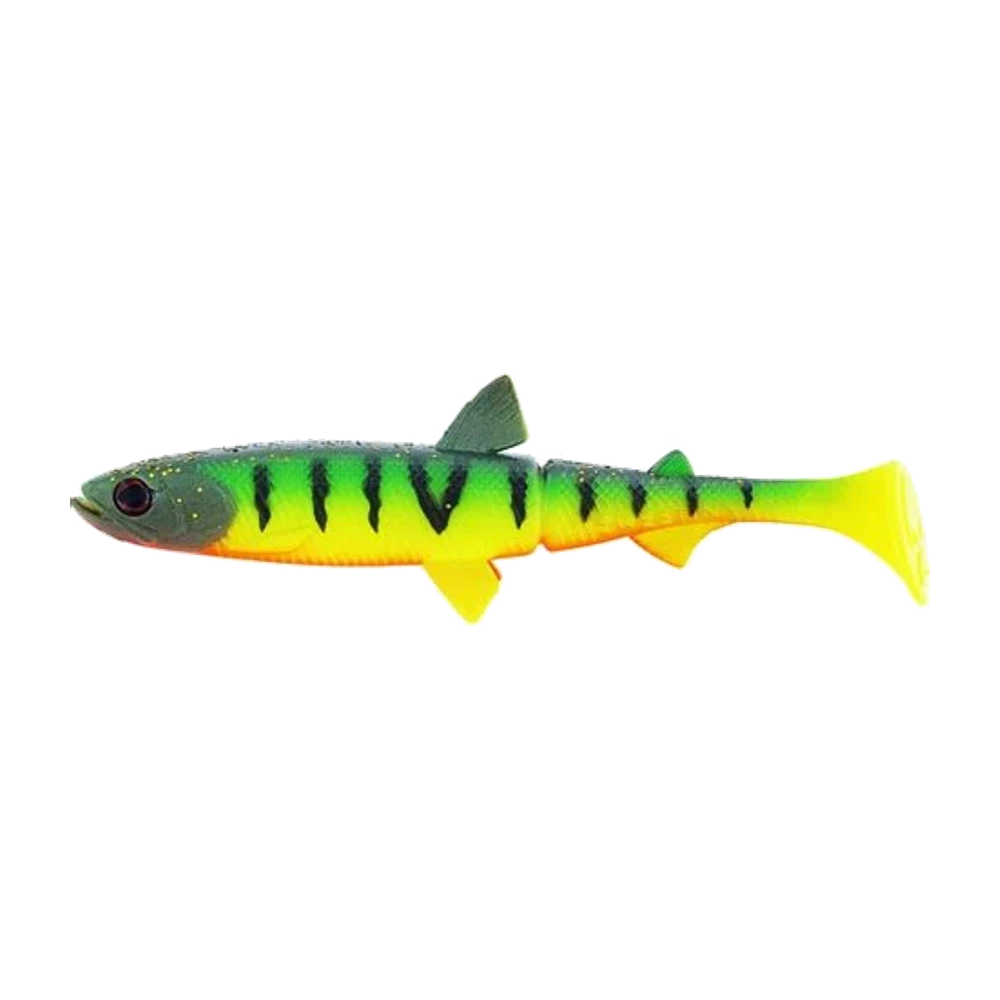
Westin HypoTeez: the shad that works on the way down
This lure shines under specific conditions. CarnaFish tells you in 10 seconds if today is one of them.
Fishing vertically, most anglers focus on the lift. You raise, you drop back, you repeat. And yet, if you watch a sounder recording in slow motion, you will see that zander almost never move while the lure is rising. They lift off as the lure comes back down, and they take it just before it reaches the bottom.
The conclusion is easy to state and hard to apply: the useful phase of the presentation is the fall, not the pull. But the lure still has to be doing something during that fall. A slim shad on a bullet head drops like a stone, straight and silent; there is nothing to look at during the two seconds that matter.
The HypoTeez is designed for the opposite. Its deep body, with plenty of lateral surface, gets purchase on the water as it descends: instead of dropping straight, it slides off to one side, rights itself, and slides off the other way. The lure takes longer to reach the bottom, and it fills that time.
A deep body, and why it changes the fall
Westin's Teez family covers several profiles, and they are not interchangeable. The parameter that decides everything here is the ratio of body depth to body length.
A slender body presents a small vertical section: it cuts the water, sinks fast, and the tail only comes alive once horizontal movement has started. A deep body presents a large surface to the upward flow during the fall. Three effects:
- A descent speed cut by roughly a third for the same weight. Over 6 m of water you gain one to two seconds of presentation per cycle. Multiplied across a day, that is enormous.
- Involuntary lateral movement. The lure does not drop back on its axis: it drifts twenty to forty centimetres to the side. That unpredictable path is precisely what lifts a settled fish off the bottom.
- A paddle that starts immediately. The broad flank stabilises the rear, so the tail kicks in from the first centimetres of movement, with none of the usual dead time.
In exchange, that body also brakes on a straight retrieve: the HypoTeez pulls harder on the rod than a slim shad, and it rises faster through the water column if you speed up. This is not a lure to wind in quickly.
The vertical presentation, step by step
- Drop on a controlled slack line until you touch bottom, thumb on the spool. Note the depth.
- Lift just twenty centimetres and let the lure settle for two seconds. Plenty of bites come on that simple lift-off, before any retrieve at all.
- One long, slow pull of sixty to eighty centimetres, rod from 9 to 11 o'clock. Not a sharp jerk: a continuous movement that lets the paddle work all the way up.
- Lower the rod, tracking the line, without giving it slack. This is the key phase: you should feel the weight of the lure fade away gradually, never abruptly. Count two to three seconds.
- Touch bottom, wait three seconds, and start again.
On a slow drift over a deep flat, the same sequence works with the rhythm shifted: the drift adds a horizontal component that lengthens the glide further still.
On the water: during the descent, keep the line slightly tight but never taut. Hold it taut and the lure pendulums back towards you and the sideways glide disappears. Give it too much slack and you stop feeling the bite — and on this lure, a bite on the drop shows up as a simple absence of contact at the expected moment, not as a knock.
Weights and depths
Weight is chosen by the fall speed you want, not by depth alone. In pure vertical fishing, aim for a descent of two to three seconds per metre over the last few metres.
| Depth | Recommended size | Jig head | Context |
|---|---|---|---|
| 4 to 6 m | 9 to 10 cm | 12 to 15 g | Gravel pit flats, edges of holes |
| 6 to 9 m | 10 to 12 cm | 15 to 21 g | Slopes, drop-offs, anchored vertical |
| 9 to 12 m | 12 cm | 21 to 28 g | River holes, slow drift |
| Over 12 m or in current | 12 to 14 cm | 28 to 35 g | Big lakes, reservoirs, deep winter |
Use a bullet head with an in-line eye to keep the axis in the vertical, and a stinger mounted on the side, a third of the way along the body: on a lure that glides as it drops, bites often come in sideways and the main hook stays in empty water.
For line, fine braid — 0.10 to 0.13 mm — to limit water drag over the whole depth, and a metre of 0.30 to 0.35 mm fluorocarbon leader.
Not sure what to tie on?
Photograph your spot: CarnaFish reads the scene, cross-checks the conditions and gives you the zone, the lure and the retrieve. Free on iOS and Android.
Its window, and what it does not do
It is built for cold, deep water. From November to March, when zander sit on a drop-off and have no appetite for chasing anything, a lure that stays in front of them at constant depth for a long time beats a fast one. It is also very good on fish glued to the bottom, the ones that show as a thick line rather than as clean arches.
It is poorly suited, on the other hand, to searching horizontally from the bank: wound in straight, it rises too fast through the water column and its deep body cuts casting distance. In shallow water, under 3 m, the whole point of the glide disappears because the fall is too short. And in strong current it starts gliding uncontrollably and you lose your vertical.
HypoTeez, Shad Teez or Shad Teez Slim
The three look alike from a distance and answer different questions.
The Westin Shad Teez is the all-rounder of the family: balanced body, definite paddle, it handles a straight retrieve from the bank as well as classic lift-and-drop. It is the one you take if you only take one.
The Westin Shad Teez Slim goes the other way: slim profile, fast fall, discreet signal. It excels in clear water on wary fish and when you need to reach the bottom fast, in current or in wind.
The HypoTeez occupies the third slot, the one about presentation time. You bring it out when the water is deep, the water is cold, the fish are settled, and you need something to happen during those two seconds of fall. In practice: Slim to get down fast, Shad Teez to cover, HypoTeez to keep at it.
Our beginner's guide to lure fishing for zander sets out how to identify the deep spots that justify vertical fishing. And if you are unsure what weight to use over a drop-off, CarnaFish analyses a photo of the spot and answers.
Key takeaways
- The deep body slows the fall by about a third and makes it drift sideways: that is where everything happens.
- The paddle starts from the first centimetres of movement, with no dead time.
- A long slow pull, then a tracked descent on a semi-tight line for two to three seconds.
- Bullet head plus side stinger: on a lure that glides, bites come in sideways.
- A cold-water, deep-water lure. Useless under 3 m, on a fast retrieve or in strong current.
FAQ
What is the difference between the HypoTeez and the Shad Teez?
The Shad Teez is the all-round shad of the range, balanced for straight retrieves as well as lift-and-drop. The HypoTeez has a deeper body that slows the descent and makes it drift sideways: it is built for slow vertical work in deep water, not for covering ground.
Should it only be fished from a boat?
That is where it is at its best, because vertical fishing makes full use of the glide. From the bank it remains usable over an accessible hole or from a bridge, but its deep body limits casting distance and makes it rise as soon as you speed up.
What jig head weight should you choose?
Aim for a descent speed of two to three seconds per metre. In practice, 12 to 15 g between 4 and 6 m, 15 to 21 g between 6 and 9 m, and up to 35 g beyond 12 m or on a drift.
How do you detect a bite on the drop?
It almost never shows up as a knock. Most often the weight of the lure disappears earlier than expected, or the line stops descending before the bottom is reached. Strike at the slightest doubt rather than waiting for confirmation.
Is a stinger necessary?
Strongly recommended, mounted on the side a third of the way along the body. Because the lure glides sideways during the fall, some attacks come in crossways and the main hook does not connect. With pike around, it becomes essential.
Does it work in rivers?
In holes with moderate current, yes, playing the slow drift. As soon as the current picks up, the deep body leans on it, the lure swings off at an angle and you lose your vertical: a slimmer profile is then preferable.
The full zander lure guideSeason-by-season strategy: which family of lure, when, and why.Go from theory to fish
CarnaFish reads your spot from a photo and gives you the game plan: zone, lure, retrieve. Free on iOS and Android.