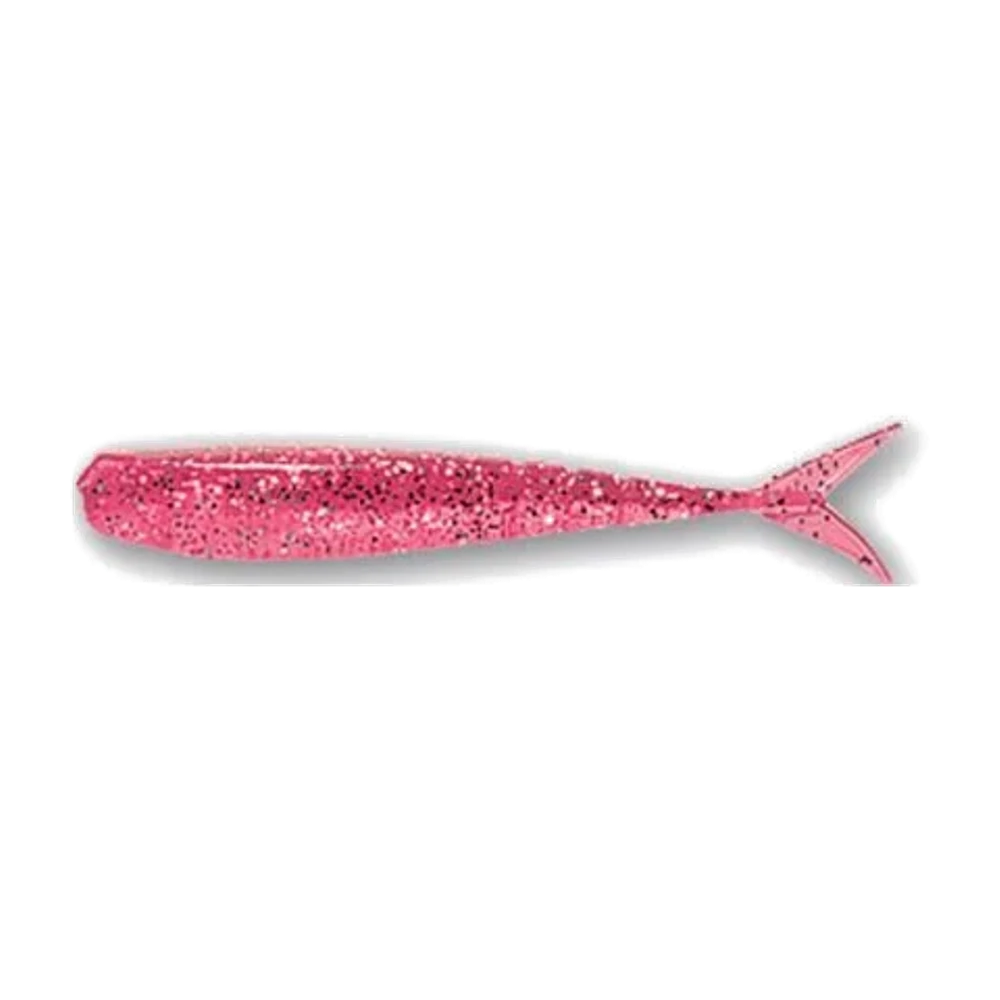
Delalande Drop Shad: the soft plastic that vibrates while your rod stays still
One lure, endless conditions. CarnaFish reads your spot from a photo so you are not just guessing.
There comes a moment in a finesse session when you stop working the lure. You have found the fish on the sounder, or watched it refuse three passes, and you decide to leave the lure where it is, forty centimetres off the bottom, doing nothing. That moment is the most productive of the day — on one condition: that the lure itself keeps moving.
That is precisely what separates a good finesse lure from a bad one. Plenty of soft shads become inert lumps of plastic the second the rod stops. Others need almost nothing: the tremble of your hand on the grip, a breath of wind on the slack line, half a knot of current.
The Drop Shad is designed around that requirement. Everything in its geometry serves to convert a micro-movement of line into a visible signal.
Three shape details that do everything
A thin, wide tail. The tail is not a rigid paddle: it is a slim blade, barely thick but with enough surface area to grip the water. That combination gives it a high vibration frequency for a minuscule driving force. It is what lets the lure quiver when nothing is pushing it.
A slim body with a tall section. Seen from above it is narrow — so discreet. Seen from the side it is tall — so readable. On wary fish in clear water, that asymmetry is exactly what you want: a silhouette identifiable as a fish, but which never suggests any real bulk.
A balanced distribution of material. The body is slightly thicker along the back than along the belly, which settles the lure horizontally when it is simply suspended on a leader. A poorly balanced soft plastic, in the same situation, hangs crooked with its head lower than its tail. A zander that sees that refuses it.
The compound, finally, is deliberately soft. That limits durability — this kind of lure does not survive twenty fish — but it is the direct price of its responsiveness.
The rig: see the drop shot page, but hook it properly
The rig itself is covered in our page on the drop shot rig: dropper length, distance to the weight, choice of knot. No need to repeat it here. Two points, though, are specific to this lure.
Where you hook it. Three options, which do not give you the same lure:
| Hooking | Behaviour | When to use it |
|---|---|---|
| Through the nose, 4-5 mm in | Perfectly horizontal body, maximum vibration | Default, in 80% of cases |
| Through the back, just behind the head | The lure hangs slightly head-up, more action on the pull | Fish that follow and refuse when it is still |
| Texas style through the belly | Clears branches and weed | Only in cluttered ground, at a cost in sensitivity |
Hook size. A 1 to 2/0 single depending on lure size. Going too big stiffens the front of the lure and kills part of the quiver — the commonest and most invisible mistake, because the lure looks perfectly normal out of the water.
On the water: on a drop shot, do not try to work the lure — work the line. Keep the weight resting on the bottom and make the line vibrate between the rod tip and the water by tapping the blank with a finger. The lure quivers on the spot without moving a centimetre, and that is what decides motionless zander sitting at the foot of a drop-off.
The retrieve, step by step
- Drop vertically or make a short cast, and wait for the weight to settle properly. The line should go slack for a second.
- Tighten until you feel the weight, without lifting it. The lure is now horizontal, square to the line, in the layer you have chosen.
- Tap the blank three to five times with a fingertip, or make the rod tip quiver over two centimetres of travel. The lure vibrates, the weight does not move.
- Stop completely for ten to twenty seconds. It feels long, and that is when most bites come on passive fish.
- Move the weight thirty centimetres with a gentle pull, then start again. A spot is fished in eight or ten stations, not three.
On feeding perch you can speed things up: two or three twenty-centimetre pulls, a five-second pause, and off again. On winter zander, never cut the pauses below fifteen seconds.
Which size for which species
- 5 to 6 cm: perch, all year round, and zander in very clear water or under pressure. This is the all-round size.
- 7 cm: the sweet spot for zander. Enough silhouette to be seen in stained water, slim enough not to spook.
- 8 to 9 cm: zander in murky water, at night, or when good-sized coarse fish dominate the diet. Keep it for deep spots.
In cold water, drop a size rather than slowing down further: a smaller lure worked normally goes over better than an oversized one crawled along.
Not sure what to tie on?
Photograph your spot: CarnaFish reads the scene, cross-checks the conditions and gives you the zone, the lure and the retrieve. Free on iOS and Android.
Where it excels, and where it has no business
Its conditions:
- Clear to lightly stained water, between 2 and 8 m, over hard or semi-hard bottom.
- Located fish — on the sounder, on sight, or after registering a bite. This is not a searching lure.
- Vertical spots: bridge piers, rock revetments, gravel-pit drop-offs, canal quays.
- Difficult periods: cold water, a weather front, fish refusing everything else.
Its limits:
- Steady current. The drop shot rig loses its geometry as soon as the line takes side pressure, and the lure swings off downstream.
- Covering large areas. Far too slow. To sweep water, a shad on a jig head covers ten times the ground.
- Pike. Nothing technically stops a bite, but thin line and a single hook are not made for it, and you will lose the lure.
- Very cluttered ground outside a Texas rig, where snags cancel out the benefit of finesse.
Drop Shad or a paddle-tail shad
A paddle-tail shad, like most searching models, needs to move forward to live. It is excellent on a straight retrieve with a jig head, where it generates a strong vibration and carries far. At rest, it does nothing.
The Drop Shad goes the opposite way: little signal while moving, plenty of signal at a standstill. They are complementary tools, not competitors. A typical day consists of searching with a paddle-tail, then coming back with the Drop Shad over the zones where you had contact without converting.
Within the same brand, the Delalande Sandra 12 occupies yet another register with its long flat curl tail: more bulk, more water displaced, for more active fish or dirtier water. Our guide to lure fishing for perch sets out when to switch from one to the other. And if you are unsure what dropper length to tie when you reach the bank, CarnaFish analyses a photo of the spot and answers.
Key takeaways
- Thin, wide tail: it quivers under micro-movements without the lure moving forward.
- Narrow head-on and tall in profile: discreet from above, readable from the side.
- Hook through the nose over 4-5 mm by default; an oversized hook kills the vibration.
- Work the line, not the lure, and leave ten to twenty second pauses on passive fish.
- Wrong tool for steady current, fast searching and pike.
FAQ
What size Drop Shad should I pick for zander?
The 7 cm covers most situations: enough silhouette to be spotted in lightly stained water, slim enough not to worry a wary fish. Move up to 8 or 9 cm at night or in murky water, and drop back to 5-6 cm on heavily pressured fish.
How do I hook the lure on a drop shot?
Through the nose, over four to five millimetres, with a 1 to 2/0 single hook. The lure then stays perfectly horizontal and vibrates at its maximum. Hooking through the back is reserved for fish that follow without attacking when the lure is still.
Can it be fished on a jig head?
Yes, but that is not its best use. Its thin tail generates little vibration on a straight retrieve; a paddle-tail will search more effectively. Keep the Drop Shad for slow, static presentations.
Why does my lure hang crooked?
Either the hook is a few millimetres off centre, or it is too big for the size of the lure. Either way the body no longer holds horizontal, and a zander sitting in front of it refuses the presentation.
Does it work in cold water?
Very well — that is its best period. Below 8 °C, stretch the pauses beyond fifteen seconds and drop a lure size rather than trying to work it even more slowly.
Does it hold in current?
Poorly. As soon as the current pushes on the line, the drop shot rig loses its geometry and the lure swings off downstream instead of staying square. On a current spot you are better off switching to a jig head matched to the flow.
The full perch lure guideSeason-by-season strategy: which family of lure, when, and why.Go from theory to fish
CarnaFish reads your spot from a photo and gives you the game plan: zone, lure, retrieve. Free on iOS and Android.