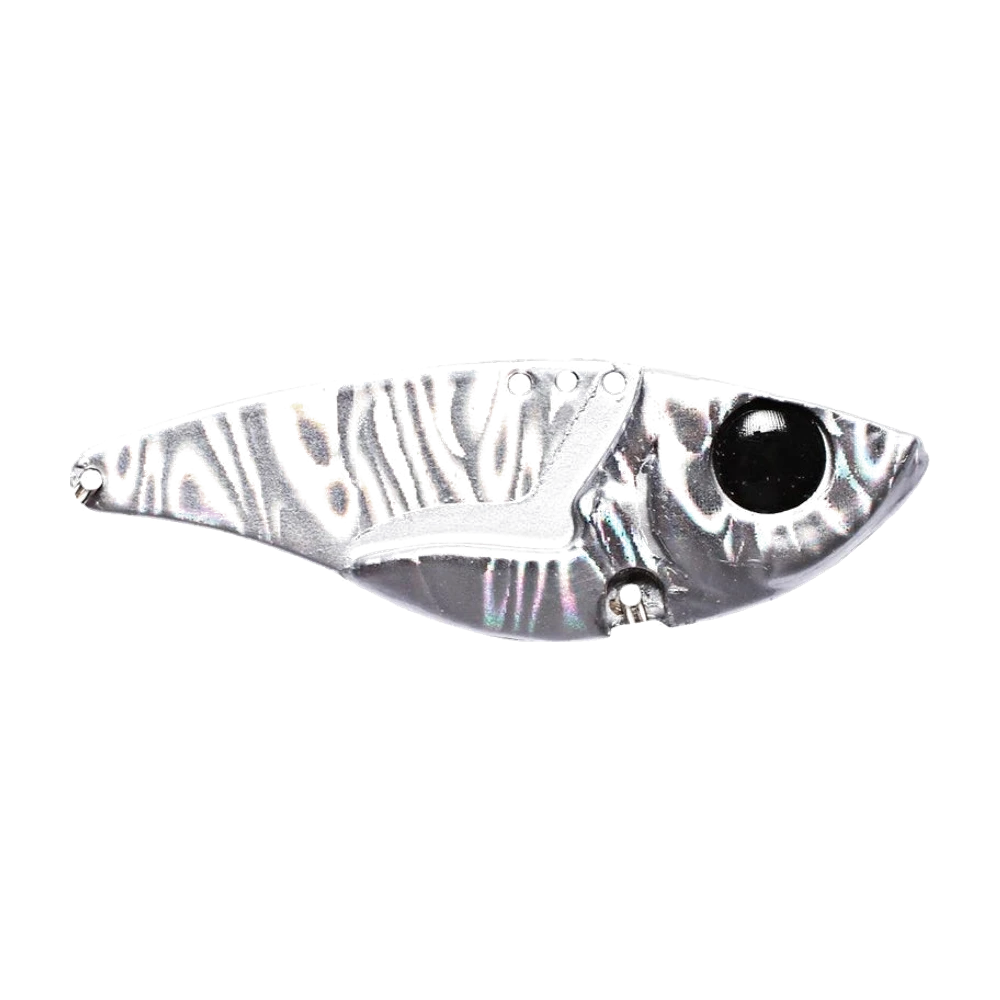
Damiki Vault: the blade bait with three line-tie holes
One lure, endless conditions. CarnaFish reads your spot from a photo so you are not just guessing.
December, ten metres of water, the sonar showing a ball of baitfish two metres off the bottom and heavier echoes pinned underneath it. At that time of year no soft plastic sinks fast enough or puts out enough signal to shake a fish out of its torpor. This is blade bait territory, exclusively, and the Damiki Vault arrives with an argument most of its rivals do not have: three tie points instead of one.
Four sizes, all sinking
Damiki publishes a complete table, which is rare enough on this type of bait to be worth noting. The Vault 42 measures 1.65 in, or 4.2 cm, for 1/4 oz, roughly 7 g. The Vault 49 runs 1.93 in, or 4.9 cm, for 3/8 oz, roughly 10.6 g. The Vault 55 steps up to 2.15 in, or 5.5 cm, for 1/2 oz, roughly 14.2 g. Finally the Vault 65 reaches 2.60 in, or 6.5 cm, for 3/4 oz, roughly 21.3 g. All four are listed as sinking by the manufacturer, which is no surprise on a solid metal blade.
Those numbers deserve a moment, because the weight-to-length ratio of a blade bait has nothing in common with a conventional hard bait. A 5.5 cm Vault 55 weighs 14 g: at the same length a plastic crankbait weighs three times less. That is exactly the point — a fast vertical drop that lets you fish under the boat in ten or fifteen metres without being swept off by current or drift.
For all-round use in Europe, the 49 and the 55 cover the bulk of it: perch and average zander for the first, zander and bass for the second. The 42 becomes interesting for very fine winter perch work in under five metres, the 65 on big deep lakes or in strong current.
The three tie holes, the real story
This is what sets the Vault apart, and the documentation is explicit about it: the back of the bait carries three holes that let you vary the pull point. The rule Damiki gives is simple and verifiable by hand in thirty centimetres of water — the closer to the head you tie, the wider the wobble; the further back you go, the tighter the vibration.
The maker states that this adjustment serves both to choose the type of vibration and to influence fishing depth. It does not specify which hole corresponds to which depth, and I am not going to fill that blank with a guess: run the test on your own water, bait in the water, rod high, counting the drop from each hole.
In practice, here is how you use it. A wide wobble, front hole, gives a loud and highly visible bait, useful in stained water, on active fish, or when you want to pull a zander up from deeper. A tight vibration, rear hole, gives a finer and more regular signal that works better in very clear water and on wary fish in mid-winter.
Fit a small round snap rather than tying direct. You switch holes in ten seconds instead of retying a knot with frozen fingers, and it is the only way to genuinely test all three settings in one session. Without a snap, nobody ever changes hole — and the whole point of the bait goes out the window.
Working it in cold water
The maker positions the Vault squarely on cold-water fishing, ripping through schools of baitfish. That is indeed where the blade bait beats every other family, between 4 and 10 °C.
The core cadence is the vertical lift. Lower the bait on a controlled line until it hits bottom, take up the slack, then pull it firmly 30 to 60 cm with a sharp flick of the wrist, and follow it back down keeping light contact. The vibration happens on the way up; the bite almost always comes on the way down. If you let the line go completely slack you will never feel it — you will simply lift a bait that feels oddly light.
The cast-and-drag version
From the bank or over a shallow flat, the Vault also fishes on the cast. Let it touch bottom, lift the blade 50 cm with a sideways rod stroke, let it fall back on a semi-slack line, take up the slack, and repeat. This version covers more water than the vertical approach and works very well on schooling autumn perch.
The classic mistake
Pulling too hard and too high. A blade bait lifted a full metre rises above the useful zone, spins out and wraps the leader around the body. The correct stroke is short, sharp, wrist only, with the rod tip coming straight back to follow the drop. You should feel the vibration start in the first ten centimetres of the lift, not halfway through.
Not sure what to tie on?
Photograph your spot: CarnaFish reads the scene, cross-checks the conditions and gives you the zone, the lure and the retrieve. Free on iOS and Android.
Hooks and leader
Damiki fits the Vault with its Viper hooks, described as super sharp. On the sample photographed the split rings are in place but no trebles are fitted — that is a catalogue shot, not an indication that the bait ships unarmed.
The real thing to watch on a blade bait is line twist. The bait rotates on itself during the drop, and without precautions your fluorocarbon ends up coiled like a spring within ten minutes. Two fixes: a rolling swivel 40 cm above the bait, or shorter lifts that limit free rotation. The second is preferable in finesse work, because a swivel adds a failure point and a visible mass.
For the leader, fluorocarbon in 24 to 30/100 suits most uses. If you are fishing a spot that holds pike, switch to wire without hesitation: a blade bait is exactly the kind of flashing silhouette that invites bite-offs.
To place the Vault among the available blades, the 6th Sense Slice plays on a longer profile and the Berkley Thin Fisher on a very thin blade. If you want the same fishing with a hollow body instead of a blade, the Duo Realis Vibration 62 covers the lipless register with a slower fall.
Colour by water
- Clear cold water: holographic silver, the finish on the sample photographed. The dark striping breaks up the reflection and avoids a pure mirror effect, which is too aggressive for a wary zander.
- Cold water, low light: pearl white. Under surface ice or a low grey sky, this is the tone that keeps the most perceived contrast viewed from below.
- Stained water: a dark or gold tone. In poor visibility the fish comes to the vibration first; colour only confirms the target in the final metre, and clear contrast does that job better than flash.
Of course you still have to drop the blade on the right break, because in winter the fish occupy a tiny fraction of the lake. That is exactly what CarnaFish helps you frame: a photo of the spot, and the app suggests the zone and the type of presentation suited to the conditions. To build a proper method around zander, our beginner's guide to zander lure fishing covers the other families that take over as the water warms.
Key takeaways
- Four sizes in the range, 4.2 to 6.5 cm and 7 to 21.3 g, all listed as sinking by Damiki.
- Three tie holes: close to the head for a wide wobble, further back for a tight vibration.
- The bite comes on the drop, never on the lift: keep light contact with the bait as it falls.
- A blade bait twists your leader; rolling swivel or shorter lifts, but do not ignore it.
FAQ
Which Vault size should I pick for zander?
The Vault 49 or the 55 cover the vast majority of situations, at 10.6 g and 14.2 g. Move up to the 65 only in more than twelve metres or in strong current, when the lighter models get swept off line.
What exactly do the three holes do?
They change the pull point. Close to the head the bait rolls wider; further back the vibration gets tighter. Damiki also states the choice influences fishing depth, without saying which hole runs deepest.
Does the Vault float or sink?
It sinks. All four sizes are explicitly listed as sinking by the manufacturer, which makes sense for a solid metal blade.
How do I stop my leader twisting?
Put a rolling swivel about forty centimetres above the bait, or shorten your lifts to limit free rotation on the drop. The second option is more discreet in finesse fishing.
Can a blade bait be fished from the bank?
Yes, on a cast-and-drag with sideways lifts and regular bottom contact. It is actually an excellent technique on schooling autumn perch, and far less demanding on depth than vertical work.
Why are my bites so subtle?
Because they come during the drop, when the fish inhales a falling bait. If your line is completely slack you feel nothing. Follow the fall with the rod tip low, keeping just enough tension to register weight.
The full zander lure guideSeason-by-season strategy: which family of lure, when, and why.Go from theory to fish
CarnaFish reads your spot from a photo and gives you the game plan: zone, lure, retrieve. Free on iOS and Android.