Molix Trago Spin Tail: the compact tail spinner for cold months
Before tying this one on, it helps to know if the spot actually calls for it. CarnaFish reads the scene from a photo.
December, ten degrees of water, echoes at mid-depth over a dam basin and fish packed tight that will not move a metre. No soft bait drops fast enough, no crankbait works at that depth. That is exactly the gap a tail spinner fills: a compact metal body, a blade turning behind it, and an ability to work vertically that few lure families possess.
Two sources of signal in a tiny lure
The Trago Spin Tail combines two separate mechanisms. The first comes from the body: Molix drew it with a wide flat back, a section the maker itself compares to a lipless crankbait. That profile generates a tight vibration as soon as the lure moves, the same kind of signal as a Strike King Red Eyed Shad but in a quarter of the volume.
The second comes from the tail. A Colorado blade — round, therefore high-resistance and wide-turning — is attached by a semi-fixed ball bearing swivel. Both words matter. The ball bearing makes sure the blade keeps turning even at very low speed, where a plain swivel seizes as soon as tension drops. The semi-fixed mounting gives the blade more travel than a rigid attachment: it can open, fold back and start again, producing an irregular flash far more arresting than a perfectly even rotation.
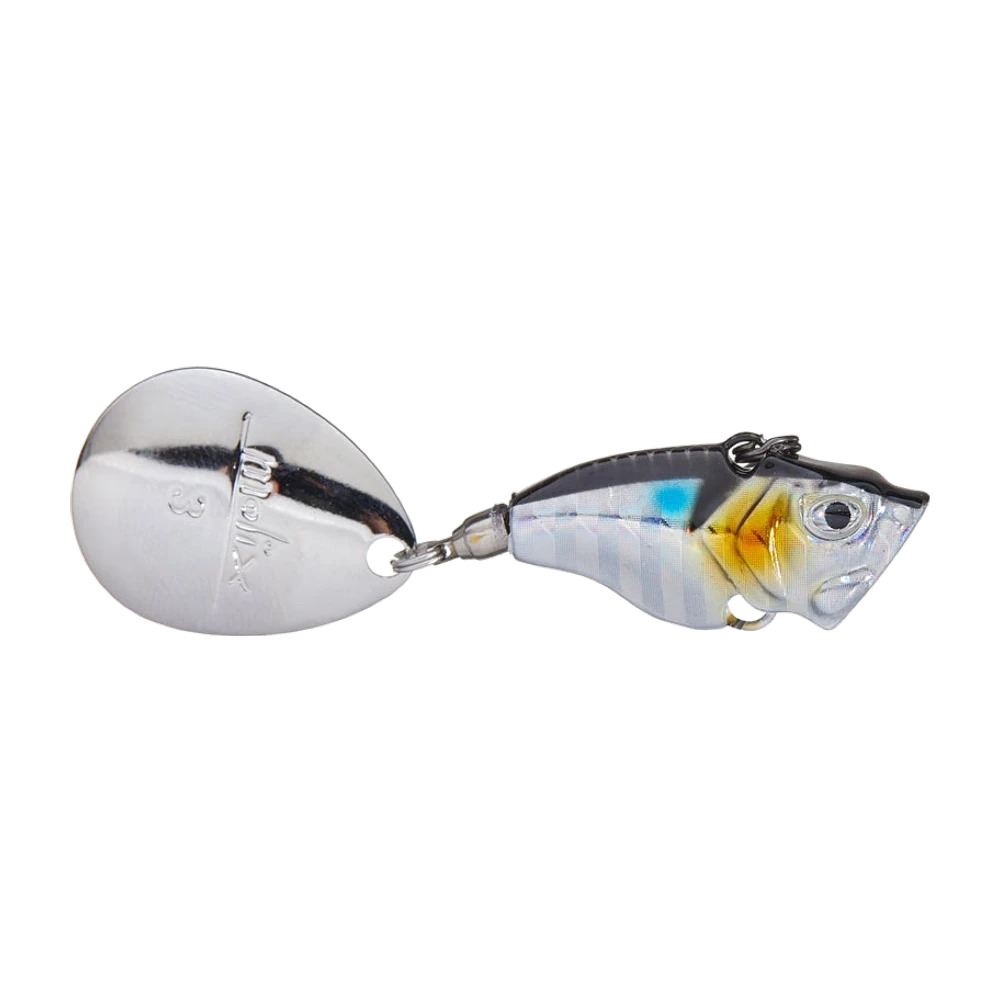
In the photo you can clearly see the swivel-and-split-ring assembly joining the blade to the body. You can also see the dorsal eyelet meant for the line and a belly eyelet, both of them bare: the lure is photographed with no hook fitted at all.
The spec table, and what it reveals
Molix publishes four rows and only two columns — length and weight, with no buoyancy class:
- 2.5 cm / 1 in for 7 g / 1/4 oz
- 2.5 cm / 1 in for 10.6 g / 3/8 oz
- 3.2 cm / 1.25 in for 14.2 g / 1/2 oz
- 3.5 cm / 1.4 in for 21.3 g / 3/4 oz
First caveat: the header does not say whether the blade is included in the measurement. In the photo it clearly extends past the body, so the real footprint at the end of your line is bigger than the table figures.
The detail that jumps out is the first two rows: same length, two different weights. Two 2.5 cm lures, one at 7 g and the other at 10.6 g, so differing in thickness or density. In practice you choose your fall rate without changing silhouette, which is valuable when fish accept one size and refuse another.
The second lesson is the overall density. Two and a half centimetres for 7 g is an extremely dense lure — nothing like a soft bait or a plug of the same size. That density gives you casting distance out of all proportion to the size, and a near-vertical drop, the two qualities you need to reach a deep school into the wind.
Molix publishes no buoyancy class for this model, so we will not claim one. The maker does explicitly describe a lure you hop off the bottom in a yo-yo and fish vertically over suspended fish: a zinc alloy body used that way goes down, and it goes down fast.
Three ways to fish it
The slow straight retrieve
This is the simplest presentation and often the most effective in cold water. Let the lure reach the bottom, then wind just fast enough to feel the blade turning in the rod tip. If you feel nothing, you are too slow; if the lure climbs through the water column, you are too fast. The right speed sits between the two and takes a few casts to find.
The yo-yo off the bottom
This is where the Trago Spin Tail beats a soft bait. A hard lift of 50 cm to a metre, then a drop on a semi-tight line: on the way up the body vibrates and the blade opens, on the way down the blade keeps turning slowly and brakes the fall. The bite almost always comes on the drop, felt as the line stopping rather than as a thump.
Vertical jigging
Over a school marked on the sounder, drop the lure to the fish and work it with short 20 to 30 cm lifts. The ball bearing makes all the difference here: a blade mounted without one stops turning as soon as the amplitude drops, and the lure loses its signal. This is the use where the Trago Spin Tail separates itself most from a plain Savage Gear Fat Tail Spin or a conventional blade bait.
The mistake that ruins a session
Fishing a tail spinner with no swivel up the line, or with a poorly balanced braid. A spinning blade feeds twist into the line, cast after cast, until it birdnests. A small ball bearing swivel set 40 to 50 cm above the lure, on the leader, solves it permanently and costs nothing in stealth.
If you are fishing vertically and the bites feel mushy, lift half a metre rather than dropping down. A lure working slightly above the school stands out against the bright surface and gets attacked from below, the position in which fish hook up far better.
A word on the material
Molix chose a non-toxic zinc alloy over lead. The environmental argument is real — a lure lost in a lake releases no lead — but it has a technical consequence worth knowing. Zinc being less dense than lead, at equal weight the body is slightly bulkier. That is one possible explanation for the two 2.5 cm versions at different weights, and it is also why these lures feel a touch larger in hand than their stated weight suggests.
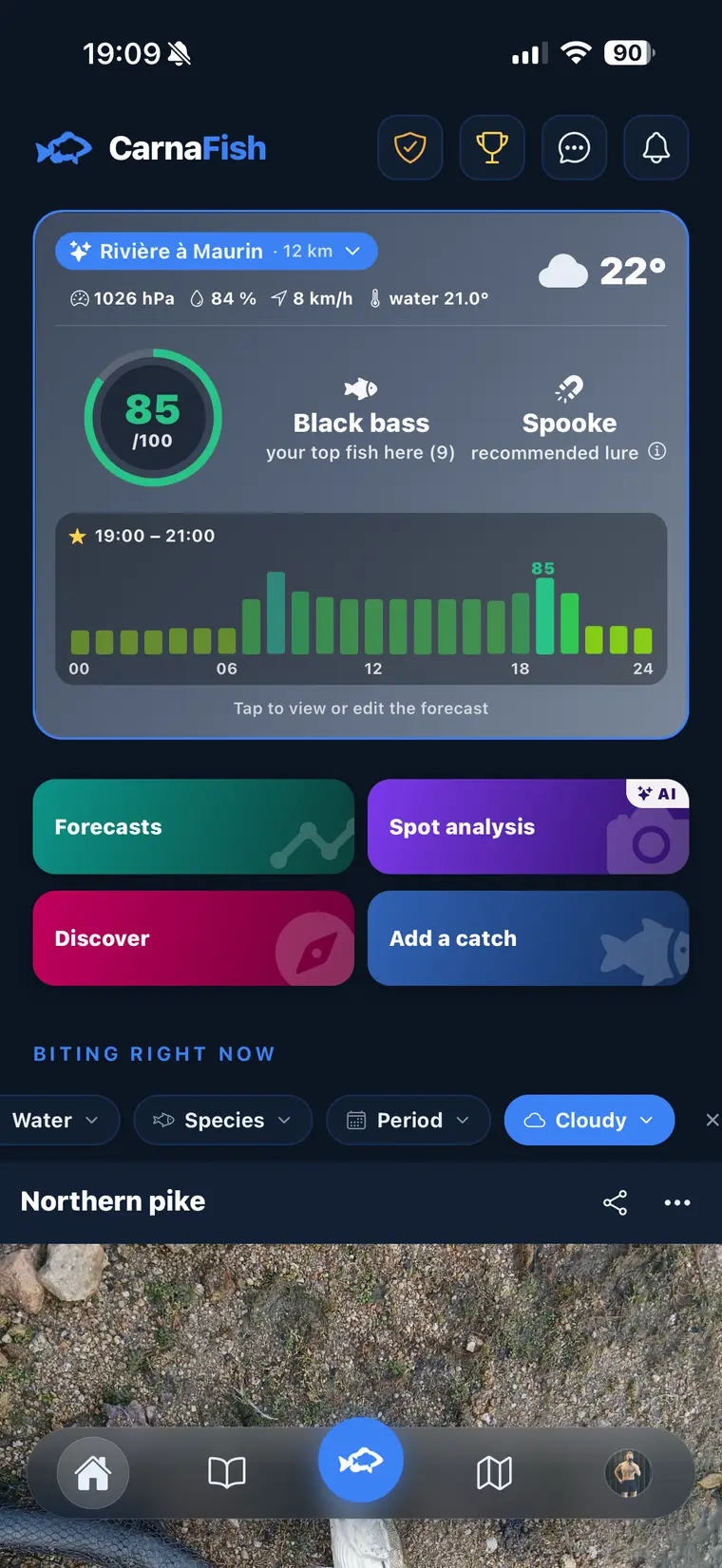
Not sure what to tie on?
Photograph your spot: CarnaFish reads the scene, cross-checks the conditions and gives you the zone, the lure and the retrieve. Free on iOS and Android.
Colours by water
- Clear water: the holographic silver shad finish in the photo, with its black back and blue spot, which copies a roach or a bleak without over-contrasting.
- Stained water: a gold or copper tone, which keeps flash in filtered light where chrome goes dull.
- Low light or deep water: pearl white, still the most readable colour when there is almost no light left.
Its real place in the box
The Trago Spin Tail is a cold-season lure for grouped fish, not a summer search bait. It shines between November and March on reservoirs, big lakes and harbours, when schools pack down and the fishing happens within a metre of the bottom. Against a direct rival like the Damiki Axe Blade Tail Spinner, it leans more on continuous blade rotation than on pure metal vibration.
You still need to know at what depth and in what spot the fish are holding that day, and that is exactly what CarnaFish makes easier: one photo of the spot, and the AI suggests the zone, the depth and the type of presentation that fit the conditions. To sharpen your reading of perch water, our guide to lure fishing for perch covers the complementary techniques.
Key takeaways
- Two combined signals: the tight vibration of a wide flat back, plus the flash of a Colorado blade on a semi-fixed ball bearing swivel.
- Four versions, two of them 2.5 cm at different weights: you set the fall rate without changing the silhouette.
- No buoyancy class published, but a metal body designed for yo-yoing off the bottom and vertical jigging.
- A ball bearing swivel on the leader is mandatory: without one the blade twists the line within a few dozen casts.
FAQ
Which Trago Spin Tail size should I pick?
The 7 and 10.6 g versions cover perch and moderate depths, the 14.2 and 21.3 g are there to get down fast over basins and in strong wind. Start with the 10.6 g, the best compromise between casting distance and discretion.
Does the Trago Spin Tail sink?
Molix publishes no buoyancy class for this model, so we will not state it flatly. The maker does describe a lure you hop off the bottom and fish vertically, uses that imply a decisive drop.
Why two versions of the same length?
Because the weight differs: 7 g and 10.6 g for a 2.5 cm body. That lets you keep exactly the same silhouette while changing the fall rate, which is very useful when fish are locked onto one size.
Do I need a swivel to fish a tail spinner?
Yes, it is essential. A rotating blade feeds twist into the line that ends in a birdnest. A small ball bearing swivel 40 to 50 cm above the lure removes the problem entirely.
What season is it for?
The maker aims it first at the colder months, which fits the technique: yo-yoing off the bottom and vertical jigging suit grouped, low-mobility fish. From November to March it is an excellent choice on reservoirs and big lakes.
Which species does it work best on?
Perch first, for the compact size and the flash, then zander worked vertically over basins. Bass take it too in cold water, on deep breaks, when conventional lures no longer drop fast enough.
The full perch lure guideSeason-by-season strategy: which family of lure, when, and why.Go from theory to fish
CarnaFish reads your spot from a photo and gives you the game plan: zone, lure, retrieve. Free on iOS and Android.