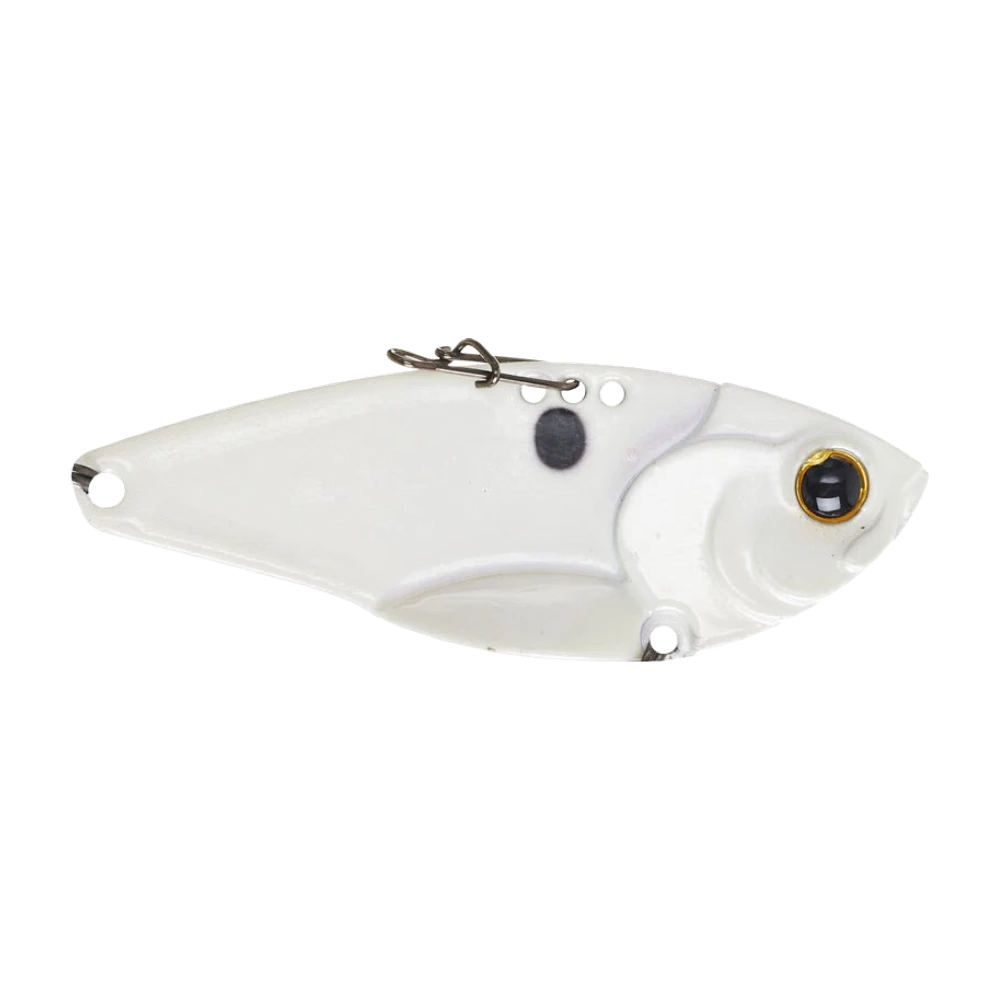
6th Sense Slice: the blade bait with three line ties
Rather not fish it blind? Photograph your spot — CarnaFish cross-checks the conditions and points you the right way.
December, water at forty-five degrees, a school clearly marked on the sonar twenty feet under the boat, welded to the bottom and completely switched off. No soft plastic is going to talk them into it, and no straight retrieve passes close enough. This is blade bait territory — a piece of metal you shake in place until a fish finally cracks on reflex. The 6th Sense Slice does that, but it also does something else, and its three-line-tie system is what makes the difference.
Three ties, three different baits
What sets the Slice apart is a back drilled with three line ties in a row, onto which you clip the included snap. It is not a gimmick: moving the pull point by three quarters of an inch changes the blade's angle of attack in the water, and therefore changes the swim completely.
Front tie. The most horizontal setting. The blade runs flat with a tight, low-amplitude vibration. 6th Sense recommend it for shallow water and for vertical jigging under the boat — or through the ice, common practice in North America. Jigged vertically, this setting lifts fast and drops back flat, which cuts down on the slack-line tangles you get on the fall.
Middle tie. The straight-retrieve setting, medium to fast, in shallow to medium depths. Use this one by default if you are fishing the blade the way you would fish a lipless: long cast, steady retrieve, let the vibration do the work.
Rear tie. The most aggressive. On a fast retrieve the blade works with noticeably more amplitude, almost unstable. And counter-intuitively, it is also the best setting for a slow retrieve in deep water: the steeper angle of attack keeps the blade vibrating even at low speed, where the other two settings go dead.
If you remember one thing: middle tie to cover water, rear tie as soon as you go deeper or slow down, front tie for pure vertical work.
Why a blade and not a lipless
A blade bait is not a metal lipless. The difference is physical: a blade is a flat, dense lure with no body and no volume, producing no rattle and no side-to-side swim. Its only signal is a high-frequency vibration transmitted straight up the line — you feel it in the reel seat, not just in the rod tip.
That density buys you two concrete advantages. First, a very long cast for a two-and-a-half-inch lure, which lets you cover open flats. Second, a fast nose-down drop that puts the bait at depth in seconds rather than in ten. The downside is the mirror image: a blade sinks like a stone, it snags on cluttered bottom, and it forgives no slack line around a sunken tree.
The classic mistake: too much amplitude
Everyone's instinct with a blade is to pull hard. You lift the rod a foot and a half, you feel a big vibration, you assume that must be right. In fact the opposite is true.
A blade is jigged vertically with lifts of four to eight inches at most, slow, followed by a controlled drop — the rod tracking the lure downward, never letting the line go slack. The bite almost always comes on that fall, and slack line means you will not feel it. A big sweep, meanwhile, pulls the lure out of the productive zone and away from the fish you located.
Jigging vertically in cold water, count three full seconds of dead pause between lifts. It feels long, it feels wrong, and it is exactly during those three seconds that a zander comes and puts its nose on the blade.
Three sizes and one label to double-check
- 2 in, 3/8 oz — about 5 cm for 10.5 g. The perch and shallow-water bass size. 6th Sense themselves flag that the packaging on some 3/8 oz baits reads 1/2 oz: the actual weight is 3/8 oz, a printing error rather than a production variation.
- 2.5 in, 5/8 oz — about 6.3 cm for 17.5 g. The all-rounder and the reference size here, and the best compromise for zander jigged vertically between thirteen and twenty-six feet.
- 2.75 in, 7/8 oz — about 7 cm for 24.5 g. For real depth, strong current or heavy wind, when staying in contact with the lure matters more than anything.
The body carries 3D detailing and eyes, a level of care that is surprising on a lure class where most makers settle for painted metal. On a blade, that realism matters mostly in clear water and on slow presentations, where the fish has time to look.
Rigging: braid does everything
A blade bait has to be fished on thin braid. The high-frequency vibration that makes the lure worth owning is precisely what stretchy monofilament erases: on braid you feel the blade buzzing continuously and you immediately register the moment it stops buzzing — which is often the real bite signal. A yard of 12 lb fluorocarbon leader is enough, unless pike are around.
Keep the included snap rather than tying direct: you will change line ties several times a day, and a knot cinched onto a blade's tie restricts the vibration the same way it restricts a crankbait's bill. The two stock trebles are sharp; just check they do not overlap, a common issue on compact blades that causes tangles on the fall.
Not sure what to tie on?
Photograph your spot: CarnaFish reads the scene, cross-checks the conditions and gives you the zone, the lure and the retrieve. Free on iOS and Android.
Colours by water and season
- Clear, cold water: bare chrome or silver. In winter the forage is silver and fish react above all to metallic flash, not to a paint pattern.
- Lightly stained water: a natural scaled back, green or blue, which keeps some realism without losing the flash on the flanks.
- Dirty water or real depth: a bright tone, chartreuse or gold. Below twenty feet the red light is gone, and a gold bait stays visible where chrome goes dull.
Where it sits among the other vibrating baits
Against a Heddon Sonar, the historic blade of the genre which also uses multiple line ties, the Slice brings a better-finished body and a quality snap in the box, but the tuning logic is identical — the Sonar remains an excellent school for understanding the principle. Compared with a Savage Gear Fat Tail Spin, which leans on a spinning blade and body volume, the Slice is subtler, denser and casts further, which suits wary fish in clear water. And against a lipless like the Strike King Red Eyed Shad, it gives up the rattle and the wide swim but gains drop speed and vertical precision.
Choosing between those three families depends entirely on the day's depth and water temperature, two parameters anglers routinely underrate. That is exactly what CarnaFish is for: a photo of the spot, and the AI suggests a zone, a depth and a presentation style matched to the conditions. To lay the groundwork on vertical fishing and lure choice, our beginner's guide to zander on lures covers the other families worth knowing.
Key takeaways
- Three line ties, three swims: front for horizontal and vertical work, middle for the straight retrieve, rear for fast-aggressive and slow-deep.
- Its only signal is a high-frequency vibration felt in the line, not a rattle and not a side-to-side swim.
- Jigged vertically, use four-to-eight-inch lifts with a controlled drop, never big sweeps.
- Thin braid is mandatory: it is the only way to detect the vibration stopping, which is often the bite itself.
FAQ
Which line tie should I clip the snap to?
The middle one if you are covering water on a medium to fast retrieve in shallow or medium depths. The rear one as soon as you slow down or go deeper, since the steeper angle keeps the vibration alive at low speed. The front one for vertical jigging under the boat and very shallow water.
Does the Slice blade work for zander?
Yes, it is one of its best applications in Europe, especially jigged vertically in cold water between thirteen and twenty-six feet with the 5/8 oz model. The tight vibration and the fast nose-down drop match exactly what triggers a zander parked on the bottom.
Why does my packaging say 1/2 oz?
6th Sense flag this themselves: on some 3/8 oz baits the label mistakenly reads 1/2 oz. The actual weight of the lure is 3/8 oz, roughly 10.5 g. It is not a production variation.
Can you fish a blade bait in wood?
No, that is its real limit. A flat, dense blade with two trebles grabs everything it touches, and it sinks fast. Keep it for clean bottom, sand or gravel flats and defined breaks. Around a sunken tree, a Texas-rigged soft plastic remains the right tool.
What is the difference between a blade and a lipless?
A lipless has a three-dimensional body, rattles that knock and a swim that rolls side to side. A blade has none of those: it is flat, silent and transmits only a high-frequency vibration. In exchange it casts further at the same size and drops much faster, which makes it the better tool deep and vertically.
Do I need a wire leader with this lure?
Only if pike share the spot. On a pure zander or perch session, a 12 lb fluorocarbon leader is subtler and perfectly adequate. A stiff wire leader on a two-inch blade also restricts the lure's freedom of movement on the drop.
The full bass lure guideSeason-by-season strategy: which family of lure, when, and why.Go from theory to fish
CarnaFish reads your spot from a photo and gives you the game plan: zone, lure, retrieve. Free on iOS and Android.