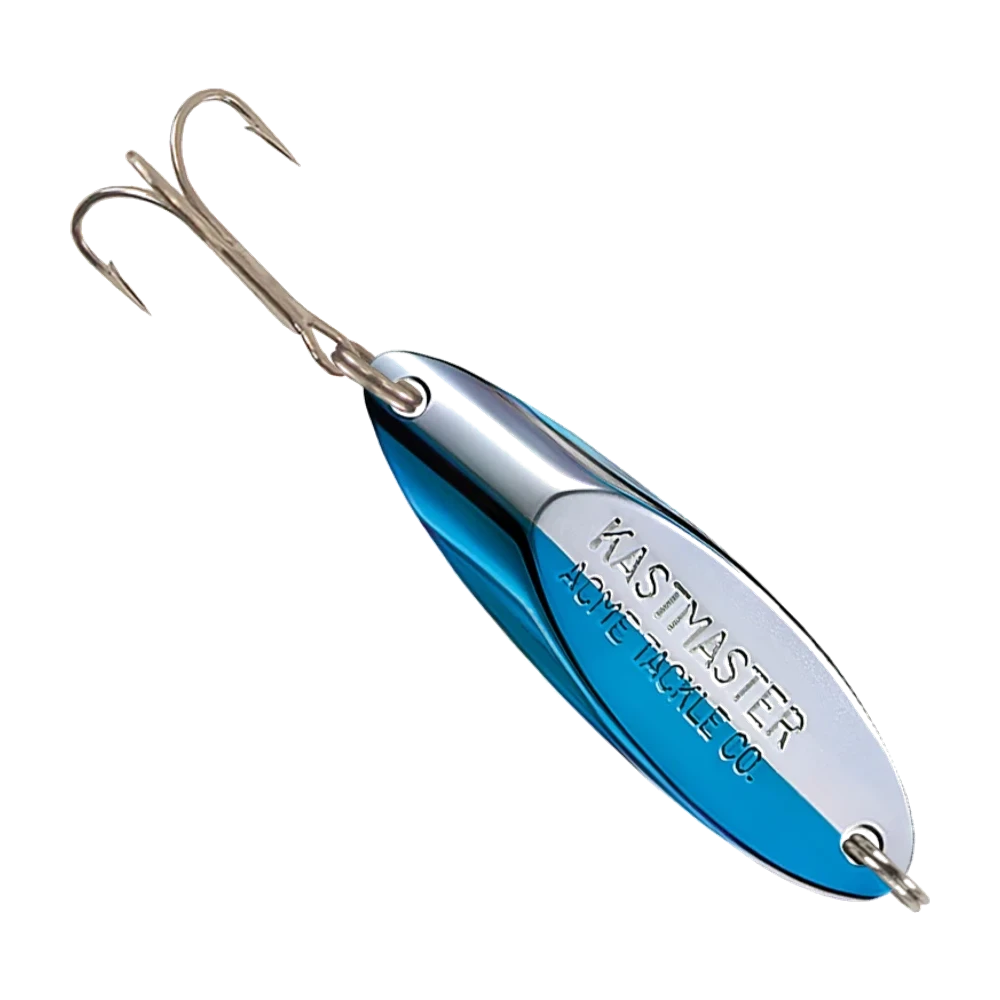
Acme Kastmaster: the machined spoon that simply casts further
Rather not fish it blind? Photograph your spot — CarnaFish cross-checks the conditions and points you the right way.
Some days the fish isn't fussy, it's just out of reach. A headwind across a big lake, a flat margin you have to cast over, rises forty metres off the bank: most spoons stall halfway out and plane back to you, too light to cut the air and too broad to sink. The Kastmaster was built around that exact problem, and it solves it with mass rather than with shape.
A bar of metal, not a pressed sheet
Nearly every casting spoon on the market is sheet work: a flat piece cut out and then stamped to give it curve and hollow. That deformation is what creates the swimming action. The Kastmaster doesn't work that way at all. Its body is machined out of a solid bar of metal and then cut on the diagonal: two angled faces, in two different planes, taken out of the thickness. Acme calls it "precision machined" and stresses the balance that comes out of it; the solid brass itself comes from the brand's own history and from retailer copy, since the current product page doesn't name the metal. Keep "machined from solid bar" — that's the part that is firm.
A stamped sheet has a lot of surface for very little weight; a cut bar has a lot of weight for very little surface. Everything the Kastmaster does follows from that ratio. It is also what separates it from the other spoon in the house, the Acme Little Cleo: the Little Cleo is a sheet hollowed into a trough that wobbles wide and slow, the Kastmaster is a block that darts short and fast. Same logo, two different jobs.
What the density changes on the bank
Casting first. A compact, heavy body doesn't catch the wind and doesn't plane in flight: it leaves on a tight line and finishes the cast instead of dying halfway. That is where the name comes from.
Then the drop. Solid metal sinks straight, without the sideways drift of a sheet that planes. So you can set your depth by the clock: count the seconds after it lands, start the retrieve, and if nothing happens add two seconds on the next cast. Three or four casts and you have swept the whole column without changing lures.
Then the action itself. The angled cuts unbalance the body just enough to tip it from side to side as it moves, in short jerks. The flash is brief, nervous, repeated — nothing like the wide slow glint of a conventional wobbling spoon. Acme states that this balance produces the action "without line twist": that is a manufacturer's claim, and it broadly holds at normal speed. Push the retrieve hard, or let the lure rise too fast at the end of a cast, and it will spin like any other spoon.
Count your seconds out loud rather than in your head. On a Kastmaster the gap between four and six seconds of sink is often a metre of depth, and the whole difference between a dead pass and a take. And if you touch bottom, drop one second on the next cast: you have just measured your spot for free.
Three retrieves, three situations
The plain straight retrieve
That's the baseline, and it is often enough. Cast, count, wind back at a steady medium pace. Along a trout-lake beach or the length of a jetty, it is the fastest way to find out whether there is an active fish within range.
The yo-yo along a drop-off
Two or three turns of the handle, a short rod pull, then a controlled drop: the lure lifts, falls back fluttering flat and throws light in every direction. The take almost always comes on the fall, felt as a line that simply stops sinking. Keep contact without tension: too tight and the lure swings back on a pendulum and loses the flutter.
Vertical jigging
Over a shoal of perch marked on the sounder, a small size dropped straight down and lifted in twenty-centimetre hops makes an excellent search lure. It is for that use that Acme runs the smallest weights, down to 1/12 oz.
Which weight for what, in Europe
Acme's standard series runs from 1/12 oz (about 2.4 g) to 3/4 oz (about 21 g), with 1/8 (3.5 g), 1/4 (7 g), 3/8 (10.6 g) and 1/2 oz (14 g) in between; the saltwater range climbs to several ounces. In European water:
- 2.4 to 3.5 g: trout in shallow lake margins, summer perch, chub in clear rivers. An ultralight rod is not optional, or you simply won't cast it.
- 7 to 10.6 g: the heart of the range, and the weight I would tie on first knowing nothing about a spot. Perch on a drop-off, trout in a big lake, good-sized chub.
- 14 to 21 g: steady wind, depth, and above all shore fishing in the sea. On mackerel feeding off the end of a breakwater, a 21 g gets to water no light soft-plastic rig will reach. Sea bass take it on the same marks, often halfway down the drop.
American copy happily ties the Kastmaster to striped bass, lake trout and ice fishing: none of that translates usefully here. And don't count on it for dedicated pike fishing — the silhouette is too narrow and the hook too light. A broad wobbling spoon like the Mepps Syclops or an Abu Garcia Toby does that job better.
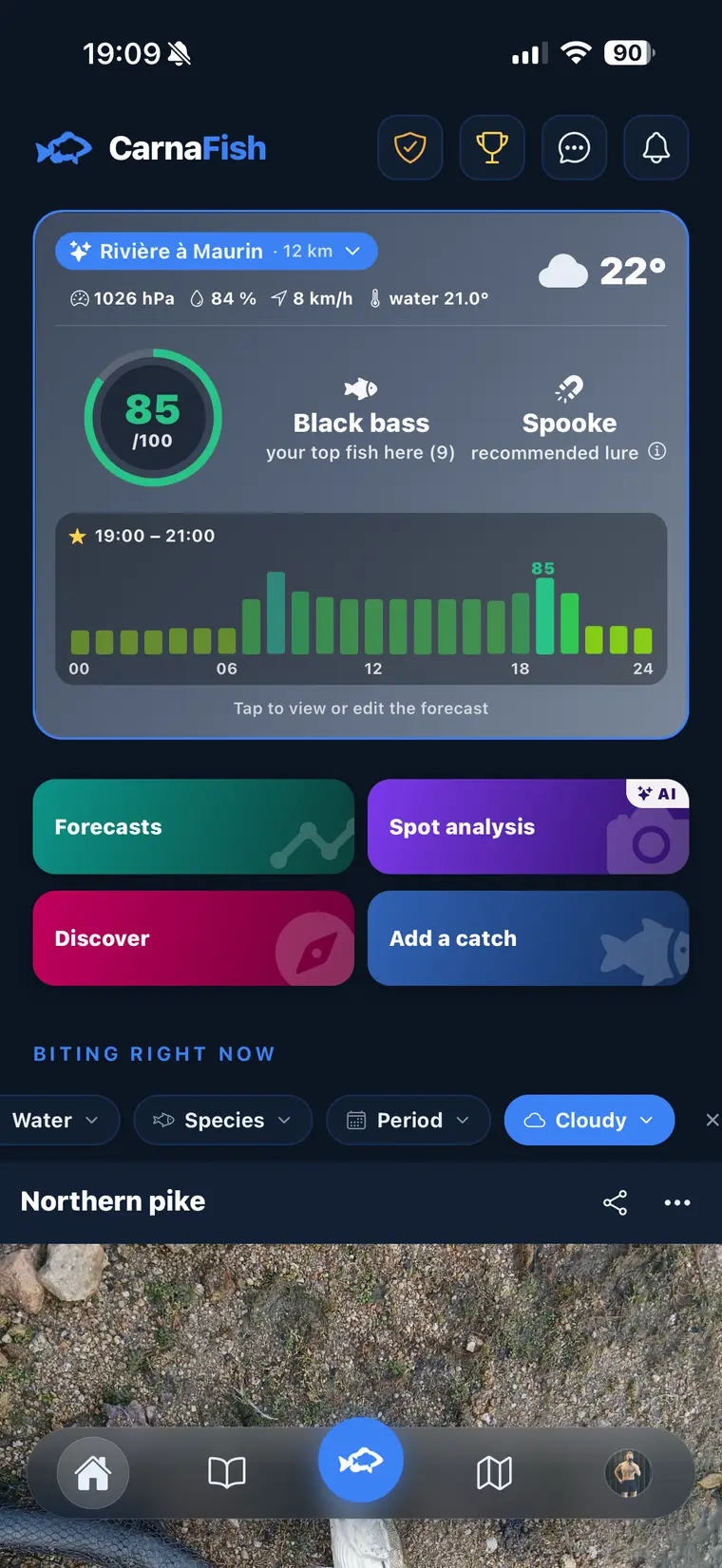
Not sure what to tie on?
Photograph your spot: CarnaFish reads the scene, cross-checks the conditions and gives you the zone, the lure and the retrieve. Free on iOS and Android.
Rigging and hooks
The Kastmaster runs off its front split ring, with a small snap if you change weights often. Put a barrel swivel forty to sixty centimetres above it, even though the brand claims a twist-free action — a full day of straight retrieving will twist a leader in the end.
The classic mistake
Staying too light out of habit. Plenty of anglers tie on 3.5 g because "trout are wary" and end up with a lure that reaches neither the distance nor the depth that matters. The Kastmaster is not a finesse lure: it stays discreet through its small size, not through being light. Go up in weight until you touch bottom intermittently, then take one second off the count.
Second point: the stock rear treble is adequate and no more, and metal that keeps tapping rock dulls its points quickly. Run a thumbnail over them before every session.
Colours by water clarity
- Clear water, bright light: Chrome, possibly the chrome-and-blue version shown in the photo. Bare metal returns the ambient light, and it is the default at sea and on big lakes.
- Stained water, low cloud, last hour of the day: Gold. Gold carries further than chrome when the light runs out.
- Dirty water or heavy fishing pressure: Firetiger, or one of the imitative patterns in the catalogue (Metallic Perch, Rainbow Trout) when fish refuse bare metal.
Knowing which weight to tie on against a given wind or current is the real question, and that is what CarnaFish does: one photo of the spot, and the AI suggests the zone, the depth to aim for and the presentation that fits the day. For the rest of the box, our guide to perch fishing with lures covers the families worth keeping around this spoon.
Key takeaways
- Body machined from a solid bar and cut on a bevel: high density, hence casting distance and a fast, straight drop.
- Short, nervous darts, very different from the wide wobble of a sheet-metal spoon.
- Set your depth by counting seconds of sink, not by changing lures.
- Takes come mostly on the fall, yo-yoing or after a pull: keep contact without tightening the line.
FAQ
Does the Kastmaster really cast further than a conventional spoon?
Yes, and the reason is mechanical: a solid bar packs a lot of mass into very little surface, so it doesn't plane in flight and doesn't catch the wind. At equal weight against a sheet-metal spoon it leaves flatter and finishes the cast.
Which weight should I start with?
7 to 10.6 g (1/4 or 3/8 oz) covers the great majority of freshwater situations. Drop to 2.4 or 3.5 g only on ultralight gear in small clear water, and go up to 14 or 21 g for the sea and for wind.
Do I need a swivel with a Kastmaster?
Acme claims a twist-free action, and it is roughly true at medium speed. But as soon as you speed up, it spins like any other spoon. A barrel swivel forty to sixty centimetres up the line fixes it for next to nothing.
How is it different from the Little Cleo?
By how it is made, and everything else follows. The Acme Little Cleo is a sheet hollowed into a trough: wide, slow wobble, spread-out flash. The Kastmaster is a bevel-cut bar: short darts, brief flash, far better penetration through air and water.
Can it be fished from the shore in saltwater?
That is one of its best grounds. On feeding mackerel or on bass along a breakwater, the 14 to 21 g sizes reach water a light soft-plastic rig can't. Rinse it in fresh water afterwards: the treble and the split ring corrode long before the body does.
How long is a Kastmaster really?
Reckon on about 3.5 cm / 1.4 in for a 1/8 oz and 6 cm / 2.4 in for a 3/4 oz. Be careful comparing retailer listings: some quote the overall length with the treble included, which easily adds a centimetre. Almost all the discrepancies between sites come from that.
The full trout lure guideSeason-by-season strategy: which family of lure, when, and why.Go from theory to fish
CarnaFish reads your spot from a photo and gives you the game plan: zone, lure, retrieve. Free on iOS and Android.