Luhr-Jensen Krocodile: the thick spoon that reaches the deep layer
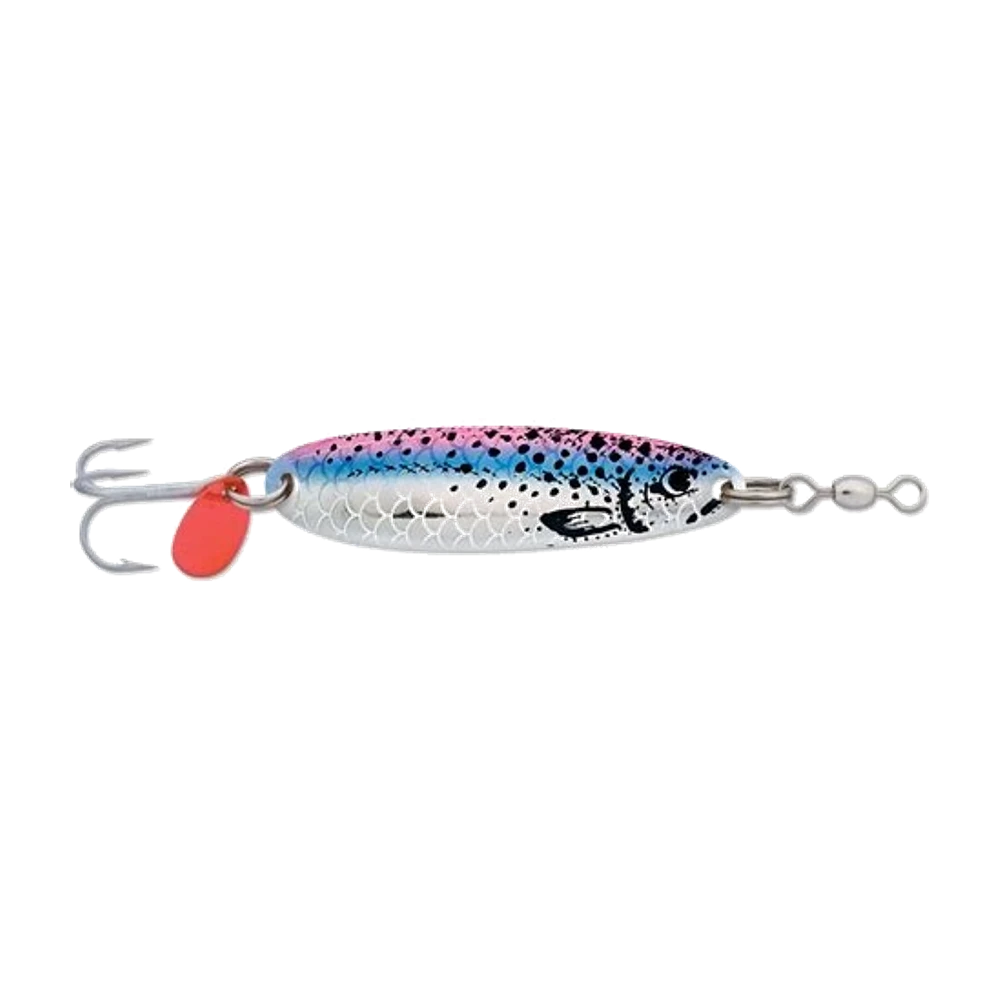
The right lure in the wrong spot still catches nothing. CarnaFish spots the zone that works, from a single photo.
You are fishing a reservoir from the bank. The fish are there, but they are six metres down and forty metres out. Your light spoon gets you twenty metres, starts swimming on the first turn of the handle and comes back through the top metre of water. You will never see those fish.
That is exactly the problem the Krocodile solves. It is not bigger than other spoons: it is thicker. At equal length it weighs considerably more, because the blank used is denser in material and the profile is narrower. The result: it cuts through the air on the cast, it sinks fast, and it lets you choose your water layer instead of putting up with the one you get.
It is also why it gets fished two very different ways — on the classic cast and retrieve, and on the vertical — where most spoons only accept one.
Thickness against surface area: what it really changes
A wobbling spoon does two things at once: it sinks under its own weight, and it is slowed by its surface area. The ratio between the two decides everything.
- Lots of surface, little weight: the lure planes, runs high, wobbles wide. That is the domain of thin spoons, handy in shallow rivers.
- Little surface, lots of weight: the lure dives fast, wobbles tight, and holds its depth even when you speed up. That is the Krocodile.
In practice, a 10 g Krocodile drops about a metre per second in still water. So you do not need any sounding gear: you count. Five seconds after it lands you are around five metres down, and you start your retrieve at that depth.
The hammered face is not just cosmetic either. It breaks the reflection into a mass of small points of light instead of one single flash, which stays visible under five metres of water where smooth chrome no longer returns much at all.
Counting the fall: the method that structures the session
This is the most productive way to fish this lure from the bank.
- Cast and let the line run, free spool, with no braking. The spoon drops straight and the line stays slack.
- Count under your breath to your chosen number. Start at 5 on your first cast.
- Close the bail and start with a decisive movement to get the wobble going, then settle into a steady retrieve.
- If nothing comes, make the same cast counting 10, then 15, then down to bottom contact.
- Note the count that produced the bite and stay on it for as long as it works.
A variant that is very effective on perch: instead of a straight retrieve, lift the spoon with a wide sweep of the rod and let it drop back on a semi-tight line. It flutters down on its flank. The bite almost always comes during that fall, and it shows up as nothing more than the line stopping.
On the water: when you are fishing a controlled fall, never follow the spoon down with the rod tip. Keep the rod still and let the line run out on its own. A tip that follows the fall kills the residual tension, and you stop feeling three quarters of the bites — which on this lure are bites on the drop.
Choosing the weight for the spot
| Spot | Weight | How to fish it |
|---|---|---|
| Medium river, 1 to 2 m | 5 to 7 g | Cast across, tight retrieve, let the current do the work |
| Big lake, searching from the bank | 10 to 14 g | Counted fall, steady retrieve |
| Deep reservoir, 6 m and more | 14 to 18 g | Full drop, yo-yo action near the bottom |
| Snaggy rocky margin | 7 to 10 g | Single hook, faster retrieve to stay above it |
The simple rule: take the weight that is just heavy enough to reach the layer you want, no more. A Krocodile that is too heavy for the spot snags constantly and its wobble becomes too tight to be seen from a distance.
Where it excels, where it has no business
Its window is big water and depth: reservoirs, gravel pit lakes, mountain impoundments, and the margins of wide rivers where the current pulls hard. It is also deadly on pure vertical jigging from a boat, over a shoal of perch marked on the sounder.
It is poorly suited to three situations. The small stream, where it hits bottom before it has swum. Heavily weeded water, because a treble loaded down by a thick spoon collects everything. And sight fishing in very clear water for wary trout: its signal is blunt, not subtle, and a light spoon will go down better in that particular case.
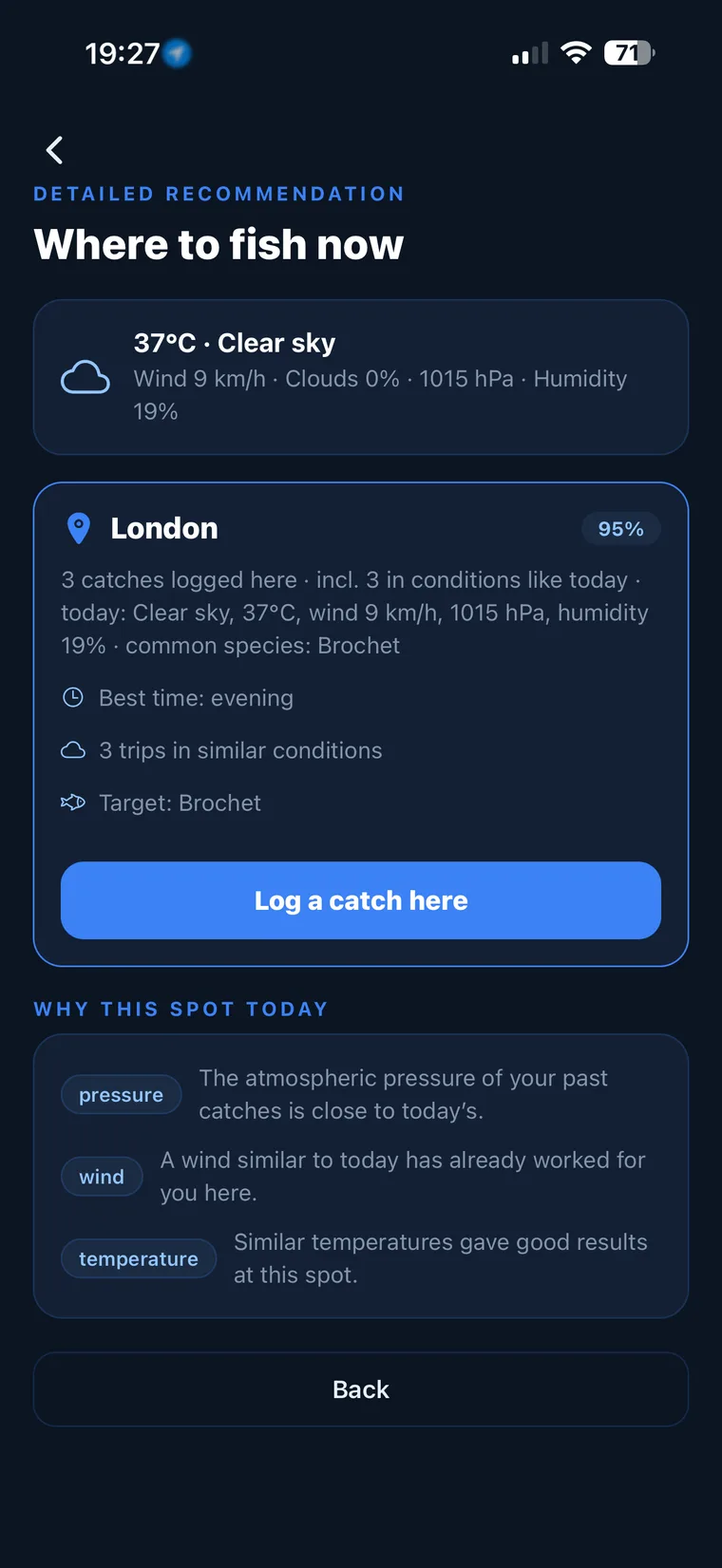
Not sure what to tie on?
Photograph your spot: CarnaFish reads the scene, cross-checks the conditions and gives you the zone, the lure and the retrieve. Free on iOS and Android.
Rigging: the point that breaks the most lines
A thick spoon spins on itself very little, but it does spin as soon as the retrieve speeds up. A rolling swivel at the head of the leader settles the question.
Two details that matter:
- The snap. Use one. A Krocodile's attachment point is a plain hole or a split ring: line tied direct wears through quickly on the metal edge.
- The stock treble. It is strong but it snags. Fishing from the bank over rock, swap it for a single hook riding point up: you lose a little sharpness, you save a lot of lures.
Krocodile or Little Cleo
Both are American spoons from the same generation, and they often get filed in the same drawer, wrongly.
The Acme Little Cleo is concave: its cupped shape stabilises it in strong current and gives it an action that stands up to fast water. It is a river lure first and foremost. The Krocodile is thicker and narrower: it is not trying to hold in the current, it is trying to get down. It is a lure for a volume of water, not for a seam.
If you could only keep one for the river, it would be the Cleo. For deep lakes and long range bank fishing, the Krocodile has no equal in the same price bracket. Our guide to reading a fishing spot helps you pick out the drop-offs where this counted-fall approach makes full sense, and if you are unsure which depth to target when you reach the bank, CarnaFish analyses a photo of the spot and answers.
For shoaling perch on a clear water, you can also alternate with a much lighter spoon such as the Acme Phoebe as soon as the fish turn their nose up at the big signal.
Key takeaways
- The thickness of the metal, not the size, is what makes the Krocodile: it drops about a metre per second.
- Fish it on a counted fall and note the number that produces the bite.
- Most takes come during the drop, with the rod still and the line semi-tight.
- Use just enough weight to reach the layer: heavier does not mean better.
- Unsuited to small streams, weed beds and sight fishing in very clear water.
FAQ
How fast does a Krocodile sink?
Reckon on about a metre per second in still water for a 10 g model, a little less for the light weights. That is accurate enough to work by counting: what matters is not the exact figure but being able to find the same count again once you have located the right layer.
Can it be jigged vertically?
Yes, and it is one of its best uses. Drop it vertically over a marked spot, lift it about fifty centimetres with a flick of the wrist, then let it fall back on a semi-tight line. The bite shows up as the fall stopping.
What colour for a deep lake?
Hammered silver stays the safe bet in clear water. Switch to brass or copper when the water is amber or the light is poor, and keep a blue or green back for bright sunny days when pure flash becomes too aggressive.
Should I keep the stock treble?
Over clean ground, yes: it is strong and well sized. Over rock or snags, a single hook riding point up cuts snagging considerably, for a loss of hooking power that is acceptable on trout and perch.
What is the difference with a Little Cleo?
The Little Cleo is concave and built to hold in river current. The Krocodile is thicker, narrower, and built to sink fast and fish deep in still water. They are two complementary uses, not two versions of the same lure.
Does it twist the line?
Not much, as long as the retrieve stays moderate. Beyond that it can start to spin on its axis. A rolling swivel placed fifty centimetres from the lure settles the problem for good, without hurting the action.
The full trout lure guideSeason-by-season strategy: which family of lure, when, and why.Go from theory to fish
CarnaFish reads your spot from a photo and gives you the game plan: zone, lure, retrieve. Free on iOS and Android.