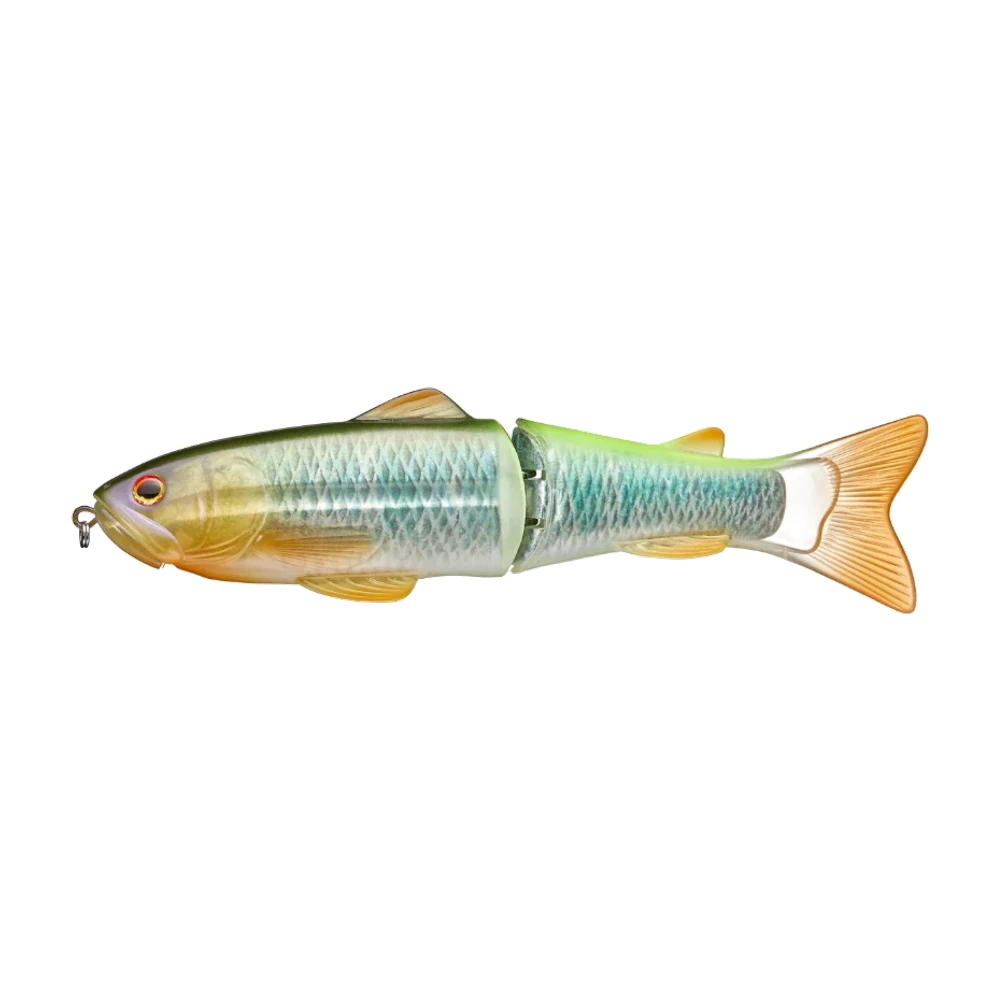
Deps Slide Swimmer 250: the glide bait that slides over a metre
One lure, endless conditions. CarnaFish reads your spot from a photo so you are not just guessing.
Most glide baits produce a 30 to 50 cm slide on every jerk. That is already enough to provoke a fish. The Slide Swimmer 250 goes considerably further: over a metre of sideways drift, with a sharp turn of nearly 90 degrees at the end of it.
That amplitude changes the nature of the fishing. You are no longer presenting a lure that zigzags: you are presenting a fish that disappears on one side and reappears on the other, more than two metres away.
What a long glide produces
Three effects stack up, and they explain why this lure converts where others fail.
The lure leaves the field of view. A following pike loses sight of it during the glide, then finds it again somewhere else. That vanish-and-reappear triggers a far stronger chase reflex than a continuous, predictable movement.
The final turn is abrupt. At the end of the glide, the lure pivots almost at a right angle. To a predator following in line astern, that is exactly what a prey fish trying to escape looks like.
The presentation lasts longer. A metre-long glide takes several seconds. The lure stays visible and believable far longer than a swimbait cranked in a straight line.
The retrieve: few movements, a lot of waiting
This is slow fishing, and it demands discipline.
- Cast and let the lure settle for two to three seconds.
- One wide, soft sweep of the rod — not a snap. The lure sets off on its glide.
- Wait out the glide without doing anything. It lasts two to four seconds.
- Take up the slack with one or two turns of the handle.
- Another sweep, sending the lure off the other way.
On the water: a short, sharp jerk makes the lure nose down instead of gliding. The movement has to be wide and followed through, as if you were pulling a rope rather than cracking a whip. That is mistake number one on this kind of lure.
The figure of eight at the end of the retrieve matters even more here than with a classic swimbait: the glide often pulls in fish that follow all the way to the bank without committing.
The weight dictates the gear
142 g is not a detail. Casting this lure on unsuitable gear breaks the rod or your wrist.
- Swimbait rod 2.10 to 2.40 m, 150 to 250 g casting weight, moderate action to load through the cast.
- Casting reel size 300 to 400, with a progressive drag and a robust retrieve.
- 0.50 to 0.60 mm braid. The load on the cast is the limiting factor, not the strength of the fish.
- Titanium leader or 0.80 mm fluorocarbon. Non-negotiable.
Reckon on twenty casts an hour at most as a sustainable rhythm. This is hunting for one big fish, not fishing for numbers.
Not sure what to tie on?
Photograph your spot: CarnaFish reads the scene, cross-checks the conditions and gives you the zone, the lure and the retrieve. Free on iOS and Android.
When to tie it on
- Autumn, when big pike feed hard before winter. That is the best window.
- Large waters and deep gravel pits with a population of sizeable fish.
- Clear water, where the full amplitude of the glide is visible.
- On located fish that have refused more conventional lures.
It is useless on small waters, in cluttered spots, and in stained water where the glide is never perceived.
Slide Swimmer or multi-jointed swimbait
A multi-jointed swimbait such as the Platypus swims in a continuous S on a straight retrieve: it reassures through realism and converts over the course of a chase.
The Slide Swimmer does the opposite: it provokes through disruption. Every glide is an escape, every turn a bid to get away. It triggers aggression rather than reassuring.
In practice the two complement each other in a single session: the glide bait to provoke and get a reaction, the multi-jointed swimbait to convert the fish that followed without biting.
Our guide to choosing a pike lure places glide baits among the other families. And if you are wondering whether a spot justifies this size of lure, CarnaFish analyses a photo and answers.
Key takeaways
- Over a metre of glide per jerk, with a final turn of almost 90 degrees.
- The jerk must be wide and followed through, never sharp — otherwise the lure noses down.
- Wait for the glide to finish completely before taking up the slack.
- 142 g: a heavy swimbait rod and a titanium leader are compulsory.
- An autumn lure, for big clear waters and big fish.
FAQ
What sets the Slide Swimmer apart from other glide baits?
The amplitude of its glide: over a metre per jerk, against 30 to 50 cm for most glide baits, with a final turn of almost 90 degrees. The lure leaves the fish's field of view, then reappears somewhere else.
How do you give it the right jerk?
A wide movement, followed through, as if you were pulling a rope, never a sharp crack of the whip. A short, brutal jerk makes the lure nose down instead of gliding — that is the commonest mistake.
What gear do you need?
A swimbait rod of 2.10 to 2.40 m rated 150 to 250 g, a size 300 to 400 casting reel, 0.50 to 0.60 mm braid and a titanium or 0.80 mm fluorocarbon leader. A standard pike setup will not do.
What is the best time of year?
Autumn, when big pike feed hard before winter. That is the window in which this kind of lure fully justifies the effort it demands.
Should you finish the retrieve with a figure of eight?
Yes, and it matters even more than with a classic swimbait. The glide frequently draws fish that follow to the bank without committing, and the figure of eight converts them.
How does it differ from a multi-jointed swimbait?
The multi-jointed swimbait swims a continuous S and reassures through realism; it converts over the length of a chase. The glide bait provokes through disruption and triggers aggression. The two complement each other in the same session.
The full pike lure guideSeason-by-season strategy: which family of lure, when, and why.Go from theory to fish
CarnaFish reads your spot from a photo and gives you the game plan: zone, lure, retrieve. Free on iOS and Android.