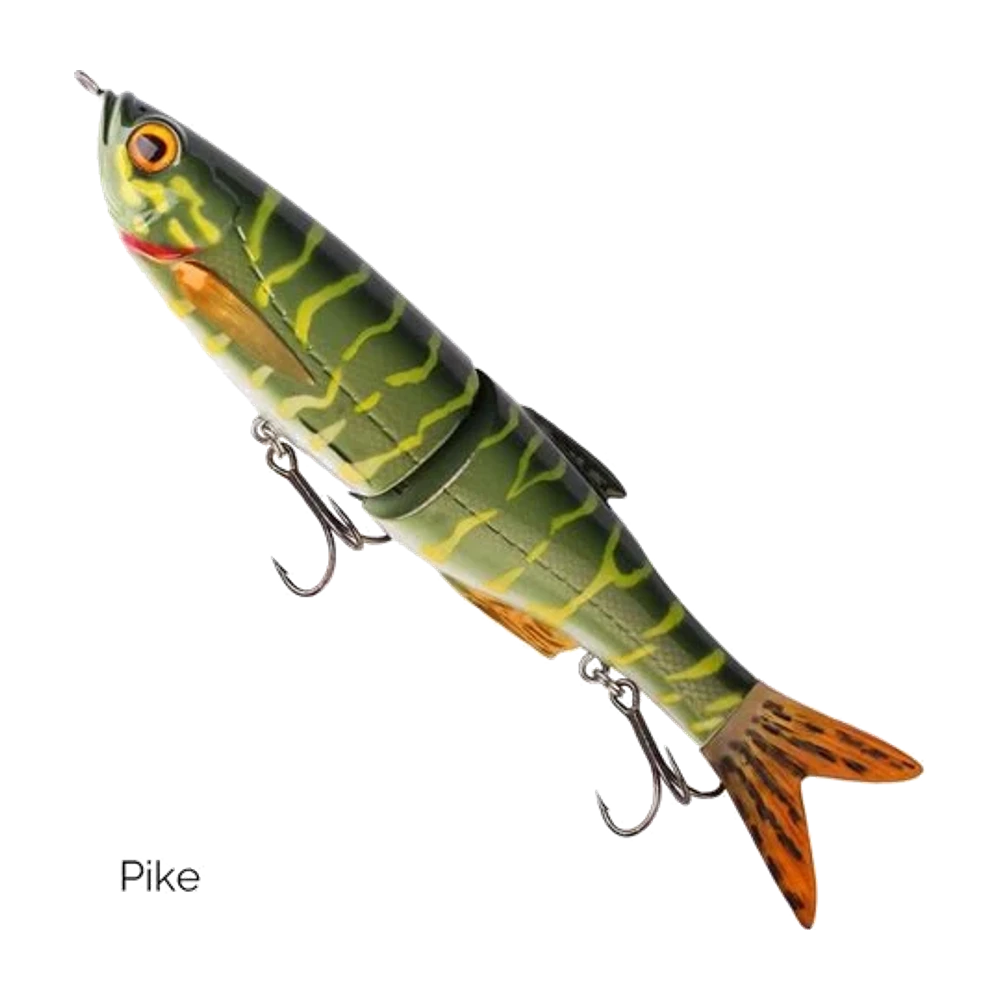
Savage Gear 3D Bleak Glide Swimmer: learning to steer a lure that skids
Rather not fish it blind? Photograph your spot — CarnaFish cross-checks the conditions and points you the right way.
First cast with a glidebait, and it is almost always the same disappointment: the lure comes back in a straight line, rolling limply, doing nothing spectacular. The conclusion is that it does not work. In reality, it simply has not been steered.
A glidebait has no action of its own. Unlike a shad or a crankbait, it produces absolutely nothing if you just wind the handle. Everything it does comes from the energy you send it through the rod, and from how you handle the slack line immediately afterwards. The Bleak Glide Swimmer, with its two segments and its bleak profile, is a good lure for learning that movement: forgiving enough to put up with an imperfect rhythm, and responsive enough to show you instantly when you get it right.
Once you have the movement, you get a lure that sweeps a width two to three times its own length on every pull, while staying almost on the spot. That is exactly what you need to work on a holding pike that refuses to chase.
The S glide: what happens underwater
On every impulse, the lure darts firmly to one side, moves thirty to sixty centimetres sideways, stops, then heads the other way on the next impulse. Seen from above, the path draws wide S shapes.
Two things make that possible. The segmentation lets the rear pivot independently of the front, which creates the change of direction. And the slack line left after the pull allows the lure to finish its run freely — that is the part everyone gets wrong.
If your line stays tight after the impulse, you pull the lure towards you and kill the glide. The sentence to remember: you give the energy, then you let the lure go.
The retrieve, movement by movement
- Cast and let the lure settle. On a floating version, let it come back up flat; on a sinking one, count the seconds to choose your layer.
- Close the bail and take up the slack until you just feel the lure, no more.
- Give a downward pull of the rod tip, wide but soft, over twenty to thirty centimetres of travel. This is not the sharp snap of a jerkbait: it is a push.
- Release immediately by moving the rod towards the lure, and give half a turn to a full turn of the handle to recover slack while the lure glides.
- Pause for one to three seconds. The lure hangs there or rises slowly depending on the version.
- Start again on the other side. How regular your rhythm is determines how regular the S shapes are.
Two useful variants. The tight glide: shorter, more closely spaced pulls, to hold the lure on a narrow spot. The long stop: a five-second pause when a fish is following — on a pike escorting the lure without committing, a dead stop is the best answer.
On the water: when a pike follows and turns off at the bank without attacking, do not recast straight away. Let the lure hang where it is, then give a single short pull that sends it sideways, towards the fish rather than away from it. A lure coming at a pike triggers far better than a lure fleeing.
Tackle is not a detail
With 30 to 45 g of lure to work several hundred times in a day, tackle directly determines the quality of the glide.
| Item | Recommended choice | Reason |
|---|---|---|
| Rod | 2.10 to 2.40 m, 40-100 g, semi-parabolic action | absorbs the weight, allows a soft push |
| Braid | 0.25 to 0.35 mm | transmits the impulse without stretch |
| Leader | supple wire or 0.60-0.80 mm fluorocarbon, 40 to 60 cm | essential for pike |
| Connection | round clip or large split ring | lets the lure pivot freely |
The most often neglected point is the connection. A knot cinched directly onto the nose ring, or a stiff triangular clip, restricts the pivot and reduces the amplitude of the glide. A round clip or a decent-diameter split ring is enough to get the action back.
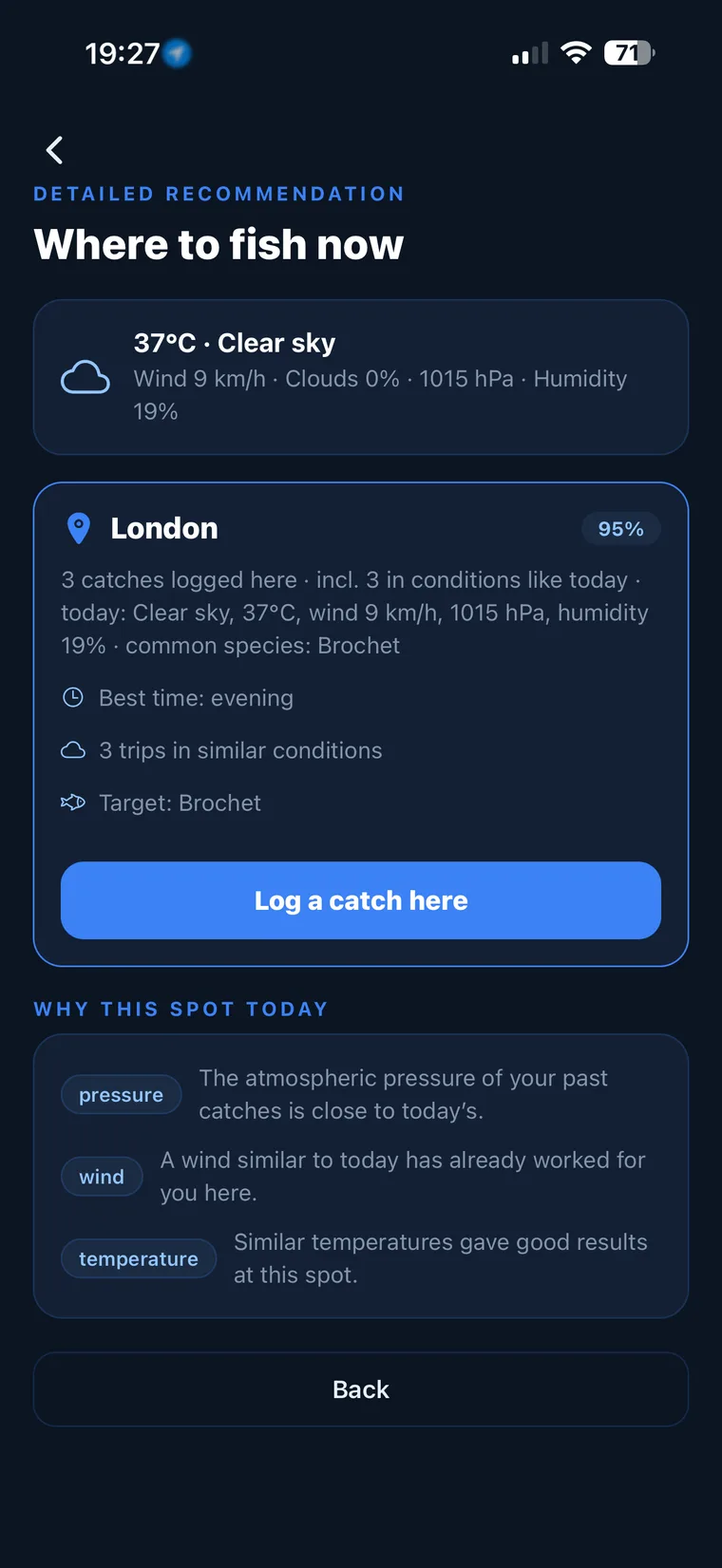
Not sure what to tie on?
Photograph your spot: CarnaFish reads the scene, cross-checks the conditions and gives you the zone, the lure and the retrieve. Free on iOS and Android.
Where it catches and where it has no business being
This lure is built for readable, shallow spots: weed bed edges, flats of 1 to 3 metres, the surroundings of dead wood, the mouths of bays. It is at its best in clear to moderately clear water, where pike see it coming from a distance and can follow it.
It peaks between 12 and 18 °C water, in late spring and above all in autumn, when pike are active but selective.
Conversely, it is unsuited in three cases. In heavily stained water, where a silent, largely visual lure will not be detected — go for something that vibrates. Over bottoms deeper than 4 metres, where it loses its point since it works in the upper layer. And in midwinter, when pike no longer move: a retrieve this energetic is then counter-productive.
Glidebait versus a swimbait with its own action
A jointed swimbait such as the Westin Mike the Pike swims on its own on the retrieve: you reel, it undulates. That is easier, more versatile for searching, and it covers ground fast.
The glidebait does the opposite: it covers little ground but works a small area enormously, and it produces a sideways fleeing signal no straight-swimming swimbait gives. It is a spot lure, not a searching lure. The Westin Swim Glidebait and the Salmo Slider belong to the same family with different glide amplitudes — the first wider, the second more compact.
The sound approach is often to search with a swimbait, spot a follow, then come back to that place with the glidebait. Our guide to choosing a pike lure covers that alternation. And if you are torn between searching wide and working a spot when you reach the bank, CarnaFish analyses a photo of the spot and answers.
Key takeaways
- The lure does not swim on its own: everything comes from the rod pull and the slack given back right after.
- A soft push, not a sharp snap: a brutal jerk breaks the glide instead of widening it.
- A round clip or a large ring is essential, a stiff connection restricts the action.
- A spot lure for clear, shallow water, not for searching in stained water.
- On a follow, stop everything, then send the lure back towards the fish, not away from it.
FAQ
How do I work a glidebait properly?
A soft rod-tip pull of twenty to thirty centimetres, then release immediately while taking up slack with half a turn of the handle, then a pause of one to three seconds. It is the release that creates the glide, not the force of the pull.
Why does my glide swimmer come back in a straight line?
Almost always because the line stays tight after the impulse: the lure is dragged towards you instead of finishing its sideways run. Check the connection too — a stiff clip or a knot cinched on the ring blocks the pivot.
What rod for a 40 g lure?
A 2.10 to 2.40 m rod rated 40-100 g with a semi-parabolic action. A rod that is too stiff tires your arm and makes the pull too sharp; one that is too soft will not transmit the impulse to the lure.
Do I need a wire leader?
For pike, yes, or failing that 0.60 to 0.80 mm fluorocarbon over 40 to 60 cm. The price of a glidebait makes a break-off particularly expensive, and pike often engulf this type of lure whole.
What season for a pike glidebait?
Late spring and autumn, when the water is between 12 and 18 °C and pike are active but selective. In midwinter the retrieve is too energetic for fish that have stopped moving.
Floating or sinking version?
The floater for spots under 2 metres and weed bed edges, since it rises during the pauses. The sinker to hold a layer between 1.50 and 3 metres or to fish in wind, counting the seconds on the drop.
The full pike lure guideSeason-by-season strategy: which family of lure, when, and why.Go from theory to fish
CarnaFish reads your spot from a photo and gives you the game plan: zone, lure, retrieve. Free on iOS and Android.