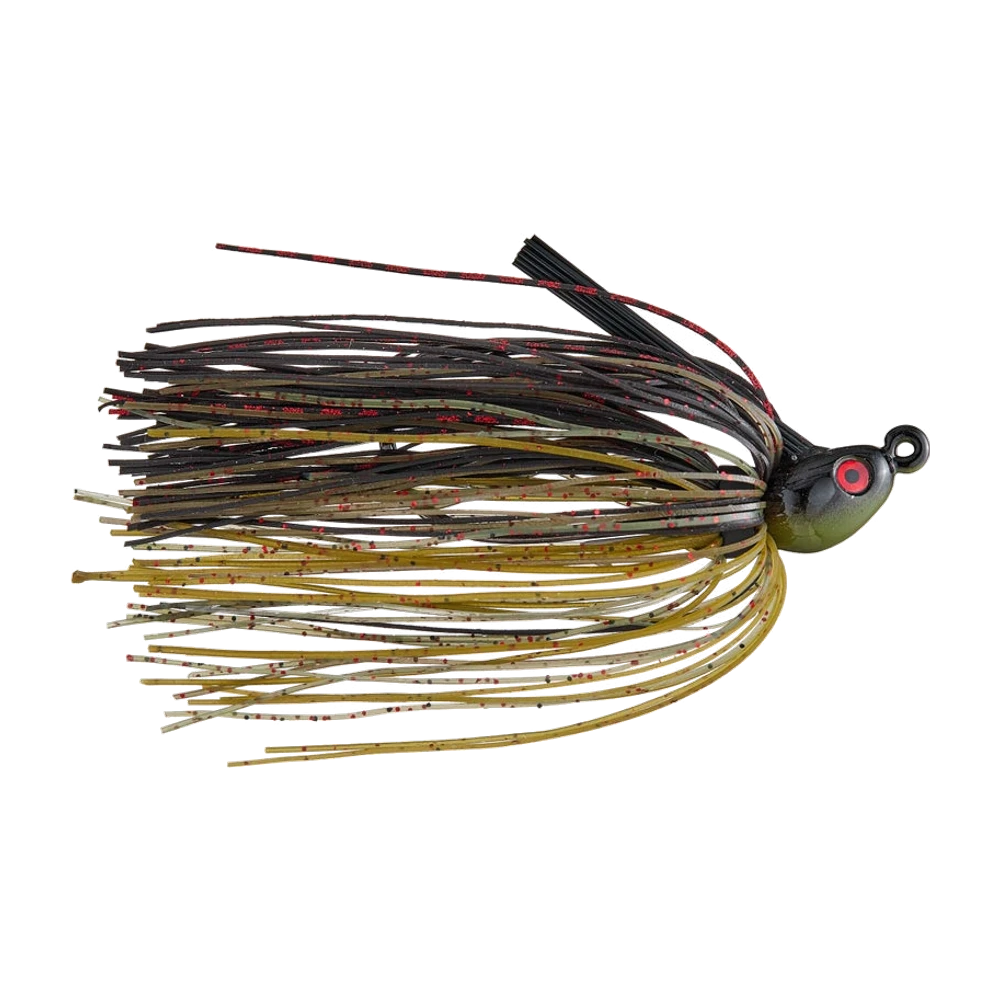
Dirty Jigs Compact Swim Jig: the swim jig built for the Alabama Shake
Not sure this lure fits YOUR spot today? CarnaFish tells you in 10 seconds, from a photo.
A swim jig dragged back on a flat straight retrieve catches a few fish. A swim jig worked properly catches three times as many, and the difference comes down to neither colour nor weight: it comes down to the shape of the head and what you do with your rod tip. The Dirty Jigs Compact Swim Jig is one of the rare models whose maker says out loud how it should be fished — and which is drawn around that specific retrieve.
A head deliberately weighted forward
Most swim jigs spread their lead around the hook to produce a stable, even swimming action. Dirty Jigs does the opposite: the mass is pushed toward the front of the profile. You feel it within the first few metres of the retrieve — the jig wants to nose down at the slightest interruption, then rights itself as soon as the pull resumes.
That apparent flaw is the whole point of the lure. A perfectly balanced jig swims straight and never does anything unexpected; a lead-forward jig breaks loose, rolls onto its side for a fraction of a second and recovers. That is exactly how a small baitfish behaves when it changes direction in a panic, and that is what a bass eats.
The wire bait keeper reinforces the effect. Dirty Jigs presents it as a system that locks the trailer in place, which it does, but it also performs a second job: it moves the balance point forward. The jig ends up considerably more reactive than a model with a conventional plastic collar.
The Alabama Shake, step by step
The maker states this jig is best served with the retrieve known as the Alabama Shake. Behind the name sits a simple technique that asks for a little coordination.
You reel at a steady medium speed, rod low and pointed toward the lure. On top of that retrieve you work a short, tight tremble into the rod tip, horizontally — not wide sweeps, just shakes of a few centimetres, continuously. The jig stops tracking straight: it weaves, rolls, breaks out to one side and comes back, and the skirt opens and closes with every shake.
The bite almost always comes on a micro-pause, when you stop the tremble for half a second. So keep a finger near the line and never drift into autopilot reeling: you will miss the soft bites, which are the majority.
If you cannot keep the tremble going without tiring your wrist, choke up on the rod and let the butt rest against your forearm. The movement comes from the wrist, not the arm. That detail is what lets you hold this retrieve for a whole day instead of twenty minutes.
Heavy-duty, and that is intentional
Dirty Jigs fits a 4/0 Gamakatsu hook and claims heavy-duty construction, built for braided line and for wrenching a big fish out of weed or flooded timber. That is useful information, because it contradicts the picture most anglers form of a "compact" lure.
A reduced profile does not mean a fragile lure or a small-fish lure. This jig is dimensioned to be dragged through vegetation on 30 to 50 lb braid with a rod that has some backbone. Rig it on a light outfit because it looks small, and you will break off on the first good fish buried in grass.
Choosing the trailer
The trailer changes the jig's behaviour more than head weight does. Three families, three jobs.
A paddle tail swimbait such as a Keitech Swing Impact Fat 3.8 or a Strike King Rage Swimmer adds a steady pulse and stabilises the jig a little: that is the search rig, and the one to start with.
A craw or a flat-appendage creature bait slows the fall and increases water resistance. The jig becomes slower, holds its depth better, and the action gets wider. Useful when fish are high in the column and you need to crawl along a weed edge.
A slim trailer with no appendages lets the jig speak for itself. That is the liveliest rig, the one that exploits the lead-forward head best — and also the one that demands the most from your rod hand.
The classic mistake: too much weight
The reflex is to go heavy to "feel it better". On a swim jig that backfires: too much lead sinks through the column during the micro-pauses and drags the lure along the bottom, when it should be riding just over the vegetation. The right weight is the one that keeps the jig 20-50 cm under the surface at your normal retrieve speed. Dirty Jigs offers several weights without detailing them in its description, so you have to read the packaging to know the exact value of the reference you buy.
Not sure what to tie on?
Photograph your spot: CarnaFish reads the scene, cross-checks the conditions and gives you the zone, the lure and the retrieve. Free on iOS and Android.
Where to use it, and for which species
The Compact Swim Jig's home is shallow cover: mid-depth grass, reed edges, laydowns, docks, scattered lily pads. Anywhere a crankbait fouls and a spinnerbait makes too much noise.
For bass it is a spring and summer lure, deadly when fish are locked onto small forage. In Europe it also interests pike in the same weed beds, with one important caveat: a swim jig is fished without a wire trace, and a decent pike will cut through. If you know the spot holds them, add a thin titanium leader and accept the slight loss of action, or pick another lure.
Colors by water and forage
- Clear water over green bottoms, dense vegetation: green pumpkin with red flake, like the finish in the photo. It is the colour that disappears best into grass while keeping one point of contrast.
- Fish locked on a fry school: white or pearl, copying the forage colour directly.
- Dark water or heavy overcast: black and blue, a classic that owes nothing to chance — silhouette rules once light stops carrying.
Knowing which edge to attack matters as much as what you send in there, and that is exactly what CarnaFish does: one photo of the spot, and the AI suggests the zone, the depth and the presentation that fit the day's conditions. For the rest of the framework — tackle, seasons, typical structure — our beginner's guide to bass fishing pairs well with this page.
Key takeaways
- The lead-forward head and the wire bait keeper shift the balance point: the jig breaks and rolls instead of swimming straight.
- The Alabama Shake — medium retrieve plus a continuous rod-tip tremble — is the retrieve the lure was drawn for.
- A 4/0 Gamakatsu hook and reinforced build: this is a small lure made for braid and for big fish in cover.
- Take the lightest weight that keeps the jig 20-50 cm under the surface, not the heaviest in the box.
FAQ
What exactly is the Alabama Shake?
It is a steady medium retrieve on which you superimpose a short, continuous horizontal tremble of the rod tip. The jig weaves and breaks sideways instead of tracking straight, and the bite usually comes when you stop for half a second.
Do I need a trailer on this swim jig?
In practice, always. The wire bait keeper exists for that, and the trailer changes the jig's behaviour more than head weight does. A paddle tail swimbait is the most versatile starting point.
Which weight should I choose?
Dirty Jigs lists several sizes without publishing the values in its description, so you have to read the packaging. The criterion stays the same: the lightest weight that keeps the jig riding just over the vegetation at your usual speed.
Can this swim jig be fished on fluorocarbon?
In open water, yes. In vegetation, no: the maker reinforced the build specifically for braid, and braid is what lets you pull a fish out of grass without leaving the lure behind.
Does this lure work for pike?
It works in the same weed beds across Europe, but without a wire trace a decent pike will cut you off. If the spot holds them, add a thin titanium leader and accept the small loss of action, or switch to a lure designed for it.
How does it differ from the same brand's finesse swim jig?
The Compact bets on a lead-forward head and a heavy-duty build around a 4/0 hook. The Dirty Jigs Finesse Swim Jig plays on an even slimmer profile and a bullet head designed to move through vegetation: two different answers to the same problem.
The full bass lure guideSeason-by-season strategy: which family of lure, when, and why.Go from theory to fish
CarnaFish reads your spot from a photo and gives you the game plan: zone, lure, retrieve. Free on iOS and Android.