Big Bite Baits Kamikaze Swimon: the trailer that wakes up a chatterbait
This lure shines under specific conditions. CarnaFish tells you in 10 seconds if today is one of them.
A chatterbait rigged with the wrong trailer is a blade beating into nothing. You can feel the vibration in the rod, everything seems normal, and yet the bait triggers nothing all day. Swap just the piece of plastic hanging behind it, without touching the blade or the skirt, and the whole thing starts catching. The Big Bite Baits Kamikaze Swimon was drawn for that exact role and for no other: being the rear engine of a chatterbait or a swim jig.
A trailer is not an accessory
On a chatterbait, the blade produces vibration and the skirt produces bulk. The trailer decides three things: how fast the bait can be retrieved before it rolls over, how high it swims, and how much signal is added to the blade's own. A flat-profile trailer, a paddle-tail shad for instance, adds little resistance and lets the blade dominate. A twin-tail trailer adds a great deal of kick, which slows the whole package down and makes it ride higher.
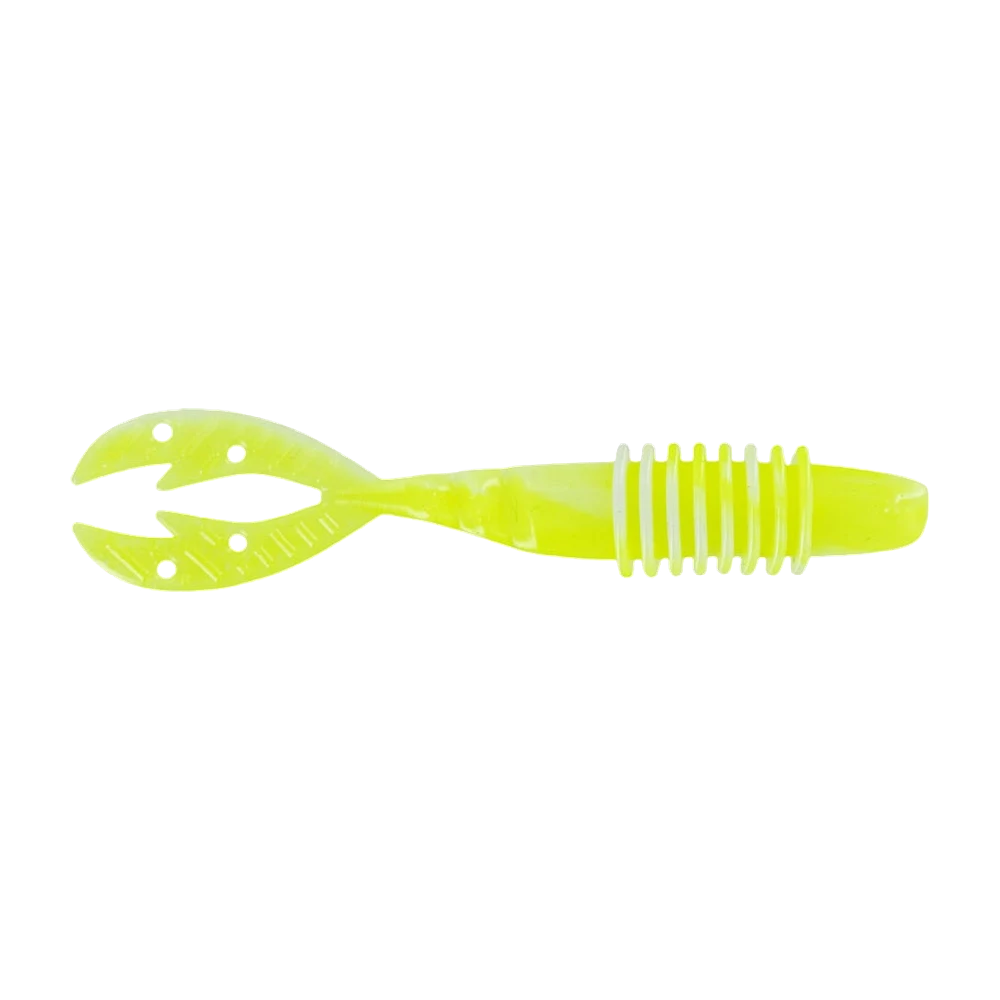
The Kamikaze Swimon sits firmly in the second camp. Its two wide, flat tails open from the first turns of the handle and create a clean kick, clearly distinct from the blade's vibration. You then get two different frequencies at once — the blade's fast vibration, the tails' slower beat — and that mix is exactly what carries in dirty water.
A vertical profile, not a flattened one
Big Bite drew the body and tails with a vertical profile, meaning taller than wide. That is consistent with the use: seen from the side by a fish attacking from below or from the flank, the trailer completes the skirt and gives the package the silhouette of a small baitfish rather than a crawfish. A flat-bodied trailer, by contrast, nearly disappears in profile.
The body also carries a segmented section just ahead of the tails. That soft joint makes the trailer bend through turns and at the moment you accelerate out of a pause. In practice the bait does not run dead straight like a block: it twists slightly, adding an irregular movement at precisely the moment the fish commits.
The ribs and the holes
Two details that are easy to ignore and genuinely useful. The front of the body is ringed with heavy ribs that displace water. In murky water or low light, it is that displacement — picked up by the fish's lateral line rather than its eye — that lets a bass pinpoint the bait before striking. A chatterbait that is loud but hard to locate produces missed strikes; well-defined ribs improve the share of bites you convert.
The tails are ribbed and pierced with small round holes. The holes slightly lighten the blades and change how they grip water: they beat with less resistance, so faster, even at a moderate retrieve speed. That is what lets the Swimon stay expressive without forcing the pace.
Fish it once on nothing but a 7 g jighead, just to see how it swims on its own. You will learn the exact speed at which its tails open, and you will never retrieve your chatterbait too slowly again.
Two sizes, two blade weights
9.5 cm
The everyday size. It goes on a 10 to 14 g chatterbait and on most swim jigs. It is the right call when the forage is under ten centimetres, which covers most spring and early summer situations.
10.8 cm
One centimetre longer, and noticeably more tail volume. Keep it for 14 to 18 g blades and heavily coloured water, where you need maximum water displacement. It is also the size to rig when you are targeting bigger fish and accept fewer bites.
How to rig it straight
This is the technical point that decides everything. Thread the trailer nose-first onto the shank, following the body axis, and bring the point out exactly in the middle of the back. A trailer sitting two millimetres off-centre makes the whole package spin as soon as you speed up, and you will spend the day untangling braid without understanding why. Take ten seconds on every re-rig; it is the best investment of the session.

Not sure what to tie on?
Photograph your spot: CarnaFish reads the scene, cross-checks the conditions and gives you the zone, the lure and the retrieve. Free on iOS and Android.
Where and when
The chatterbait is a search bait, and the Swimon adds signal to it. In other words, the package is made for stained to dirty water, grey days, the edges of emerging vegetation in spring and flats covered in low weed. In Europe the most productive window runs from March to June, then returns in September and October when the water cools and the forage schools up.
On a swim jig the register shifts a little: the swim is smoother and less vibrating, and the Swimon mainly adds bulk and a visible kick in sparse weed. It makes a good trailer for a 6th Sense Divine Swim Jig or a 6th Sense Fixed Jig Saw Vibrating Jig, with different behaviour in each case that is worth checking at the bank.
The classic mistake
Retrieving too slowly. A twin-tail trailer only switches on above a certain speed; below it, the blades stay stuck together and you are dragging an inert piece of plastic behind your blade. If you absolutely have to slow down, change trailers: a craw trailer like the Big Bite Baits Fighting Craw works better at low speed.
Colour by water clarity
- Dirty water, a flood or heavy overcast: pearl chartreuse, like the one in the photo. It is the benchmark chatterbait colour in coloured water, because it stays readable when visibility drops to a few tens of centimetres.
- Clear water over silver forage: White Shad, a restrained pearl white that completes a white skirt without betraying it.
- Weedy bottom or lightly stained water: Green Pumpkin, more sober, for days when a loud chatterbait pushes fish away instead of pulling them in.
A bait that does not exist on its own
One thing has to be clear: the Kamikaze Swimon is not a standalone bait. On a plain jighead it works, but with no particular advantage over a standard shad. Its reason to exist is to hang behind a blade or a skirt, and every design choice — vertical profile, soft segment, ported tails — only makes sense in that configuration.
Knowing when to pull out a chatterbait rather than a slow bait depends mostly on season, water temperature and the light of the day. That is exactly what CarnaFish makes easier — a photo of the spot, and the app suggests the zone and the presentation suited to the conditions. To line up your choice of lure family with the calendar, our season-by-season predator fishing guide lays out the windows worth knowing.
Key takeaways
- A trailer designed for one job: adding kick and bulk behind a chatterbait or a swim jig.
- A vertical profile and segmented section for a baitfish silhouette that twists through turns.
- Front ribs to displace water in low visibility, ported tails to kick faster at moderate speed.
- Rigging it straight on the shank is no detail: two millimetres off and the whole thing spins.
FAQ
Which size, 9.5 or 10.8 cm?
The 9.5 cm for a 10 to 14 g chatterbait and most spring situations. The 10.8 cm when you move up to a 14 to 18 g blade, in heavily coloured water, or when you are hunting a bigger fish at the cost of fewer bites.
Can the Kamikaze Swimon be fished on its own jighead?
Technically yes, but there is little point. Its entire design assumes a blade or a skirt in front of it. For plain jighead fishing a paddle-tail shad makes far more sense.
Why has my chatterbait started spinning since I fitted this trailer?
Almost always because the trailer is not threaded straight on the shank. Pull it off, realign the nose with the body axis and bring the point out exactly in the middle of the back. That fixes it in nearly every case.
Do I need to retrieve fast?
Faster than with a paddle-tail trailer, yes. The two tails only open above a certain speed. Run the test once near the bank, watching the bait, to memorise the minimum speed.
Is it suitable for pike?
Yes, a chatterbait rigged with this kind of trailer is an excellent pike bait in stained water, provided you add a suitable leader. The soft plastic trailer itself will not survive many strikes.
Do the salt and the attractant really matter on a trailer?
Less than on a slowly fished bait. On a chatterbait coming back on a straight retrieve, the fish strikes on reflex and has no time to evaluate taste. The salt mainly affects density and how the plastic holds up.
The full bass lure guideSeason-by-season strategy: which family of lure, when, and why.Go from theory to fish
CarnaFish reads your spot from a photo and gives you the game plan: zone, lure, retrieve. Free on iOS and Android.