Dirty Jigs Tour Level Pitchin' Jig: the Arkey head that stands up
This lure shines under specific conditions. CarnaFish tells you in 10 seconds if today is one of them.
A line of boulders running under a dock, three metres of water, and a bass that turns down anything passing more than fifty centimetres from its nose. In that situation the lure does not need to swim: it needs to arrive in exactly the right place and stay believable for the five seconds it sits still. The Tour Level Pitchin' Jig is built around that single requirement, and its head shape is the direct consequence.
The Arkey head, and why it stands up
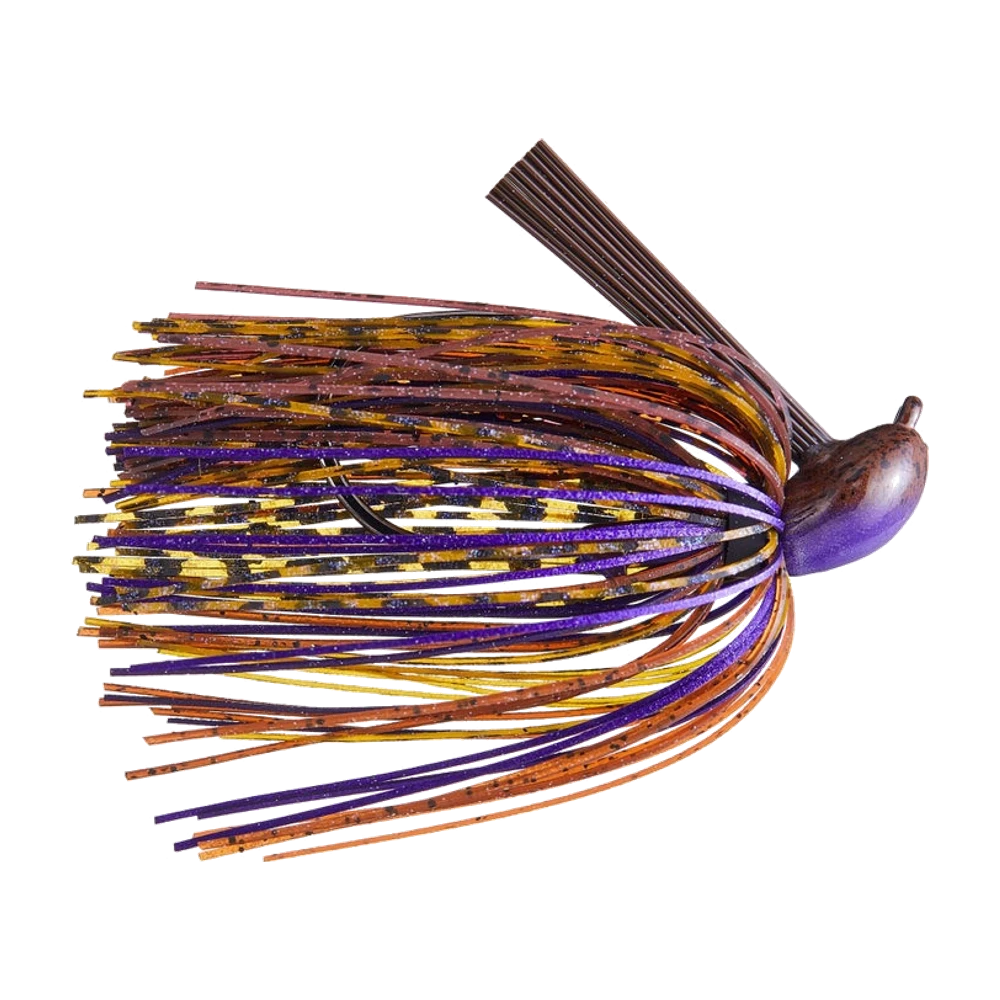
Dirty Jigs is explicit here: the head is an Arkey style, chosen because it holds the jig upright once it settles on the bottom, which best mimics a crawfish. That is not a throwaway line. An Arkey head has flattened sides and a widened base that acts like a keel. Set down on hard bottom, it refuses to tip over sideways: it settles on that base, eye forward, hook up.
The practical consequence is what the fish sees. Instead of a skirt lying flat in the sediment, you get a silhouette pointing upward, trailer raised, exactly the posture of a crawfish lifting its claws when it feels threatened. It is one of the rare cases where imitating a behaviour, rather than a shape, genuinely moves your bite count.
That head has another, less advertised quality: it slides well over rock. The flat sides and broad base spread the contact, and the jig tends to lift off edges rather than wedge into them. On a riprap bank, that is what lets you keep working a spot where a round head would already have cost you two rigs.
When your jig is sitting on rock, resist the urge to pick it up and pitch again. Give it two small taps of the rod tip without moving it: the skirt flares, the trailer twitches, and the fish that has been watching it for ten seconds usually commits right then, not when you lift.
Skirt, bait keeper and hardware
Dirty Jigs says its skirts can blend up to ten different colors on a single model. It shows in the photo: brown, orange, gold, purple and black overlap across the same silicone strands. The point is not decoration. A single-color skirt reads as a uniform blob; a multi-color one creates internal contrasts that shift against each other as the strands spread, and it is that micro-movement of color that looks like living prey rather than an object.
On the hardware side, the brand fits a 60-degree Gamakatsu hook described as stout and very sharp. No size is given in the copy, unlike other models in the range: that is something to check on the package if you care about matching hook size to trailer size.
The detail that earns its keep day to day is the bait keeper: a large lead barb moulded onto the shank to stop the soft plastic sliding back. On a pitching jig that will bang into rock all day, that is the difference between reeling in every three minutes to reset the trailer and actually fishing.
What the copy omits, and where it contradicts itself
Neither length nor weight is published for this model. As with the rest of the Tour Level range, the figure is on the package, and it is what sets your fall rate and your rod choice.
There is also an internal contradiction worth flagging. The text states that every head gets a three-tone airbrushed paint job, while the note at the top of the same page says the brand is moving to a single-color painted head, with both batches running until the old ones sell through. Both cannot be true at once: the copy describes the historical product, the note describes current production. In plain terms, you may receive the two-tone head from the photo or a solid one, for the same color code.
Pitching is a question of distance and silence
Pitching happens between five and twelve metres, rod low, the lure swung underhand so it lands flat with no splash. That is the difference from flipping, which works closer still and without the reel. Here you can target the back of a dock, the gap between two boulders, the base of a piling — places where a conventional cast would spook the fish before the lure even touched down.
Once it lands, let it drop on a controlled slack line while watching your line. On contact with the bottom, you wait. Two small shakes with no displacement, one very short drag, and you start again. A pitching jig is not a search bait: you cover targets, not water.
The classic mistake
Rigging too large a trailer for the jig. Plenty of anglers add a 4 in craw with broad appendages thinking it raises the appeal. The result is a fall so slow that the lure drifts out of the target zone, and above all the trailer's bulk offsets the widened base of the head, which tips the jig onto its side when it lands — you lose precisely the quality you bought an Arkey head for. Stay on a compact trailer such as a Strike King Rage Tail Craw or a Berkley PowerBait Chigger Craw, and nose it short onto the lead barb.

Not sure what to tie on?
Photograph your spot: CarnaFish reads the scene, cross-checks the conditions and gives you the zone, the lure and the retrieve. Free on iOS and Android.
Colors by bottom and light
- Rock and riprap in lightly stained water: the brown, orange and purple blend from the photo, playing the crawfish card over mineral substrate without ever standing out.
- Dark water, under a dock or late in the day: black and blue, the silhouette that stays readable when there is almost no light left.
- Spring, water warming over the flats: green pumpkin lifted with orange, at the point in the year when crawfish become the dominant prey again.
Where it sits in the range
This model is the Dirty Jigs all-round contact jig: rock, docks, wood, at pitching range. For genuinely heavy cover where you have to haul the fish out, the Dirty Jigs Tour Level No-Jack Version 2 Flipping Jig and its vertical tie suit better. For a quieter profile on educated fish in clear water, the Dirty Jigs Luke Clausen Compact Pitchin' Jig cuts the bulk without changing the logic of the presentation.
You still have to know which dock and which rock bank deserve a stop. That is what CarnaFish does: you photograph the spot, and the AI suggests the zone, the depth and the presentation that match the day's conditions. And if you are putting together your first outfit for this kind of fishing, our budget predator tackle guide will save you some pointless purchases.
Key takeaways
- Arkey head: flat sides and a broad base, so the jig stands up on the bottom instead of lying down, with the trailer pointing like a defensive crawfish.
- Skirts blending up to ten colors, for a micro-contrast that shifts as the strands spread.
- Large lead-barb bait keeper: the trailer does not slide back, even after bumping ten rocks.
- Neither weight nor hook size published, and copy that contradicts itself on the head paint. Check the package.
FAQ
What exactly is an Arkey head?
It is a head shape with flattened sides and a widened base, designed so the jig settles upright when it touches bottom instead of rolling onto its side. Dirty Jigs picks it here for precisely that reason: hook up and trailer raised, the resulting silhouette looks like a crawfish in a defensive stance.
What is the difference between pitching and flipping?
Distance and motion. Pitching works at roughly five to twelve metres, with an underhand swing that lands the lure flat. Flipping works closer still, often inside five metres, without using the reel, holding the line in your hand. Both target precise spots, but not at the same range.
Why does my jig lie down on the bottom?
Usually the trailer. A soft plastic that is too bulky or too buoyant offsets the widened base of the Arkey head and tips the whole thing over. Switch to a more compact trailer and nose it short onto the lead barb, and the jig will stand up again.
Should I trim this model's skirt?
It arrives full length and works very well that way: the bulk slows the fall and fills space during the pause, which is the key moment in this presentation. If you want a slimmer profile, cut the front strands level with the hook bend and no further.
What hook size is fitted?
The copy specifies a stout, very sharp 60-degree Gamakatsu, but gives no size. If that matters for matching the jig to your trailer, check the package of the model you are buying.
Does this jig work in rivers?
Yes, provided you match the weight to the current: along a rocky river bank, the Arkey head releases off edges well and holds position better than a round head. In strong flow, though, you will have to go considerably heavier to keep contact, which undercuts the slow-fall advantage.
The full bass lure guideSeason-by-season strategy: which family of lure, when, and why.Go from theory to fish
CarnaFish reads your spot from a photo and gives you the game plan: zone, lure, retrieve. Free on iOS and Android.