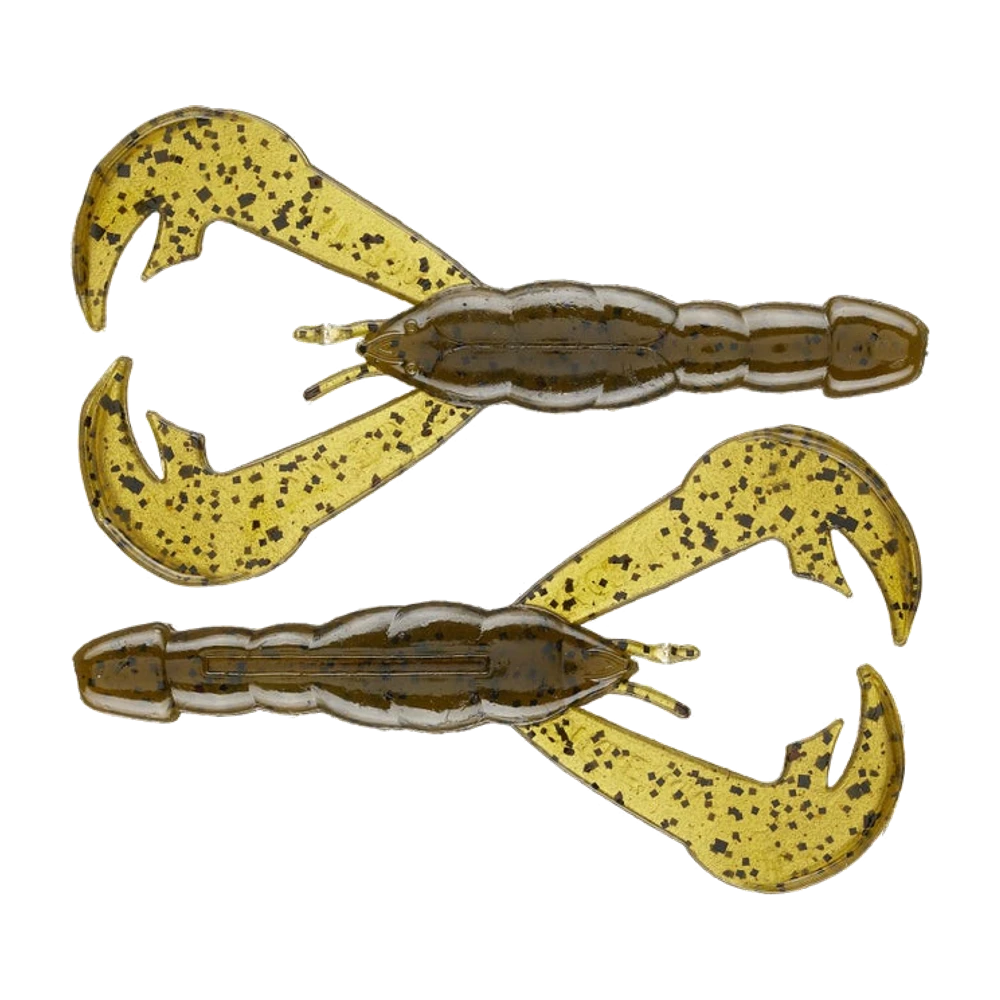
Strike King Rage Tail Craw: the soft craw whose claws kick on their own
This lure shines under specific conditions. CarnaFish tells you in 10 seconds if today is one of them.
A crawfish that darts away fast and vanishes under a rock doesn't interest a bass — there's no time to react. A wounded crawfish, waving its claws frantically without going anywhere, is a different story: it's an easy meal, and that's exactly what the Rage Tail Craw reproduces the moment it hits bottom.
Rage Tail technology in short
The Rage Tail Craw's two claws are moulded with a curved profile that grabs water differently on each side. The result: on the slightest movement — a pull, a fall, even vibration transmitted through the line — the claws thrash violently, with barely any retrieve needed to trigger it. That's what sets this craw apart from a generic model: most soft craws need real rod action to "come alive," the Rage Tail moves almost on its own.
Three rigs, three jobs
As a jig trailer
The most classic use. Slide the Rage Tail Craw onto a skirted jig's hook and it amplifies the jig's fall — the claws work the moment the jig hits bottom and through every following drop. This is the go-to combo for working a spot vertically, along a dock or a stump.
Texas-rigged for flipping and pitching
With a 7-14 g bullet weight free-sliding on the line and a wide-gap hook rigged weedless through the craw's back, you can flip it straight into the tightest brush and cover without hanging up. This is the technique that gets in where no hardbait can.
Carolina rig to cover ground
Fixed weight up the line, a metre-long leader, Texas-rigged hook. This setup covers large stretches of hard bottom or gravel while keeping the craw close to the ground through the entire retrieve.
A rule that applies to every craw bait: move it as little as possible. A crawfish rarely flees in a straight line at a steady pace — it moves in fits and starts, stops, backs up. Reproduce that with short hops and long pauses.
When to reach for the Rage Tail Craw
This is a cold-water and post-spawn bait through and through. Coming out of winter and right after the spawn, crawfish shake off their torpor and become an easy, abundant meal — bass key in on them far more than on fast-moving baitfish during this window. That's when this craw outfishes faster baits like a Strike King KVD Squarebill.
The mistake that costs bites
The classic trap: setting the hook the instant you feel a bite. A bass eating a craw often nips and releases it a few times before fully committing. Give it two or three seconds of felt "chewing" before you set, going by feel rather than weight.
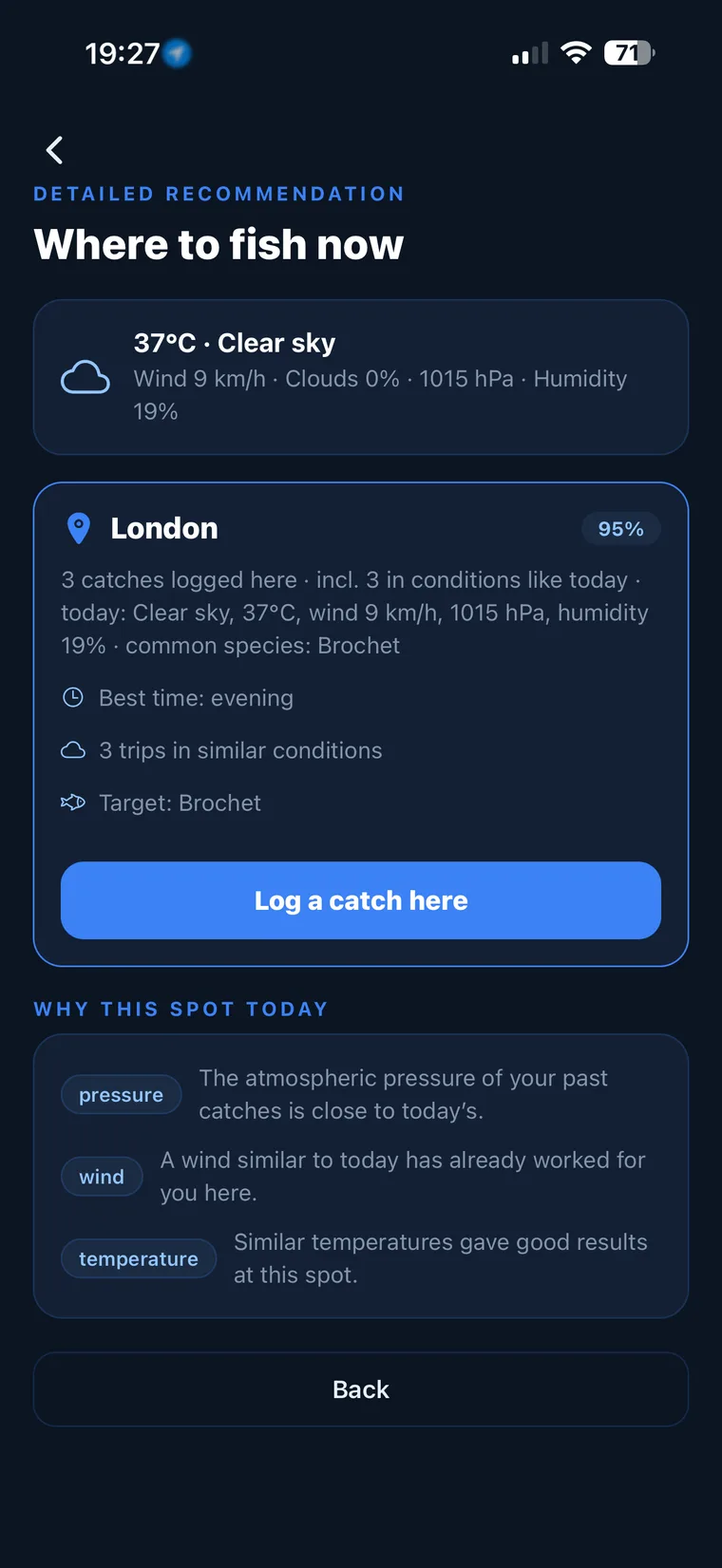
Not sure what to tie on?
Photograph your spot: CarnaFish reads the scene, cross-checks the conditions and gives you the zone, the lure and the retrieve. Free on iOS and Android.
Colour by water clarity
- Clear water: Green Pumpkin, the closest match to a real freshwater crawfish.
- Dark water or low visibility: Black/Blue Flake, a high-contrast silhouette that shows up from a distance.
- Post-spawn, warming water: Craw orange, mimicking the colouring of moulting crawfish, which are especially vulnerable during this period.
Rage Tail Craw or a cousin in the lineup?
Strike King offers the Rage Tail in several sizes and profiles: the original Rage Craw has a shorter, more compact body, better suited to small jigs and finesse rigs. For a thinner, more subtle profile in very clear water, a Molix Real Craw is worth considering.
The best craw bait in the world won't make up for fishing the wrong spot. That's the whole point of knowing where to look for bass before tying anything on — exactly what CarnaFish does: a photo of your spot, and the app suggests a zone and a presentation to try first. For tackle basics and typical spots, our beginner's guide to bass fishing is a solid starting point.
Key takeaways
- Rage Tail claws that kick on the slightest movement, even without much rod action.
- Three complementary rigs: jig trailer, Texas flip, Carolina rig.
- Excellent coming out of winter and post-spawn, when crawfish become an abundant target.
- Wait two to three seconds before setting the hook: bass often chew before fully committing.
FAQ
What hook should I use to Texas-rig the Rage Tail Craw?
A wide-gap hook, 3/0 to 4/0 depending on the bullet weight used, rigged weedless through the craw's back so it slips through brush without snagging.
Does the Rage Tail Craw work as a jig trailer?
Yes, it's one of its best uses. Slid onto a skirted jig's hook, it amplifies the jig's fall and keeps kicking its claws once it settles on bottom.
When should I fish a craw instead of a crankbait?
Mainly coming out of winter and post-spawn, when crawfish become an abundant target and bass are looking for a slow, easy meal rather than fast-moving baitfish.
Why am I missing bites with a craw bait?
Usually because the hookset comes too early. Bass chew and release a craw a few times before fully eating it — wait two to three extra seconds before setting.
What bullet weight should I flip the Rage Tail Craw with?
Between 7 and 14 g depending on cover density and depth: lighter for a slow fall in shallow water, heavier to punch through dense vegetation quickly.
What's the difference between the Rage Tail Craw and the Rage Craw?
The Rage Tail Craw has a longer body, better suited to Texas and Carolina rigs. The original Rage Craw is more compact, often preferred as a small jig trailer or in finesse rigs.
The full bass lure guideSeason-by-season strategy: which family of lure, when, and why.Go from theory to fish
CarnaFish reads your spot from a photo and gives you the game plan: zone, lure, retrieve. Free on iOS and Android.