DUO Realis Shinmushi: the lure you fish by doing nothing
Rather not fish it blind? Photograph your spot — CarnaFish cross-checks the conditions and points you the right way.
July, mid-afternoon. The bank is lined with willows and oaks leaning out over the water. Under every tree, in the shade, you can see discreet rises: a small ring, a sucking noise, nothing more. Those are not silver fish. They are bass picking off insects that have dropped from the branches.
At that moment, reaching for a popper or a stickbait is a mistake. All those lures imitate a wounded fish panicking on the surface. But the bass is not looking for a fish: over several weeks it has got into the habit of looking up at anything that falls and barely moves.
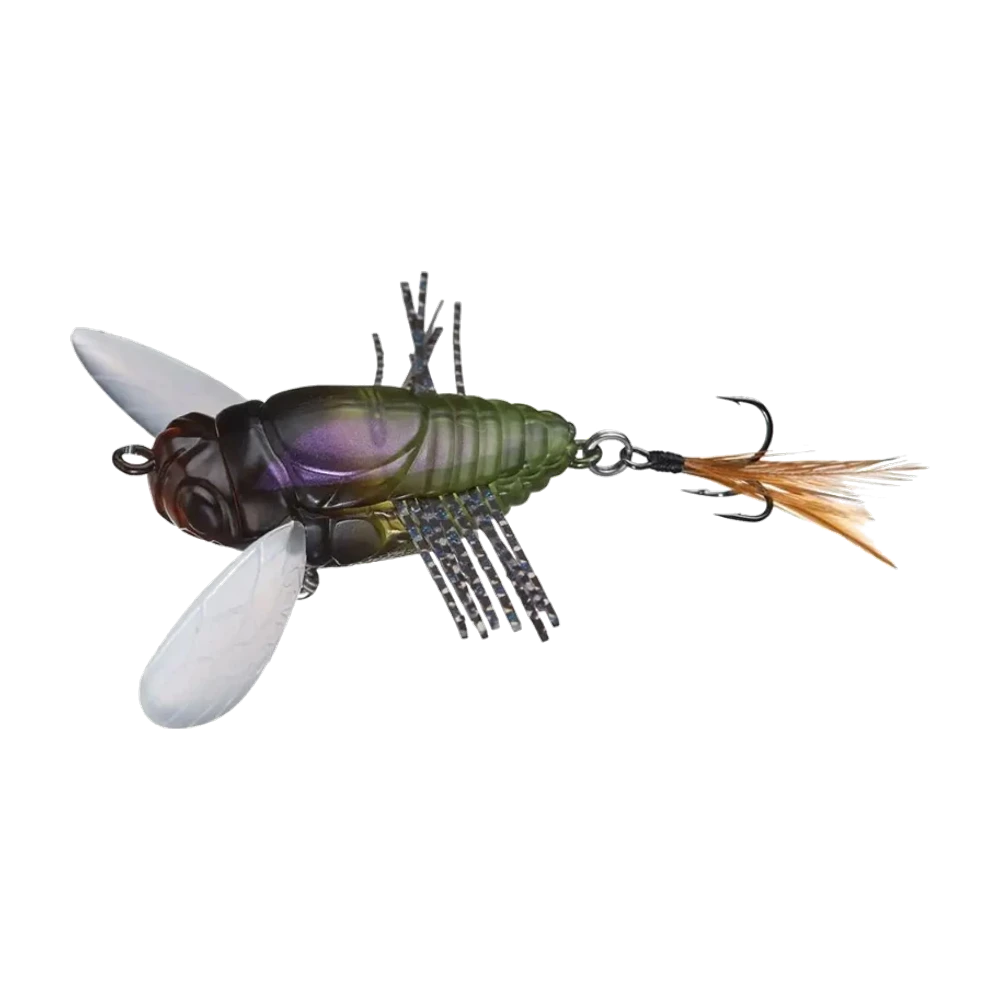
The Shinmushi imitates that something. It is a four-centimetre insect body with rubber legs that floats at an angle. And what makes it special comes down to one sentence: this is a lure you fish by doing nothing.
The tilted float and the legs: the whole mechanism
Three things define its behaviour, and none of them depends on you.
- It floats nose up, tail down. That tilt is the posture of a fallen insect that has broken the surface tension and is slowly drowning. It is not the same attitude as a horizontal surface lure.
- The rubber legs quiver constantly. The slightest breath of air, the smallest edge swirl gets them moving. The body is still, the legs are not: that is exactly the signal of an insect struggling without managing to escape.
- The density allows skipping. The lure skips across the water and lands under a low branch, in places no normal cast can reach.
The body usually carries two small fine trebles. On sucked-in surface bites, those are what stick — not a big Texas hook. That dictates the whole way you set.
Placement before retrieve: skipping
With this lure, eighty per cent of the result comes from the cast.
- Pick your landing spot before casting: the deepest pocket of shade under the branch, not the edge of it.
- Cast low and sidearm, rod parallel to the water, aiming twenty centimetres short of the surface so the lure skips.
- Thumb the spool on impact to avoid a bird's nest and so the lure lands without a jolt.
- Touch nothing while the rings disperse. Ten seconds, sometimes twenty.
- If nothing happens, give one small pull with the rod tip, just enough to make the lure shiver on the spot without moving forward.
- Wait another ten seconds, then reel in and start again on the next spot.
On the water: with a surface insect, the worst mistake is making the lure travel. An insect that has fallen in does not head out into open water, it struggles where it landed. If your surface rings move more than ten centimetres, you are fishing a stickbait, and you have thrown away everything the Shinmushi offers.
Reading a tree-lined bank before you cast
This lure does not search water. So you have to know where to put it, and a line of trees is not uniform.
- The shade-to-light edge is the most productive line. The bass sits in the shade and looks out into the lit water. Drop the lure on the dark side, thirty centimetres in from the edge.
- Branches touching the water create a channel: insects slide down the branch and fall. Aim at the exact contact point.
- Species matter. An overhanging oak or willow drops far more than a conifer. A poplar bank produces very little.
- A dead tree in the water combines both advantages: submerged cover and branches above. It is the most reliable spot of all.
Note the wind direction too. A breeze pushing towards the bank concentrates whatever is floating there; a breeze blowing off the bank shifts the accumulation zone a few metres out, and that is where the lure should land rather than tight against the roots.
Finally, take three minutes to watch before you cast. In this kind of fishing, one rise you have actually seen beats ten random casts — and a rise shows up as a ring appearing for no reason, in the shade, away from any current swirl.
The hookset: the real sticking point
This is where most anglers lose their fish.
A bite on a surface insect is sucked in, not smashed. The bass rises under the lure, opens its mouth and creates a vacuum: the lure vanishes into a small funnel, often without a splash. The reflex is to set on sight. That is too early.
The right sequence:
- Wait until you feel the weight in the line, not until you see the bite. Count one full beat.
- Set with a sideways sweep, rod out to the side and down, not up. A vertical hookset on a fish two metres away pulls the small trebles out.
- Keep constant tension afterwards: with fine trebles and a fish shaking its head on the surface, any slack costs you.
Fluorocarbon of 0.18 to 0.22 mm is the right compromise: discreet enough for clear water, strong enough to pull a fish out from under a branch. An L to ML rod with a forgiving tip completes the setup.
Not sure what to tie on?
Photograph your spot: CarnaFish reads the scene, cross-checks the conditions and gives you the zone, the lure and the retrieve. Free on iOS and Android.
When and where, precisely
Its windows:
| Condition | Why |
|---|---|
| June to September | The period when insects genuinely fall in the water |
| Overhanging, tree-lined banks | The bass sit underneath and wait |
| Clear to very clear water | The fish finds the lure by sight, which is essential |
| Sunny middle of the day | Shade under the trees concentrates the fish |
| After a blow | Insects fall in numbers, the fish are switched on |
Its blind spots:
- Stained water: without visibility, a motionless 4 cm lure never gets found.
- Big open expanses with no structure: nothing to fish, you need cover above the water.
- Strong wind and chop: the lure drifts off station and the rings vanish.
- Cold spring and late autumn: the fish are no longer keyed on insects.
- Covering water fast: twenty seconds per cast limits how many spots you can fish in an hour.
Shinmushi or compact popper
The Megabass Pop-X works on the opposite principle. It produces a signal — a spray, a sound — to call a fish that has not yet seen the lure. It is a calling tool, effective over a wide spot and on fish you have to persuade to come up.
The Shinmushi calls nobody. It simply has to be believable to a fish that is already looking up. That changes how you choose: if you see no sign of surface activity, take the popper; if you see rises under the branches, the popper will scare them off and the insect will catch them.
In the same vein, an Illex Bubble Bug covers a similar approach with a different profile, useful when you want to alternate without changing the logic. Our beginner's guide to bass fishing explains how to read a tree-lined bank before casting. And if you are torn between a calling lure and an insect imitation when you reach the water, CarnaFish analyses a photo of the spot and answers.
Key takeaways
- Tilted float and rubber legs: the body stays still while the legs move on their own.
- Skipping the lure under the branches accounts for most of the result, before any retrieve at all.
- Never make the lure travel: a fallen insect struggles where it landed.
- The bite is sucked in, so the hookset is delayed and sideways. Setting on sight tears the trebles out.
- A summer lure for clear water and tree-lined banks. Anywhere else it is useless.
FAQ
How do you work the Shinmushi?
As little as possible. You land it, you wait ten to twenty seconds without touching it, then you give a micro-pull with the rod tip to make it shiver on the spot. Making it travel destroys all its credibility.
When should you set the hook on a surface bite?
When you feel the weight in the line, not when you see the lure disappear. The bass sucks the insect in: setting on sight pulls the lure out of its mouth before it really has it.
What time of year should you use it?
June to September, when insects genuinely fall from the trees and the bass have got into the habit of looking up. Outside that window, a more conventional surface lure makes more sense.
Do you absolutely need clear water?
Yes. This is a small, motionless lure that puts out no sound and no vibration: the fish has to see it. In stained water it goes unnoticed and a popper does the job better.
How do you cast it under branches?
By skipping: a low sidearm cast, rod parallel to the water, aiming at the surface twenty centimetres short of the target so the lure skips. Thumb the spool on impact.
How does it differ from a popper?
A popper calls in a fish that has seen nothing, using noise and spray. The Shinmushi makes no noise at all: it relies on being believable to a fish already turned towards the surface. Neither replaces the other.
The full bass lure guideSeason-by-season strategy: which family of lure, when, and why.Go from theory to fish
CarnaFish reads your spot from a photo and gives you the game plan: zone, lure, retrieve. Free on iOS and Android.