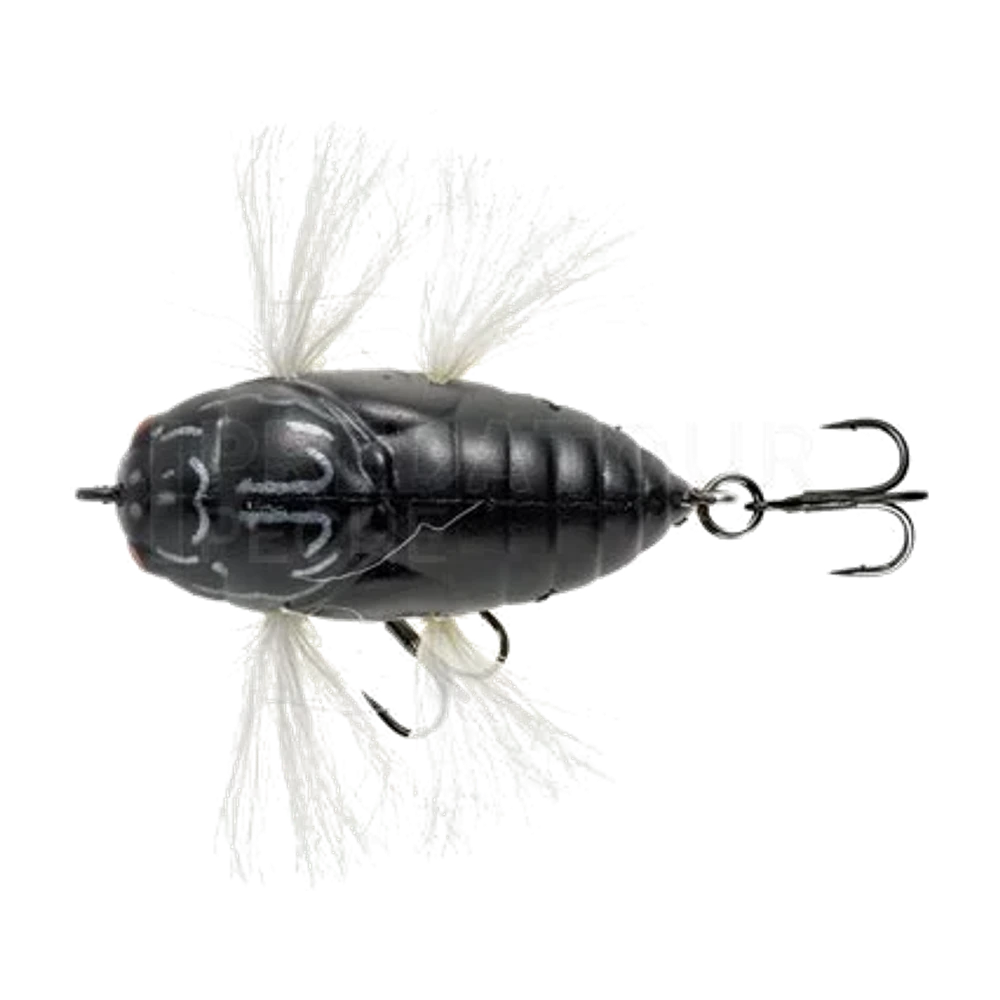
Tiemco Soft Shell Cicada: fishing the cicada fall under the trees
Rather not fish it blind? Photograph your spot — CarnaFish cross-checks the conditions and points you the right way.
Late July, two in the afternoon, thirty degrees. The water is dead: not a ring, not a swirl, nothing out in the open. You have tried everything offshore and you are starting to pack up. Go and look at the metre-and-a-half strip running along the shaded bank, where the alder and willow branches almost touch the water. There is a good chance every fish is in there, tucked under the cover, nose up.
What they are waiting for has nothing to do with a fry. In high summer, a wooded bank is a food source that falls from above: caterpillars, beetles, grasshoppers, and above all cicadas when the season allows. These insects arrive from overhead, hit the water with a dull plop, and struggle for a few seconds before sinking or being eaten. A bass sitting under a tree spends its day watching for exactly that.
The Soft Shell Cicada imitates the whole sequence. This is not a lure you retrieve, it is a lure you drop and let live. The entire technique is in the cast and in the patience that follows.
A soft insect, not a hard lure
The essential build detail is the material. The body is soft plastic, which produces three effects a rigid surface lure cannot reproduce.
The impact sound is dull. A hard lure hitting the water cracks. A soft body makes a muffled plop, exactly the sound of a falling insect. On a calm margin where the fish is a metre from the point of impact, that difference in tone matters.
The lure deforms under pressure. When a bass inhales it, it does not meet a hard block of resin that it spits out instantly: it feels something give. You gain a fraction of a second, and on a 4 cm lure struck at distance, that fraction decides a lot of fish.
The wings and legs quiver on their own. Sitting in the film, they respond to the slightest movement of water or the smallest tremor in the line. That is what makes a practically motionless presentation possible.
The lure floats flat, body in the water, wings resting on the surface. It does not dive and it does not right itself: it stays put, like an insect that cannot get going again.
The retrieve: skip it in and count to thirty
- Find the strip of shade. It is rarely more than two metres wide. That is your fishing zone, all of it. Anything three metres off the bank does not interest you.
- Cast flat and low, skimming the water, to slide the lure under the branches. An underhand pendulum cast, or a horizontal side cast, goes far deeper under cover than a standard overhead cast.
- Let it drop naturally for the last few centimetres. Do not feather the spool too early: you want the lure to hit the surface with the right sound.
- Touch nothing for twenty to thirty seconds. This is the hardest and the most important step. The lure sits there, the appendages work on their own, and the fish rises slowly to look at it.
- Give it two tiny shivers by tapping the blank with a finger, without taking up line. The lure must vibrate on the spot, not move forward.
- Wait another ten seconds, then repeat once. If nothing happens, retrieve slowly and cast again three metres further along the same margin.
Count on roughly a minute per cast. Over a hundred metres of bank you will spend an hour. That is normal: this is fishing by density, not by water covered.
On the water: never strike at the sound or the movement. A bass that takes an insect off the surface often turns it in its mouth before going back down, and an immediate hookset rips the lure away before it is properly taken. Count two full seconds after the take, wait until you feel the weight in the line, then sweep the rod sideways. It feels wrong, and it doubles your hook-up rate.
Setting up your line under the trees
| Constraint | Line choice | Reason |
|---|---|---|
| Open margin, clear water, wary fish | 0.20-0.22 mm fluorocarbon straight through | Maximum discretion, easy casting of a 5 g lure |
| Low branches, risk of hanging up overhead | 0.12 mm braid + 0.25 mm fluorocarbon leader | Lets you pull the lure off a branch without breaking |
| Good-sized bass in dense cover | 0.16 mm braid + 0.30 mm fluorocarbon leader | Immediate extraction before the fish buries itself |
| Very clear water, pressured fish | 0.18-0.20 mm fluorocarbon | Last resort when everything else fails |
Two details count as much as the line. The knot: prefer a loop knot to a knot cinched tight on the eye, so the body can move with the micro-movements of the line. The rod: a short 1.70 to 1.90 m model lets you cast underhand and backhand while keeping enough backbone to haul a fish out of cover.
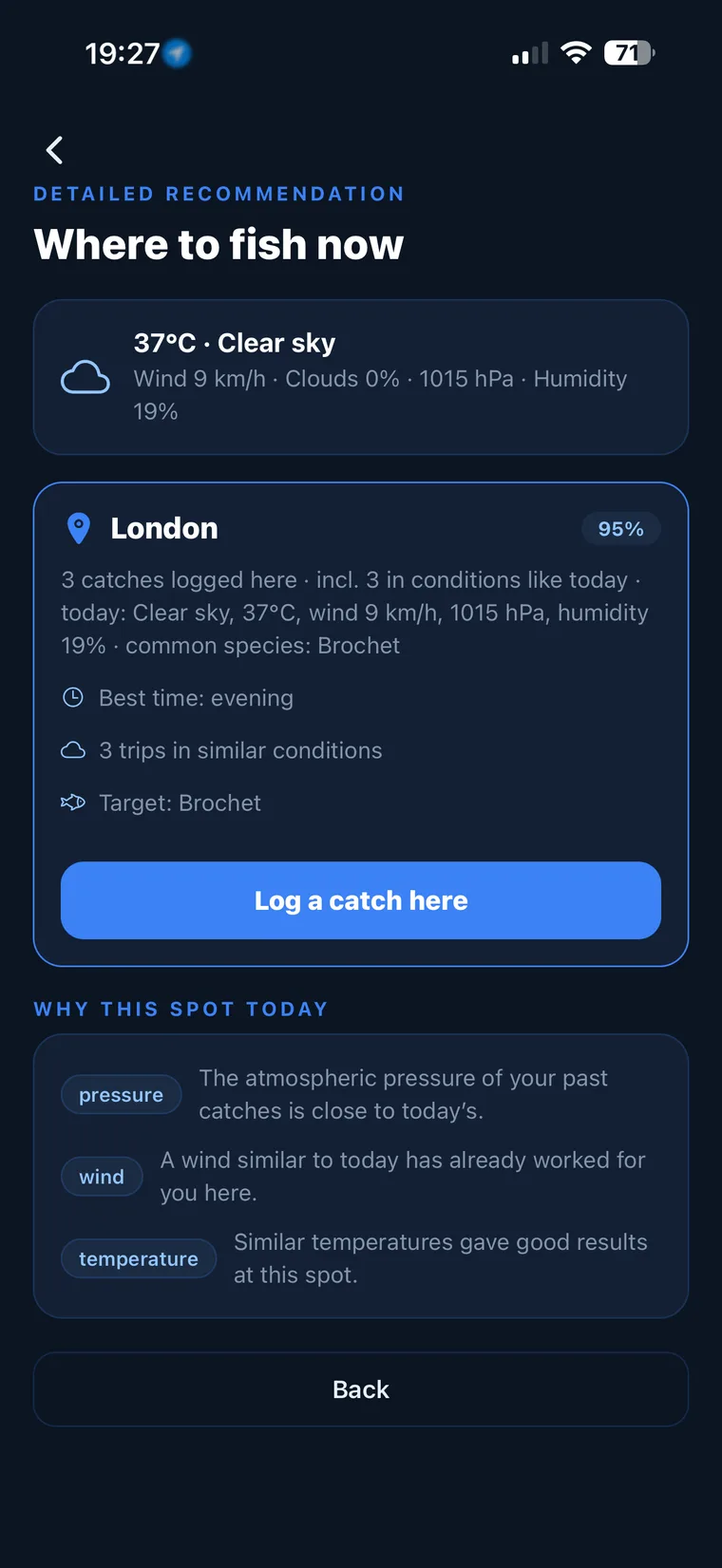
Not sure what to tie on?
Photograph your spot: CarnaFish reads the scene, cross-checks the conditions and gives you the zone, the lure and the retrieve. Free on iOS and Android.
Where and when this works
The window is narrow, and it pays very well while it is open.
- Season: late June to early September, peaking through the hottest spells.
- Time of day: unlike most surface fishing, this one works in broad daylight, between eleven and five, when the sun pushes fish under cover and insects are active.
- Spots: wooded banks with overhanging branches, alders, willows, bamboo; tree-lined canal margins; small forest ponds. Depth matters little, shade matters a lot.
- Conditions: calm and warm. A little wind shaking the trees is actually a bonus, because it knocks more insects down.
This approach is wrong everywhere else. On an open, treeless bank there is no insect fall, so no fish sitting in wait. In cold weather or in spring, bass are not keyed on that food source. And in choppy water or strong wind on the surface, a 5 g lure lying flat becomes unreadable and drifts out of control.
Cicada or another surface lure
Against an Illex Bubble Bug you stay in the insect-imitation family, but the use differs: the Bubble Bug is a hard lure you work more actively, with a stronger signal. The Soft Shell Cicada plays on soft material and near-total stillness — a notch further in discretion, to be kept for fish that have refused everything else.
Against a Booyah Pad Crasher the logic changes completely. The weedless frog is fished on top of the cover, walked with heavy line: that is power fishing. The cicada is fished under the cover, in the strip of open water in the shade, with fine line and stillness: that is finesse fishing. And if you need to comb the bank rather than work spot by spot, bring out the Strike King KVD Splash: big spray, continuous movement, the opposite logic.
Our guide on how to read a fishing spot helps you pick out productive shaded margins at a glance, and the beginner's guide to bass fishing places this technique within the season. If you are unsure which margin to attack first when you arrive at a summer pond, CarnaFish analyses a photo of the spot and answers.
Key takeaways
- Fish the strip of shade under the branches, one to two metres wide, no more.
- The soft body changes the impact sound and delays the spit-out: two decisive advantages.
- Twenty to thirty seconds of stillness after the drop, then shivers on the spot without moving forward.
- Strike two seconds after the take, on weight, never on sound.
- Narrow window: high summer, broad daylight, wooded banks, calm weather.
FAQ
When should you fish a cicada imitation?
From late June to early September, in broad daylight, along banks shaded by trees. It is one of the rare surface techniques that works better at two in the afternoon than at dawn, because the fish sit under cover waiting for insects to fall.
How long should the lure stay still?
Twenty to thirty seconds after impact, doing absolutely nothing. That is the step almost everyone cuts short. The bass rises slowly to inspect the insect, and it is during that wait that the soft appendages work on their own.
How do you cast under low branches?
Underhand, with a pendulum or a horizontal backhand cast, skimming the water. A standard overhead cast sends the lure too high and hangs it in the branches. A short 1.70 to 1.90 m rod makes the movement far easier.
Why does the fish spit the lure out?
Usually because you struck too early. A bass turns an insect in its mouth before swallowing it: count two seconds, wait to feel the weight in the line, then sweep sideways rather than upwards.
Braid or fluorocarbon?
Fluorocarbon straight through, 0.20 to 0.25 mm, on an open margin, for discretion and for casting a light lure. Under branches or in dense cover, switch to fine braid with a fluorocarbon leader, which lets you free the lure and haul fish out.
Does this work on a bank with no trees?
No. The whole principle rests on insects falling from overhanging vegetation and on fish positioned to wait for that windfall. With no cover above the water there is neither a food source nor fish in position.
The full bass lure guideSeason-by-season strategy: which family of lure, when, and why.Go from theory to fish
CarnaFish reads your spot from a photo and gives you the game plan: zone, lure, retrieve. Free on iOS and Android.