Evergreen Gizmo: the floating cicada imitation for finesse topwater
Rather not fish it blind? Photograph your spot — CarnaFish cross-checks the conditions and points you the right way.
There are days when bass stop looking at the water and start looking at the trees. Insects dropping out of the canopy, spent cicadas on the surface, gnats sitting on the film: the fish tucks under an overhang and waits for a terrestrial to make a mistake. In those conditions a 12 cm walking bait triggers nothing at all, because it looks like none of what the fish is watching for. The Evergreen Gizmo answers that exact scenario.
A bait designed around one specific prey
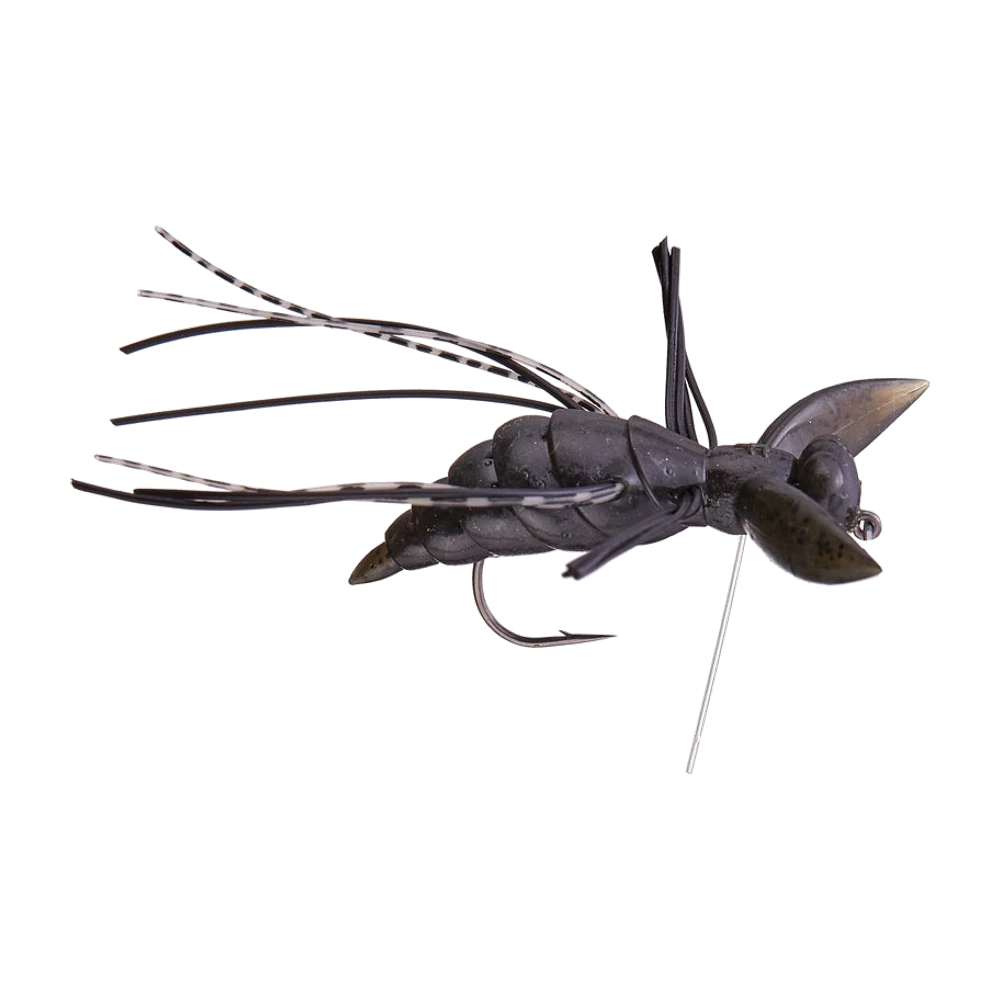
The description is explicit about the intent: imitate a cicada, which is a major food source for bass in parts of the United States, Mexico and Japan. That is not a marketing line, it is a design constraint — and you can see it in the photo. Segmented abdomen, two wings folded over the back, barred rubber legs front and rear, a short stocky silhouette. Nothing on this bait is trying to look like a fish.
As for numbers, the table gives 1-1/2 in, or 3.8 cm, at 1/10 oz, class floating. One honest caveat is due on the weight: a tenth of an ounce is not a fraction you meet often in the trade, where sixteenths and eighths are the norm. It most likely comes from converting a round figure in grams, around 2.8 g. We take it as an order of magnitude, without being able to verify it, and it is enough to pick your tackle.
What elastomer changes versus ordinary soft plastic
The body is not soft PVC but elastomer, a material that is both very tough and very buoyant. Two direct consequences, and they matter more than anything else.
The first is flotation. The bait sits on the surface with no help at all, hook included, and it stays there indefinitely. You can leave it motionless for thirty seconds under a branch without it sinking, which is precisely the presentation a holding fish waiting on an insect wants to see.
The second is responsiveness. An elastic material returns the smallest rod-tip impulse instantly. In practice, a two-centimetre wrist vibration is enough to make all four rubber legs quiver, ringing the surface without the body moving at all. That is the bait's most important movement: a live insect struggling in place, not a prey fleeing.
Do not advance it. The most common mistake with this kind of bait is reeling it in. Drop it twenty centimetres off the bank, leave it absolutely still for five seconds, then shake the rod tip without recovering a centimetre of line. If nothing happens, wait another five seconds and start again. A Gizmo that travels no longer looks like a cicada.
The weed guard, and what it genuinely allows
The bait ships with a translucent monofilament weed guard, visible in the photo, and a size 2 Decoy jig hook moulded directly into the body. That setup is not removable: the lure is fished as it comes, with no added weight and no special leader.
Translucent mono has one advantage and one drawback. The advantage: it is far less visible than a wire guard or an opaque double strand, which counts when a fish is inspecting a prey sitting ten centimetres from its nose. The drawback: it protects less. Evergreen talks about trees, laydowns and brush, and that is the right level of ambition — you fish along a submerged branch, through scattered grass, under an overhang. You do not cross a closed lily pad mat: for that you need a hollow-body frog with the point fully tucked away.
Tackle, the real bottleneck
2.8 g is the weight that disqualifies most setups. With a standard casting rod, or even a 5-20 g spinning rod, you will not throw this bait more than ten metres and you will not place it accurately under a branch. You need a light spinning rod, ideally a finesse or BFS blank, with a tip soft enough to load on that little weight. Evergreen goes as far as offering a dedicated spinning rod in its own range, which says plenty about what the format demands.
For line, thin mono or fluorocarbon rather than braid. Mono floats and does not pull the bait's nose down during long pauses, and its stretch cushions the hookset on a single size 2 hook, which does not forgive a violent snatch.
The classic mistake
Setting the hook too hard, out of reflex inherited from ordinary topwater baits. Here you have one single hook, in an elastomer body that compresses, on a light rod and thin line. A sharp, powerful set rips the bait out of the mouth before the point ever drives home. The right reaction is a sweeping sideways set, progressive, triggered when you feel weight — not when you see the rise.
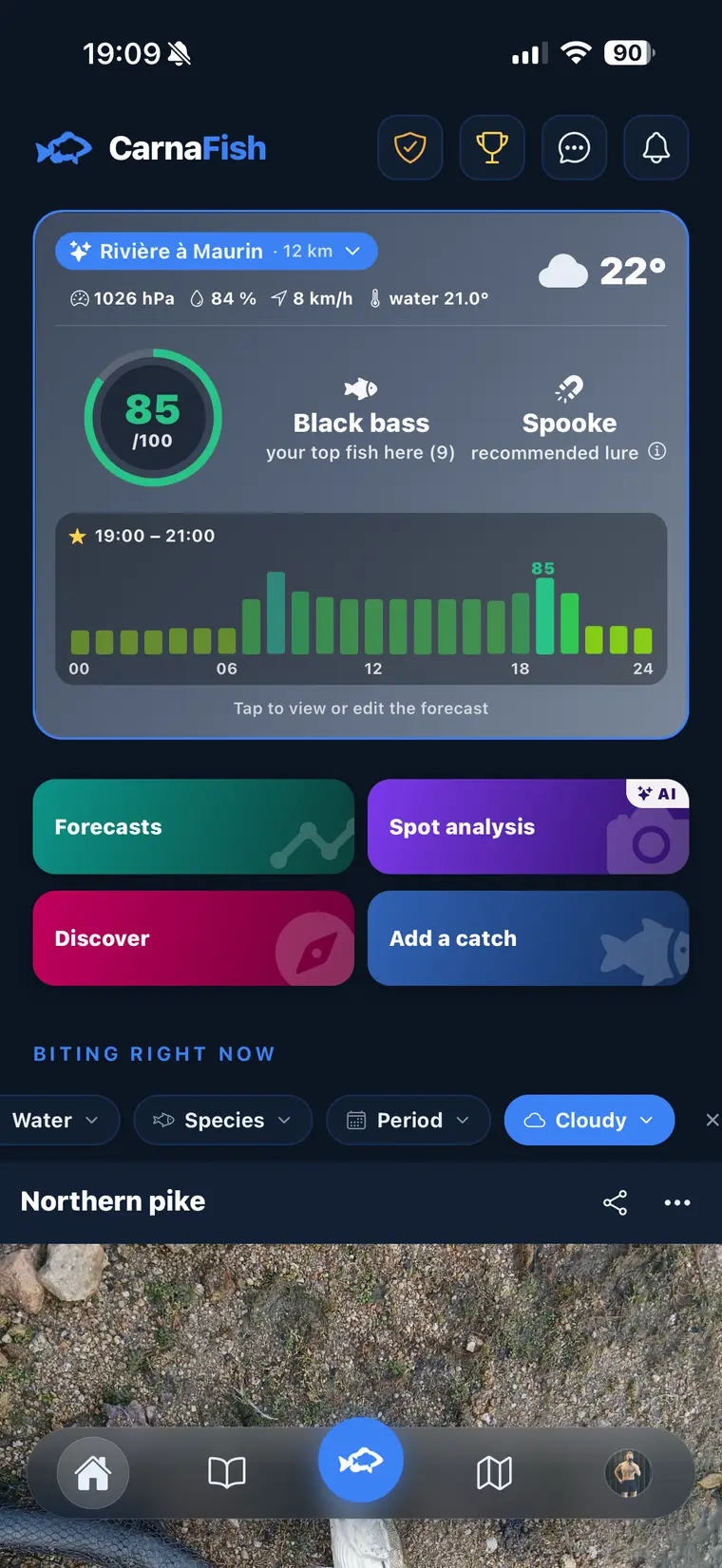
Not sure what to tie on?
Photograph your spot: CarnaFish reads the scene, cross-checks the conditions and gives you the zone, the lure and the retrieve. Free on iOS and Android.
Colours by light
- Full sun, fish looking up: black, like the one in the photo. On top, the fish sees a shadow against the sky, and black gives the cleanest outline. By far the most logical colour for an insect imitation.
- Clear water and sight fishing: a natural green or brown, which holds up when a fish comes in to inspect a motionless bait at close range.
- Overcast, low contrast: a lighter finish, which compensates for the absence of strong backlight and stays detectable from below.
The Gizmo is not a search bait: you pull it out once you have identified a fish or a precise spot, under a low branch, along a dock or at the edge of a weed mat. In the same fallen-insect register, the Tiemco Critter Tackle Cicada plays a close tune with a hard body. And if the fish definitively refuses the surface, dropping into subsurface finesse with an ultra-thin worm like the Evergreen Bow Worm Noodle is the logical switch. For denser weed, go back to a better-protected Gunki Micro Frog.
Knowing when fish are looking up is half the job. CarnaFish helps you decide from a simple photo of the spot, suggesting the zone, the depth and the type of presentation that match the day's conditions. To go back over bass spot fundamentals, our beginner's guide to bass fishing walks through the situations one at a time.
Key takeaways
- 3.8 cm / 1.5 in, around 2.8 g, class floating, size 2 Decoy hook moulded into the body: the bait is fished exactly as it comes.
- Elastomer gives permanent flotation and instant leg response to the smallest rod-tip twitch.
- The action happens in place: a Gizmo that travels loses the whole point.
- Translucent mono weed guard: discreet, but not enough inside a closed weed mat.
FAQ
What exactly does the Gizmo weigh?
Evergreen lists 1/10 oz, roughly 2.8 g. That is an unusual fraction in the trade, most likely the result of converting a round figure in grams, and we could not cross-check it. Take the order of magnitude: a bait under 3 g, which forces a matched setup.
Can I cast it on a normal rod?
Barely. Under 3 g, a light spinning or BFS rod is close to essential for distance and above all for accuracy. On a standard setup you can get it on the water, but not slide it under a low branch at fifteen metres.
Does the Gizmo really float with the hook in it?
Yes, the manufacturer's table lists it as floating and the body is elastomer, a very buoyant material chosen for exactly that. The single moulded hook is not enough to sink it.
Should I remove the weed guard?
No. The mono strand is translucent and barely visible, and it does not hinder the hookset on a single hook. Removing it would cost you the ability to fish along laydowns, which is this bait's whole terrain.
Which colour first?
Black. On topwater the fish sees a backlit silhouette, and black gives the most readable outline. Natural tones only take over on sight fishing in very clear water, when a fish closes in to inspect.
Does it work outside insect season?
Yes, but less well. It stays credible all through the warm season wherever there is bankside vegetation hanging over the water. Outside periods of surface activity, though, a subsurface bait will almost always do better.
The full bass lure guideSeason-by-season strategy: which family of lure, when, and why.Go from theory to fish
CarnaFish reads your spot from a photo and gives you the game plan: zone, lure, retrieve. Free on iOS and Android.