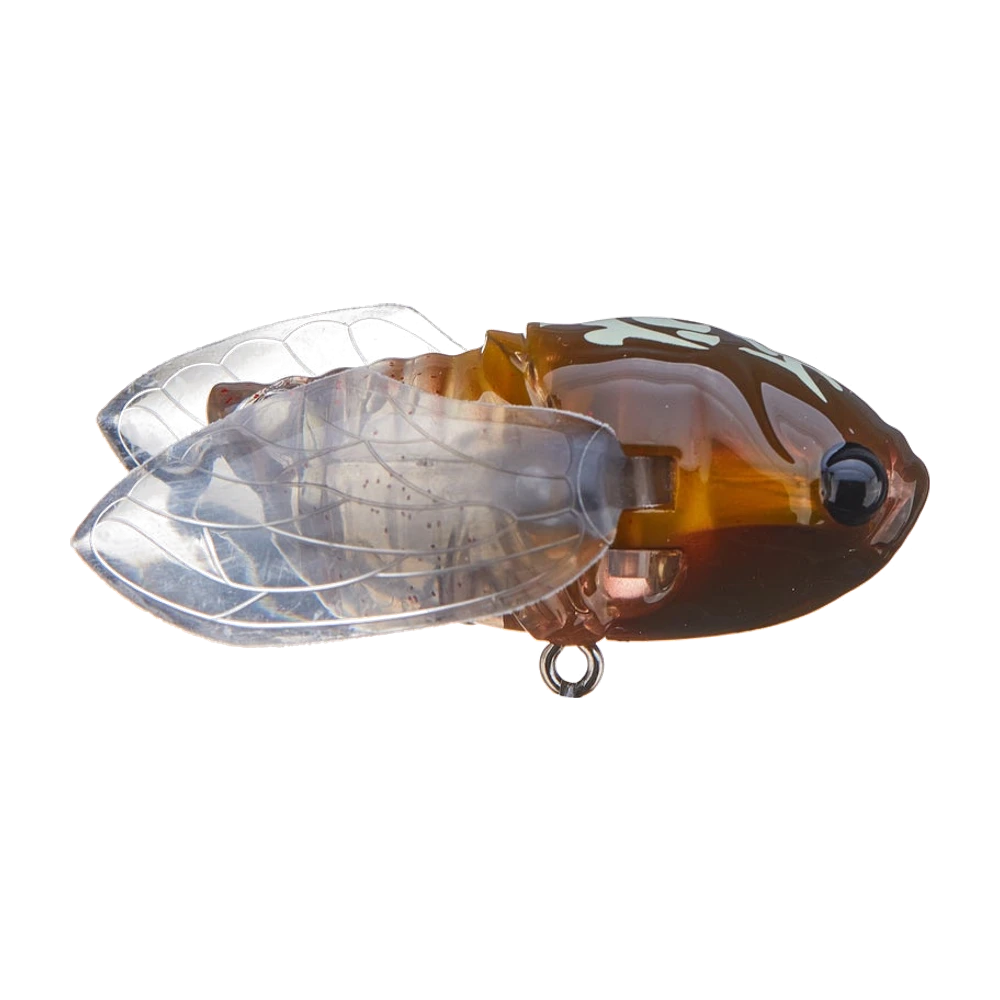
Megabass Grand Siglett: the 4 cm cicada that crawls instead of walking
The right lure in the wrong spot still catches nothing. CarnaFish spots the zone that works, from a single photo.
Late July, a river arm lined with trees, cicadas or heavy insects dropping into the water every couple of minutes and fish rising under the branches. No conventional stickbait will help you here: the fish is locked onto a prey that doesn't dart away in a zigzag but falls, struggles and exhausts itself on the spot. The Megabass Grand Siglett imitates that behaviour, and it belongs to a lure category barely represented in Europe.
A shelf label that doesn't describe what the lure does
Let's settle this first: the Grand Siglett is often filed under "walking bait" by retailers, but the Megabass technical description calls it a crawling topwater cicada lure. That's not a nuance: a walking bait travels in a zigzag from side to side, while the Grand Siglett crawls, bubbles and thrashes while barely moving forward. Buy it expecting the walk of a stickbait and you'll be disappointed. Taken for what it is, it does something no stickbait can.
The published figures are short: 1-2/3 in, roughly 4.2 cm, for 1/4 oz, roughly 7.1 g, and the class is Topwater. That's very dense for a 4 cm bait — nearly as heavy as a stickbait twice its length. Two reasons, both in the description: the body houses a tungsten alloy balancer, and the bait carries an extra-wide-gap double hook. That density is also what makes a bait this small castable at all.
The wings are the real mechanism
They're the centrepiece. On the cast the wings fold tight against the body: the bait becomes a compact projectile and travels a long way despite its 4 cm. From the first pull on the line they open wide and the bait's behaviour changes completely.
With the wings open, on a slow to medium retrieve, the Grand Siglett crawls across the surface throwing water and leaving a bubble trail. The wings act as brakes and paddles at once: they stop the bait running away and turn every centimetre of travel into commotion.
On micro-twitches it barely moves at all and pulses in place. That's the presentation for under a low branch, in a dead-water pocket or along a dock — where you have one useful square metre and a bait that travels leaves the spot in two seconds.
Finally, on short but strong pulls it erupts into a burst of noise and spray. That's the provocation move, saved for waking up a fish that ignored the first two presentations.
Alternate within a single cast: two hard pulls to draw attention from a distance, then ten seconds of micro-pulsing on the spot. The strike almost always comes in the slow phase, but it would never have happened without the noise that pulled the fish in.
The rattle chamber and the cicada's cry
The Grand Siglett's hard-plastic exoskeleton doubles as a resonance chamber: inside, the tungsten alloy balancer produces a sound Megabass describes as tuned to mimic a cicada's fading cry. The claim sounds poetic, but the concrete result is a high, irregular tone very different from the dull knock of a crankbait rattle.
In practice that matters most in cluttered water or under trees, where fish work by ear as much as by sight. And it explains the choice of frequency: low notes travel far but locate badly; high notes let a fish pinpoint the source precisely, which is exactly what a bait that barely moves needs.
The reversible double hook
Two settings, two uses
The Grand Siglett ships with an extra-wide-gap double hook, and Megabass has built it so you can switch the direction of the points. The two settings do not belong in the same place.
In dense cover — trailing branches, weed, timber — turn the points upward, tucked alongside the body. The bait becomes near weedless and you can work it among obstructions without spending the day unhooking it.
In open water, or when fish strike short and come off, turn the points away from the body. The hook-up ratio climbs noticeably, at the price of a bait that catches on anything it touches.
The classic mistake
Leaving the weedless setting on an open spot "just in case". You then pay both penalties with none of the benefits: you miss fish on a spot where nothing forced you to shield the points. Take thirty seconds at the water's edge to set the hook for the swim you're actually going to fish.
Not sure what to tie on?
Photograph your spot: CarnaFish reads the scene, cross-checks the conditions and gives you the zone, the lure and the retrieve. Free on iOS and Android.
Colour by light and setting
- Clear water under trees: the translucent amber brown from the photo, with its cream marbling. That's the most credible insect silhouette when fish are keyed on natural falls.
- Against the light, open bank: a black body. Seen from below against a bright sky only the outline counts, and black gives the cleanest one.
- Cloud cover or lightly stained water: a pale tone, white or chartreuse, to keep a visible reference point when the surface turns grey.
A format that isn't fished like a search bait
A 4.2 cm bait covers very little ground. The Grand Siglett isn't built to rake a two-hundred-metre bank, it's built to grind on a spot you've already identified. That's also why it fishes so well for perch, which is often the best-placed fish under a tree in summer.
To search before you pull this one out, a Megabass Giant Dog-X will cover water far faster, and a Megabass Pop-X will make more noise along a bank. For a comparable small-and-targeted topwater logic, the Damiki Umpa 40 BFS plays in the same yard. And if the spot sits squarely in floating vegetation, a Megabass Gabarin Jr. Frog is the tool to reach for.
Finding those spots under the trees, spotting insect falls and picking the hour is half the work. CarnaFish exists for exactly that: a photo of the bank, and the app suggests the zones to grind and the presentation that matches the time of day. To go further on the species most concerned by these small topwaters, our guide to perch fishing with lures fills in the rest of the frame.
Key takeaways
- This isn't a walking bait: the Megabass description calls it a crawling cicada-shaped topwater, and that's what it does in the water.
- 4.2 cm for 7.1 g is dense: a tungsten balancer and a double hook explain the weight, and the weight explains the casting distance.
- The wings fold on the cast and open on the first pull, which gives you two behaviours inside one bait.
- The double hook sets both ways: points tucked in cover, points out in open water.
FAQ
Does the Grand Siglett walk like a walking bait?
No, despite the name it's often sold under. The Megabass technical description calls it a crawling topwater, not a bait that zigzags. It moves a great deal of water while travelling very little — the opposite of what a stickbait does.
Why does a 4 cm bait weigh 7 g?
Because it carries a tungsten alloy balancer inside a hard-plastic exoskeleton that doubles as a resonance chamber, and because it's armed with an extra-wide-gap double hook. That density is also what lets you cast a bait this small to a useful distance.
How should the double hook be set?
Points turned upward and tucked along the body in dense cover, to limit snagging. Points turned away from the body in open water or when fish strike short, to improve hook-ups. Megabass designed the hook to allow both.
What time of year suits this bait?
Mainly summer, when insects drop into the water and fish are keyed onto those falls. A tree-lined river arm, a pond with branches trailing in the water, a warm late afternoon: that's the context where an insect silhouette beats a baitfish imitation.
Does it catch perch?
Yes, and that's one of its best uses outside bass. The 4.2 cm format suits a perch's mouth exactly, and summer perch often sit precisely where this bait works best, under low branches.
Is it effective in open water?
Less so. It barely travels, so it covers little ground per unit of time. In open water its hard pulls serve mainly to draw in a fish you've already located; along an empty bank with no focal point, a popper or a stickbait will pay better.
The full bass lure guideSeason-by-season strategy: which family of lure, when, and why.Go from theory to fish
CarnaFish reads your spot from a photo and gives you the game plan: zone, lure, retrieve. Free on iOS and Android.