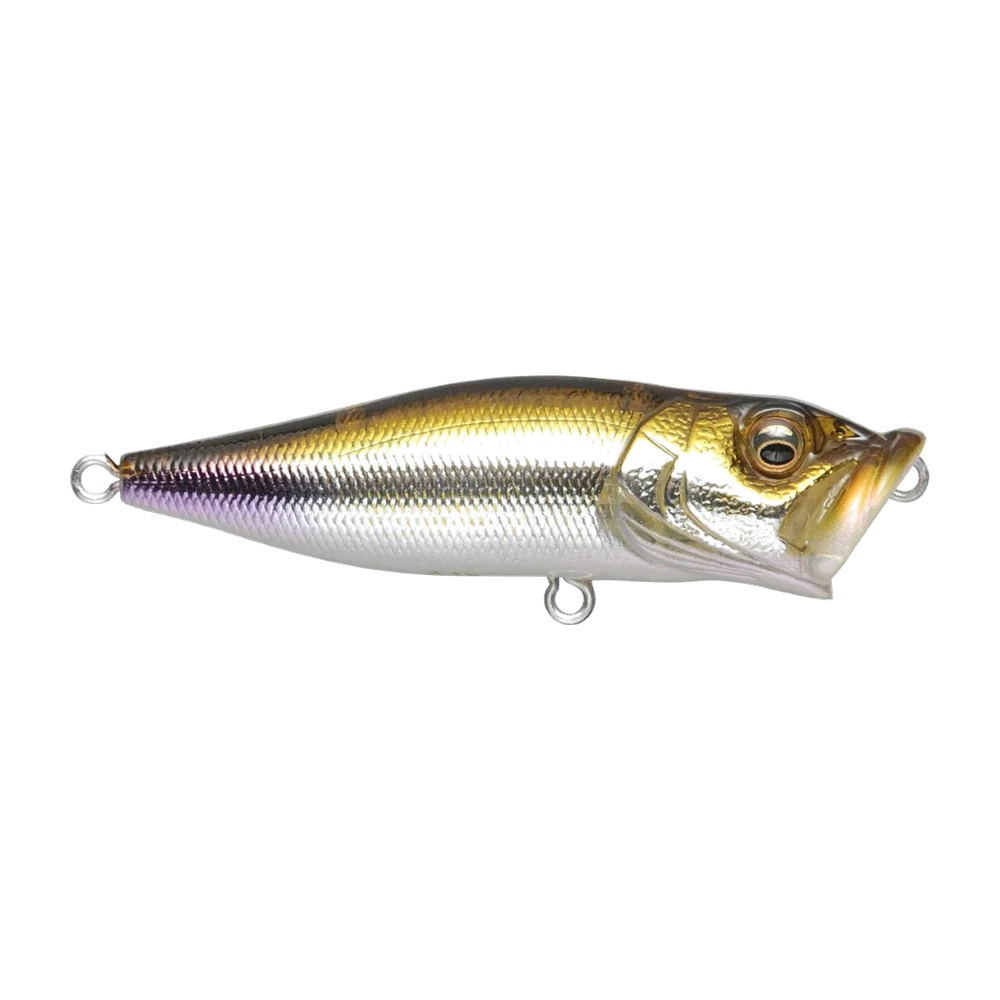
Megabass Pop-X: the popper that dips its nose under the water
Not sure this lure fits YOUR spot today? CarnaFish tells you in 10 seconds, from a photo.
Most poppers work while staying flat: the cupped nose strikes the surface, throws water, and the body stays horizontal. The Pop-X does something else. On every pop, its nose dips briefly below the surface before returning to horizontal, producing a finer spray, a quieter sound, and above all a bubble of air dragged underwater.
That design detail explains why this little Japanese popper has a reputation for catching fish that classic poppers no longer convince.
A fine spray rather than a big plop
A wide-mouthed popper displaces a lot of water and produces a deep sound that carries far. That is perfect for calling fish scattered across a big expanse — and it is too much on a small clear water where the bass have already heard that noise a hundred times.
The Pop-X offers the opposite:
- A reduced, vertical spray, looking more like an insect or a fry taking something off the surface than a panicking fish.
- A bubble of air dragged under as the nose dips, which then rises and creates a secondary visual signal.
- An immediate return to horizontal, the lure settling without drifting, which lets you link pops in the same spot.
The retrieve: one pop, then nothing
This is where most anglers go wrong with this lure. The reflex is to link pops together. The Pop-X demands the opposite.
- Cast and wait for the rings to disperse completely. Five to ten seconds, doing nothing.
- One sharp pop, wrist only, rod tip down.
- A long pause, three to five seconds. The lure sits still while the rear feather keeps moving imperceptibly.
- Repeat, holding that slow rhythm through the whole retrieve.
Field rule: on a discreet popper, the spray is only an announcement. It is the silence that follows which decides the fish. Link your pops together and you delete exactly the phase that produces bites.
A useful variant when a fish follows without attacking: two pops very close together, then a dead stop. That abrupt change of rhythm often forces the decision.
The rear feather is not decoration
The rear treble carries a feather. It plays a precise role: during the pause, while the body is perfectly still, the fibres keep breathing with the slightest current. It is the only visible movement at that moment, and it is often what triggers the take.
Two practical consequences: do not trim it, and replace the hook with an equivalent feathered model when it wears out.
Where it excels
The Pop-X is a precision lure, not a searching one.
- Small clear waters where a loud popper sends fish fleeing.
- Precise, sheltered spots: under a low branch, against a jetty, at the edge of weed.
- Educated fish, on heavily fished water where big poppers no longer work.
Conversely, it is poorly suited to large windy expanses: too light to cast far, too discreet to call from a distance, and its fine spray is lost as soon as there is chop.
Not sure what to tie on?
Photograph your spot: CarnaFish reads the scene, cross-checks the conditions and gives you the zone, the lure and the retrieve. Free on iOS and Android.
Colours
- Clear water, full sun: translucent, natural tones that let light through.
- Overcast: a little more contrast, a darker back.
- Backlight: a dark silhouette, as with any surface lure — the fish sees a shape cut out against the sky, not a colour.
Pop-X or classic popper
A bulkier popper such as the Rebel Pop-R produces a strong signal and carries far: the right choice over a large area, in stained water, or on active fish. The Pop-X takes the lead exactly where the other fails: small volumes of water, clear conditions, wary fish, precise spots.
The two do not replace each other — they cover opposite situations. Our beginner's guide to bass fishing covers the windows where topwater beats everything else. And if you are unsure whether a surface lure makes sense when you reach the bank, CarnaFish analyses a photo of the spot and answers.
Key points
- The nose dips under on every pop: fine spray, quiet sound, air bubble dragged under.
- One pop, then three to five seconds of pause. The pause is the retrieve.
- The rear feather moves during the stillness: do not remove it.
- A precision lure for clear water and educated fish, not for searching.
- Ineffective as soon as there is chop or wind.
FAQ
Why does the Pop-X dip its nose?
By design: the head shape and mass distribution make the nose dip below the surface on the pop. That produces a finer spray and drags a bubble of air under, two signals more discreet than a classic popper's.
How many pops should I link together?
One, followed by a three to five second pause. Linking pops is the commonest mistake with this lure: it removes the still phase during which the fish makes up its mind.
Is the Pop-X suitable for big waters?
Hardly. Its low weight limits casting distance and its fine spray is lost in chop. Over a large expanse or in wind, a bulkier popper suits better.
Should I keep the rear feather?
Yes. It keeps moving during the pauses while the body is motionless, and that residual movement is often what triggers the attack.
What line should I use?
Fluorocarbon of 0.20 to 0.25 mm. Finer and you lack strength for hooksets near structure; heavier and you restrict the action of a lure weighing only 7 g.
When should I prefer a classic popper?
As soon as the surface is choppy, the area to cover is large, or the water is stained. The Pop-X is built for clear, calm water and fish that have seen everything.
The full bass lure guideSeason-by-season strategy: which family of lure, when, and why.Go from theory to fish
CarnaFish reads your spot from a photo and gives you the game plan: zone, lure, retrieve. Free on iOS and Android.