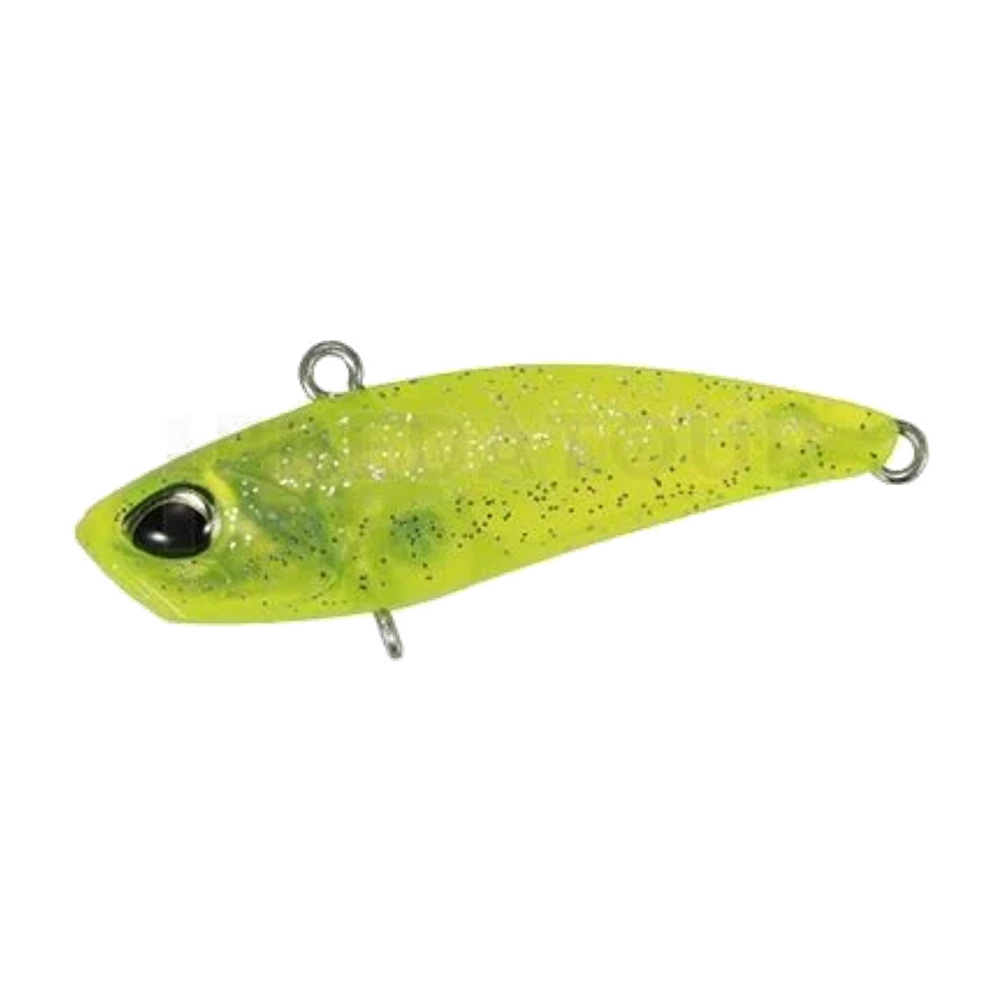
DUO Tetra Works Bivi: the micro vib that sinks fast and small
Before tying this one on, it helps to know if the spot actually calls for it. CarnaFish reads the scene from a photo.
In winter, perch gather in tight shoals and hold deep, often glued to the bottom, in very specific places: the corner of a dock, a hole in a canal, the foot of a quay. The problem is not finding them — they are always in the same spots — but presenting them something small, quickly, at three or five metres down, without spending thirty seconds getting the lure there.
A small shad on a light jig head takes forever to sink. A heavy jig head brings a profile that is too big. And a crankbait never reaches that layer.
The Bivi solves exactly that problem. It is a 4 cm lipless weighing around 5 g: an unusual density for that size, which lets it reach the bottom in three or four seconds while keeping the profile of a small baitfish.
Small, dense, and loud for its size
The body is flat and deep, with a blade-like section seen head on. That geometry produces a high-frequency vibration on the slightest movement, going up or going down. Unlike a soft shad, the Bivi does not need a firm pull to come alive: it vibrates as it falls.
The line tie sits on its back, not on the nose. That is the lipless signature: the lure is pulled from above, which forces it to work nose down and vibrate along its whole axis. Many models offer several attachment points: moving the tie back levels the lure and raises the frequency, moving it forward tilts it more and lengthens the glides.
The descent is flat, with a rocking motion. This is what matters most in vertical fishing. A lure that drops nose first says nothing during its fall; the Bivi falls swinging, so every descent is a fishing phase in its own right.
It makes noise. The internal beads generate a high-pitched rattle, audible and detectable by the lateral line several metres away. On a shoal of perch in cold, slightly coloured water, that signal is often what gathers the fish around the lure.
Two retrieves depending on context
On the cast, over a flat or a hole
- Cast and let it drop on a free line while counting. Around three seconds per metre, to be adjusted on your first cast.
- On bottom contact, lift the rod fifty centimetres, firmly, over one second.
- Let it fall back with the rod following it, tip tracking the lure. Do not leave the line completely slack: you would not feel the bite.
- Take up the slack, wait a second, start again.
- Two casts out of five, swap the lift for five turns of the handle at moderate speed. On some days the perch are a metre off the bottom and only the straight retrieve reaches them.
Vertically, along a quay or a piling
- Drop the lure to the bottom, keeping the line controlled.
- Lift it just twenty centimetres, with a short sharp flick of the wrist.
- Let it fall back with the rod following until it touches down.
- Wait two to three seconds without moving on the bottom.
- Repeat, moving a metre along the quay each time.
On the water: with a micro vib, almost every bite comes during the descent, and they show up as an absence — the lure stops before it should, or the line stops paying out. Count your seconds of fall systematically on the first casts. The moment a descent ends earlier than the previous ones, set the hook: a perch has intercepted the lure in mid-water.
Setting up by depth
| Spot | Depth | Retrieve | Expected fall time |
|---|---|---|---|
| Canal, margin | 1.5 to 2.5 m | 50 cm lifts on the cast | 5 to 8 s |
| Harbour dock | 3 to 5 m | Vertical, 20 cm lifts | 10 to 15 s |
| River hole | 4 to 6 m | Upstream cast, controlled drift | variable |
| Dam flat | 2 to 4 m | Long cast, straight retrieve | 8 to 12 s |
Where it excels, and where it disappoints
- Shoaling winter perch, December to March, on urban spots: canals, harbours, docks, bridge footings.
- Vertical work along a structure: sheet piling, quays, bridge piers, where casting is impossible.
- Cold bright days, when the fish are pinned to the bottom and will not come up.
- Shore fishing in town, where you cannot move back from the bank and the depth starts immediately.
Conversely, it is poorly suited to heavily cluttered bottoms. Its two exposed trebles make it a snag magnet on wood or broken rock: you will leave three lures behind per session. It is also of little interest on surface-feeding fish or in full summer activity — in those situations a crankbait or a soft plastic cover more water for less effort. Finally, its small size makes it unsuitable for pike: bites are frequent but so are dropped fish, and a well-placed tooth cuts the line without a leader.
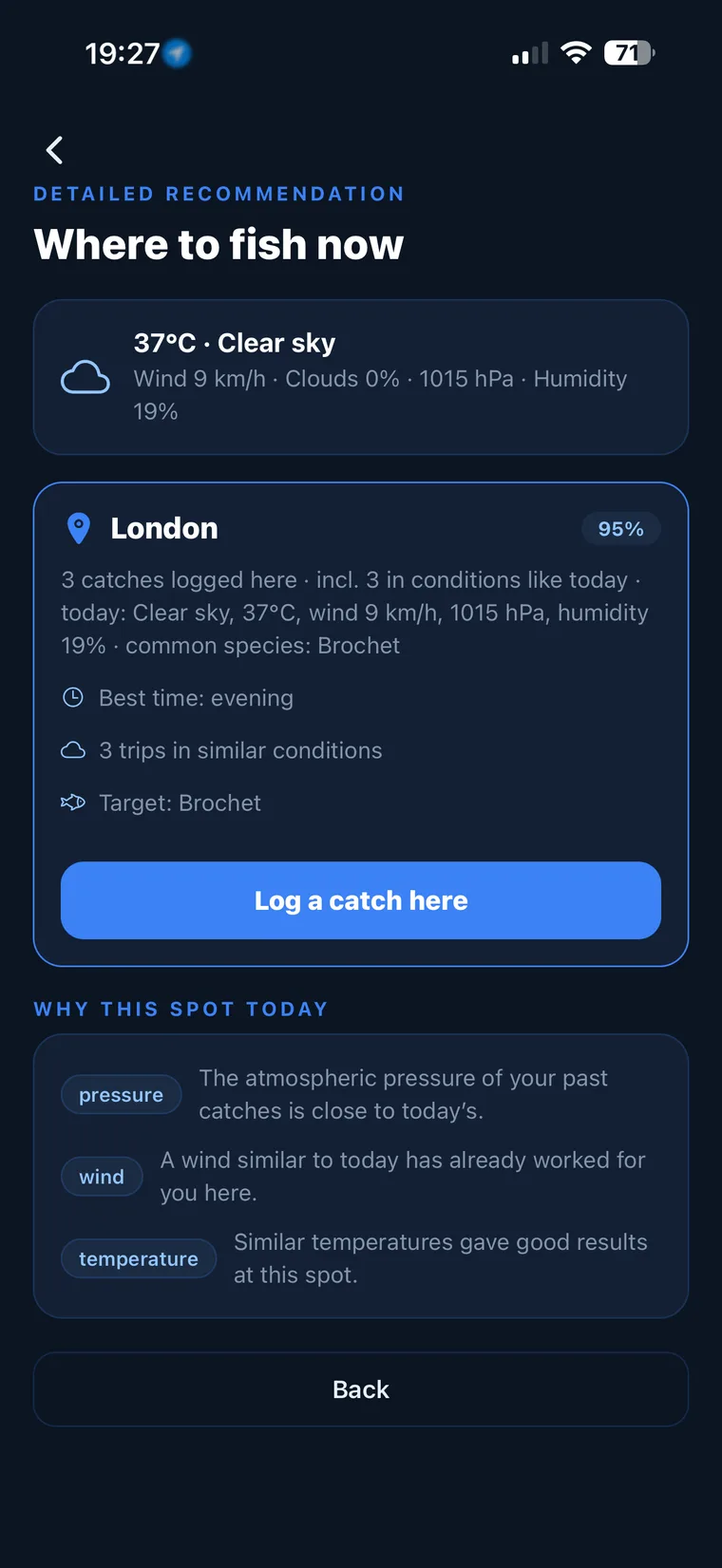
Not sure what to tie on?
Photograph your spot: CarnaFish reads the scene, cross-checks the conditions and gives you the zone, the lure and the retrieve. Free on iOS and Android.
Bivi or a bigger vib: a question of layer and size selection
The lipless family reads by size above all. The DUO Realis Vibration 62 plays in the category above: longer, heavier, it casts further, sinks faster still and speaks to adult perch as well as zander. That is the choice when you need to cover a big flat or sort out the better fish.
The Bivi accepts the opposite trade-off: less distance and less size selection, but a far higher bite rate when the fish are small, wary or inactive. In winter, on a shoal of twenty to thirty centimetre perch, it is very often the Bivi that saves the session while the bigger model gets ignored.
In a finer register still, an Illex Nitro Vib 40 offers a similar profile with a slightly different fall behaviour. Our guide to perch fishing with lures sets out the logic of working vertically on urban spots. And if you cannot decide whether to attack the bottom or mid-water when you get to a quay, CarnaFish analyses a photo of the spot and answers.
Matching tackle
Rod: 1.80 to 2.10 m, 2 to 10 g rating, fast tip action. Sensitivity comes first: you are trying to detect an interrupted fall, not a thump.
Line: fine braid of 0.06 to 0.08 mm for transmission, with a one-metre fluorocarbon leader of 0.16 to 0.20 mm. Braid straight through is too visible in clear cold water, and it forgives nothing on a hard hookset against thin lips.
Hooks: the stock trebles are small and fine. That is deliberate — they penetrate on a soft bite. Check their points after every contact with the concrete of a quay, which blunts them very quickly.
Key takeaways
- Around 5 g for 4 cm: the density gets you to the bottom in seconds with a small profile.
- The flat descent is a fishing phase, not dead time: that is when the bites come.
- Count your seconds of fall and set the hook as soon as a descent ends too early.
- Moving the line tie back levels the lure and raises the vibration frequency.
- Avoid it on cluttered bottoms, in active summer conditions, and for pike without a leader.
FAQ
At what depth should you fish the Tetra Works Bivi?
From about one and a half to six metres. Its density lets it reach the bottom quickly in those layers, which makes it particularly suited to canals, docks and river holes in winter.
How do you detect a bite on a micro vib?
By the interrupted fall. Count the seconds of descent on your first casts: the moment a descent ends earlier than expected, or the line stops paying out, set the hook immediately.
What setup should you use?
Fine braid of 0.06 to 0.08 mm with a one-metre fluorocarbon leader of 0.16 to 0.20 mm. The braid provides detection, the fluorocarbon the discretion needed in clear cold water and some give on the hookset.
What are the different attachment points for?
For adjusting the attitude. A tie set back towards the tail levels the lure and raises the vibration frequency; a tie forward towards the head tilts it more and lengthens the glides during the fall.
Does the Bivi work for zander or pike?
For zander occasionally, but a bigger lipless is better suited. For pike, its small size causes a lot of dropped fish, and a wire trace is essential unless you want to be cut off.
What colour in cold water?
Natural translucent tones when the water is clear, chartreuse or white as soon as it colours up. In winter, visibility is often the limiting factor: strong contrast works better than a realistic finish.
The full perch lure guideSeason-by-season strategy: which family of lure, when, and why.Go from theory to fish
CarnaFish reads your spot from a photo and gives you the game plan: zone, lure, retrieve. Free on iOS and Android.