DUO Spin: the compact tail spinner that drops fast and flashes
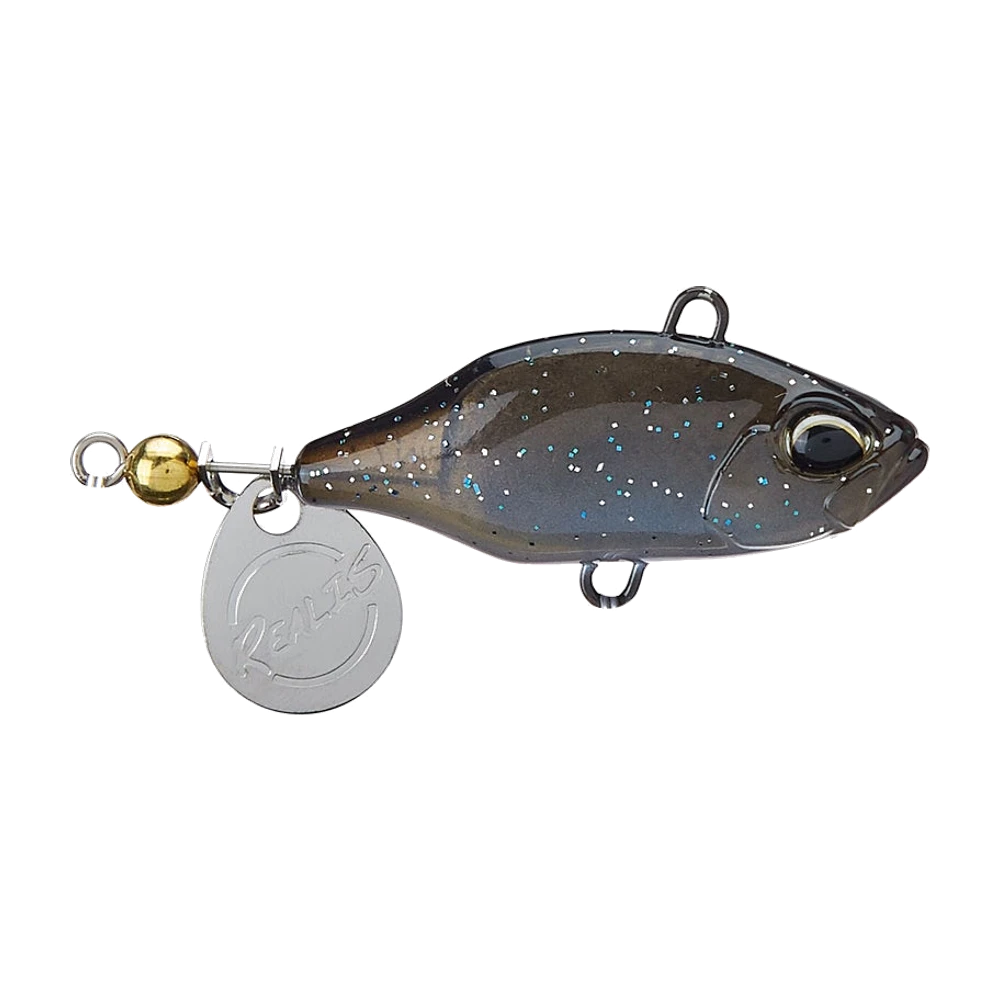
This lure shines under specific conditions. CarnaFish tells you in 10 seconds if today is one of them.
November, the water has dropped to 9 °C / 48 °F and the perch have grouped up over a hole at 6 m / 20 ft, just off the bottom. They show tight on the sonar and they won't move all day. A soft plastic takes forever to get down, a standard lipless goes past too fast. You need something that falls straight, that already puts out a signal on the way down, and that works vertically as well as horizontally. That is the definition of a tail spinner.
A lipless body, a spinnerbait blade
The DUO Spin combines two mechanisms that usually live apart. The body is a small, stubby, weighted baitfish that rolls side to side on the retrieve the way a miniature lipless would. At the rear, on a wire arm, a small Colorado blade turns and throws flashes of light at every movement, including during the fall.
That combination has one immediate practical consequence: unlike a blade-only lure, the DUO Spin puts out a signal even when it isn't going anywhere. It falls, and it flashes as it falls. For a perch sitting on the bottom in cold water, one that won't cross three metres of water to attack, that constant emission on the way down is worth more than any retrieve-action quality.
The maker also specifies weighting calculated so the bait stays balanced on both a fast and a slow retrieve. That matters: plenty of tail spinners blow out and spiral the moment you speed up, which rules out fast searching.
Three sinking sizes, three uses
The spec table lists three versions, all rated sinking: 1-3/8 in (about 3.5 cm) at 1/4 oz, that is 7.1 g; 1-1/2 in (3.8 cm) at 3/8 oz, 10.6 g; 1-5/8 in (4.1 cm) at 1/2 oz, 14.2 g. Those lengths are the body, with the blade adding behind.
The weight-to-volume ratio is the key figure: 14.2 g on a 4 cm body is very high density, well beyond a crankbait of comparable size. The direct consequence is that the bait falls fast and straight, and casts a long way even into a headwind. That is exactly what you want from a lure for vertical work and deep searching.
The 7.1 g suits holes down to 4 m / 13 ft and wary perch in clear water. The 10.6 g is the do-everything size, the one that stays tied on most of the time. The 14.2 g is for getting down fast over 8 m / 26 ft or more, and for holding bottom while the boat drifts.
Count the drop out loud, cast after cast. A sinking tail spinner teaches you the contours of a spot far faster than a sonar does: when the count changes by two seconds between two casts, you've just found the breakline.
Working a tail spinner: three rhythms to know
Straight vertical
Under the boat, over a located school. Drop to the bottom, come up two or three reel turns, then give small rod-tip twitches of ten centimetres, broken up by one-second pauses. The blade turns on the slightest movement. The bite almost always registers as a sudden extra weight, rarely as a knock.
The drifting yo-yo
Short cast, let it sink to the bottom, then lift in two or three wide pulls before letting it drop back while keeping contact. It's the most productive retrieve for zander, which takes on the fall almost every time.
The fast straight retrieve
Less obvious but very effective over perch busting bait on the surface: cast into the middle of the boil and reel fast, keeping the lure 50 cm / 20 in under the surface. The body rolls, the blade vibrates, and the compact silhouette matches the fry the school is herding.
The classic mistake
Fishing this lure like a spinnerbait, on a constant mid-depth retrieve. A tail spinner gets most of its effectiveness from the fall, and an uninterrupted retrieve removes every fall phase. If you never let the bait drop back, you're using a heavy lure to do a light lure's job.
A second, often neglected point: the belly treble. On a bait this compact, the slightest dullness costs fish, because a perch or zander mouth offers little soft surface. Change it the moment it catches on your nail without biting in.
Not sure what to tie on?
Photograph your spot: CarnaFish reads the scene, cross-checks the conditions and gives you the zone, the lure and the retrieve. Free on iOS and Android.
Why a Colorado blade and not a willow leaf
The blade shape isn't decorative. A willow leaf, long and narrow, spins tight against the shaft and mostly produces flash with very little resistance: that's what you want on a spinnerbait burned through open water. A Colorado blade, round, spins wide and creates far more pressure, and therefore far more vibration at slow speed.
On a lure built to work vertically and on the fall, Colorado is the only coherent choice: it's the only shape that keeps turning when the lure drops almost straight down, where a willow leaf would just flutter limply. It's also why the DUO Spin stays interesting in cold water, when fish no longer move for a flash of light but still react to pressure picked up by the lateral line.
The trade-off is more pronounced drag on a fast retrieve, which lifts the lure slightly in the column. Compensate by dropping the rod rather than slowing down, so you keep depth without losing blade rotation.
Colour by water clarity
- Clear water: the smoked grey with blue and silver glitter from the photo, which plays on translucency rather than colour and matches the silver blade.
- Stained water or the back of a reservoir: a chartreuse or fire tone, which compensates for lost visibility when the blade flash no longer carries.
- Fry busting on the surface: pearl white, the closest silhouette to what the school is eating.
Finding a perch hole or a productive breakline is the real work of an autumn day. That's what CarnaFish simplifies: a photo of the spot, and the app suggests the zone, the depth and the lure type that suit the conditions. To sharpen your approach to this species, our guide to lure fishing for perch covers the sizes and rhythms worth testing.
Next to a Damiki Axe Blade Tail Spinner or a Savage Gear Fat Tail Spin, the DUO Spin stands out mainly on body finish and extreme compactness. For work even tighter to the bottom, a 6th Sense Slice Blade Bait, which vibrates without a blade, offers a very different signal.
Key takeaways
- Three sizes from 3.5 to 4.1 cm for 7.1 to 14.2 g, all rated sinking.
- The lure puts out a signal during the fall thanks to the rear Colorado blade: that's its main argument.
- Very high density: a fast, straight drop and long casts even into a headwind.
- With no fall phase in your retrieve, most of the lure's potential goes unused.
FAQ
Which DUO Spin size should I pick for perch?
The 3/8 oz, 10.6 g, covers the vast majority of situations down to 6 or 7 m / 20 to 23 ft. Go to the 1/4 oz (7.1 g) in clear water on wary fish, and the 1/2 oz (14.2 g) to get down fast past 8 m / 26 ft or to hold bottom on a drift.
Does the DUO Spin sink?
Yes, all three sizes are rated sinking by the maker. That's what allows vertical work and counting the drop to find the depth the fish are holding at.
How does it differ from a metal blade bait?
A blade bait transmits vibration produced by the body blade itself, with no moving part. The DUO Spin has a body that rolls and a blade that turns: two distinct signals, one of which keeps working during the fall.
Can it be fished for zander?
Yes, yo-yoed along a breakline or vertically over a school. Keep contact on the drop: that's when zander take, and the bite shows up as the line simply stopping.
Do I need a special leader?
Fluorocarbon in the 6 to 10 lb range is enough in most cases. If pike use the spot, add a thin wire leader: the short action and compact silhouette pull teeth in too.
Why has my blade stopped turning?
Check the swivel or split ring carrying the blade: sand and grit seize the axis over time. A rinse in fresh water at the end of a session heads the problem off before it appears.
The full bass lure guideSeason-by-season strategy: which family of lure, when, and why.Go from theory to fish
CarnaFish reads your spot from a photo and gives you the game plan: zone, lure, retrieve. Free on iOS and Android.