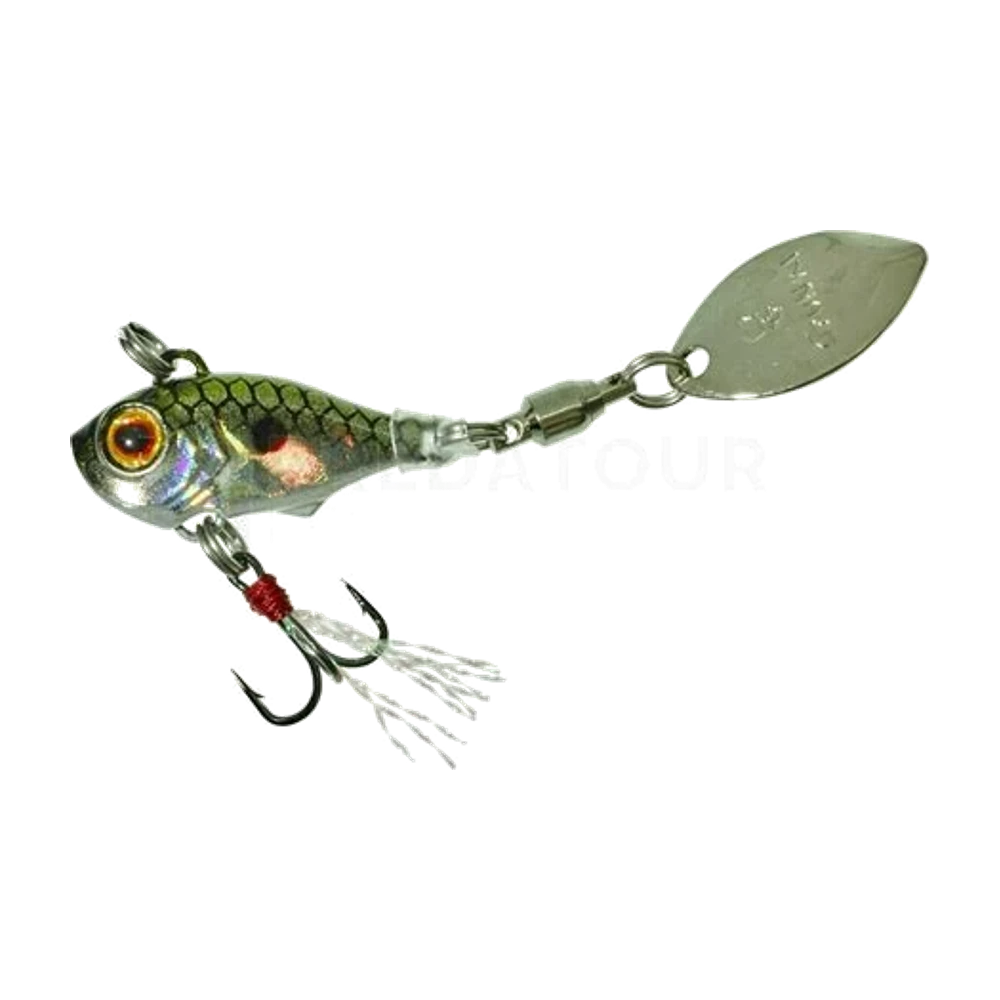
Gunki Chocho: the compact lipless you fish vertically
One lure, endless conditions. CarnaFish reads your spot from a photo so you are not just guessing.
The lipless has a stubborn reputation: a horizontal searching lure you cast a long way and wind back fast to cover a flat. That reputation is deserved for the big models. It also explains why plenty of anglers put their lipless box away as soon as the water drops below 10 °C and zander glue themselves to the bottom in 6 m, motionless.
That is exactly where the Chocho gets interesting. Its small size and high density make it a lipless you can fish vertically, under the rod, on a settled fish — something bulkier models handle badly, because they rise too fast and push too much water in a confined space.
Small body, high-frequency vibration
Two lipless baits of identical weight but different volume do not put out the same signal. The big body moves a lot of water at low frequency: a slow wave that carries far and that a fish detects from a long way off. The small dense body does the opposite — a tight, fast vibration of low amplitude.
On the Chocho that translates into:
- An instant start-up. The lure begins vibrating within the first ten centimetres of the pull. You do not need to drag it three metres to get it working, which is the condition for fishing a short yo-yo.
- A flat fall. The top tow point and the mass distribution mean it does not nose-dive: on the drop it glides slightly forward instead of dropping like a sinker.
- A signal that does not saturate. On a fish 2 m from the lure, a violent low-frequency wave is aggressive. The Chocho's high-pitched vibration stays readable without putting the fish on alert.
It is that combination — short start-up, flat fall, fine signal — that allows vertical use. A standard lipless in the same situation rises two metres on every lift and spends its life above the fish.
The yo-yo: the lift makes the noise, the fall makes the bite
The movement is short and repetitive. Count your lifts, not your handle turns.
- Drop vertically to bottom contact on a tight line. Note the depth.
- Lift 50 to 80 cm with a sharp flick of the wrist. You should feel the vibration start immediately in the rod tip.
- Give line while following it down, without letting go completely. The lure glides forward and comes back down flat. This is the phase where 80 % of the bites happen.
- Touch bottom again, wait two to three seconds.
- Repeat, varying the height of the lift until you find the one that triggers.
Cast and retrieve, the same principle applies horizontally: three handle turns, one sharp lift, one controlled falling phase. Never wind it back straight — the Chocho is not a lure you simply make vibrate, it is a lure you make fall.
On the water: fishing vertically, tighten the line by a centimetre just before the next lift. If the lure already feels heavy, a zander has taken it on the drop without you feeling a thing. Strike sideways, with no vertical snatch, and you will lose far fewer fish.
Matching size and weight to depth
| Situation | Size / weight | Approach |
|---|---|---|
| Margins, under 2 m, active perch | Small size, 9 to 10 g | Cast and retrieve with short lifts |
| Flat or drop-off, 3 to 5 m | Medium size, 11 to 12 g | Cast-and-yo-yo, controlled fall |
| Hole or mooring, 6 to 8 m | Heavy size, 13 to 14 g | Pure vertical under the boat |
| Strong river current | Heavy size | Controlled drift, very short lifts |
A simple marker: if you cannot feel bottom contact at the end of the fall, go one step heavier. A lipless fished blind is useless, because all the information — and all the bites — are in the falling phase.
Where it takes the lead, and where it disappoints
The Chocho shines in three situations:
- Settled zander in cold water, from November to March, over hard bottom in 4 to 8 m. The flat fall and fine signal get through where a big lipless is refused.
- Perch feeding in scattered fashion over a flat: the small size matches the fry they are on, and the high-pitched vibration stands out in a shoal.
- Low-visibility rivers, where the lure announces itself by vibration rather than silhouette.
It is poorly suited, on the other hand, to searching a big flat quickly in warm water: in that window bulk pays, and a bigger model will call fish from much further away. It is also hard to use in branches and over cluttered bottom — two bare trebles on a body that falls flat is a guaranteed snag.
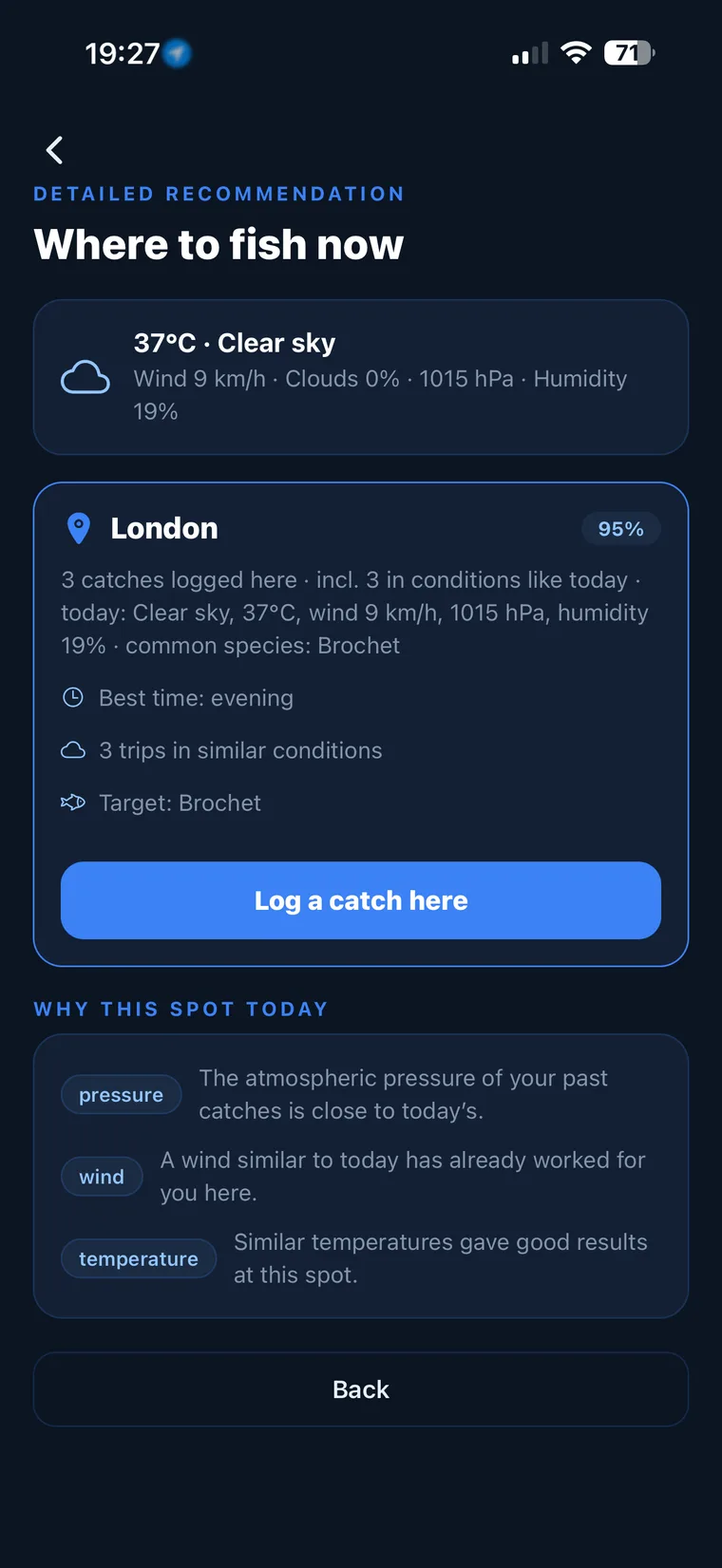
Not sure what to tie on?
Photograph your spot: CarnaFish reads the scene, cross-checks the conditions and gives you the zone, the lure and the retrieve. Free on iOS and Android.
Colours
- Clear, cold water: silver, roach, translucent. The vibration does the work, the colour should not add a second signal.
- Stained water: dark back and contrasting flank, or a touch of orange under the belly, visible on the drop.
- Dark bottom and late in the day: a solid silhouette, black or brown. Zander see a mass, not a detail.
Chocho, Fat Vibes or TN 70
These three lipless baits do not replace one another, they fill three distinct niches.
The Savage Gear Fat Vibes is the searching tool: broad body, low-frequency wave, it calls from a distance and suits big flats and stained water. It is the one you cast to find fish.
The Jackall TN 70 is the horizontal precision lipless, with a very tight action and a history aimed at bass on weed and margins. It excels ripped through vegetation.
The Chocho is after neither: it sacrifices signal range and casting distance to become usable vertically, on a fish you have already located. When you see marks glued to the bottom and you know where they are, it goes first. Our beginner's guide to zander fishing with lures explains how to chain searching and fine fishing in a single session. And if you are unsure whether to attack a spot horizontally or vertically, CarnaFish analyses a photo of the spot and answers.
Within the Gunki range, the Whiff covers the soft and slow register: it takes over when even the Chocho's fall is judged too fast by the fish.
Key takeaways
- The small dense body starts vibrating within ten centimetres: that is what makes the short yo-yo possible.
- The fall is flat and gliding, not vertical. Most bites happen there.
- Sharp 50 to 80 cm lift, follow it down, bottom contact, two to three second pause.
- Go heavier until you feel the bottom; without bottom contact you are not really fishing.
- A bad choice for searching a big flat quickly or for fishing in branches.
FAQ
Can a lipless be fished vertically?
With a compact, dense model like the Chocho, yes. It starts vibrating on a very short pull and comes back down flat, which lets you stay in the fish's water layer instead of rising two metres on every lift.
How high should I lift when fishing vertically?
Between 50 and 80 cm to start with. If the sounder shows fish off the bottom, stretch it to a metre. If they are glued to the substrate, shorten to 30 cm and lengthen the pause on contact.
Why do I miss zander bites?
Because they come on the drop and the line is slack. Tighten slightly before each lift to feel the weight, then strike sideways rather than with a big vertical sweep.
What line for the Chocho?
Fine braid for detection, with a fluorocarbon leader of around 0.25 mm. Fluorocarbon alone dampens the vibration too much when fishing deep and vertical.
Do I need a wire trace for pike?
If you are fishing a pike zone, yes, but a wire trace shortens the glide on the drop. Heavy fluorocarbon of 0.50 to 0.60 mm is an acceptable compromise when pike are only occasional.
Is the Chocho any good in summer?
It works, but cold water and settled fish are where it really stands out. In summer, on active scattered fish, a bulkier lipless will cover more ground and call from further away.
The full zander lure guideSeason-by-season strategy: which family of lure, when, and why.Go from theory to fish
CarnaFish reads your spot from a photo and gives you the game plan: zone, lure, retrieve. Free on iOS and Android.