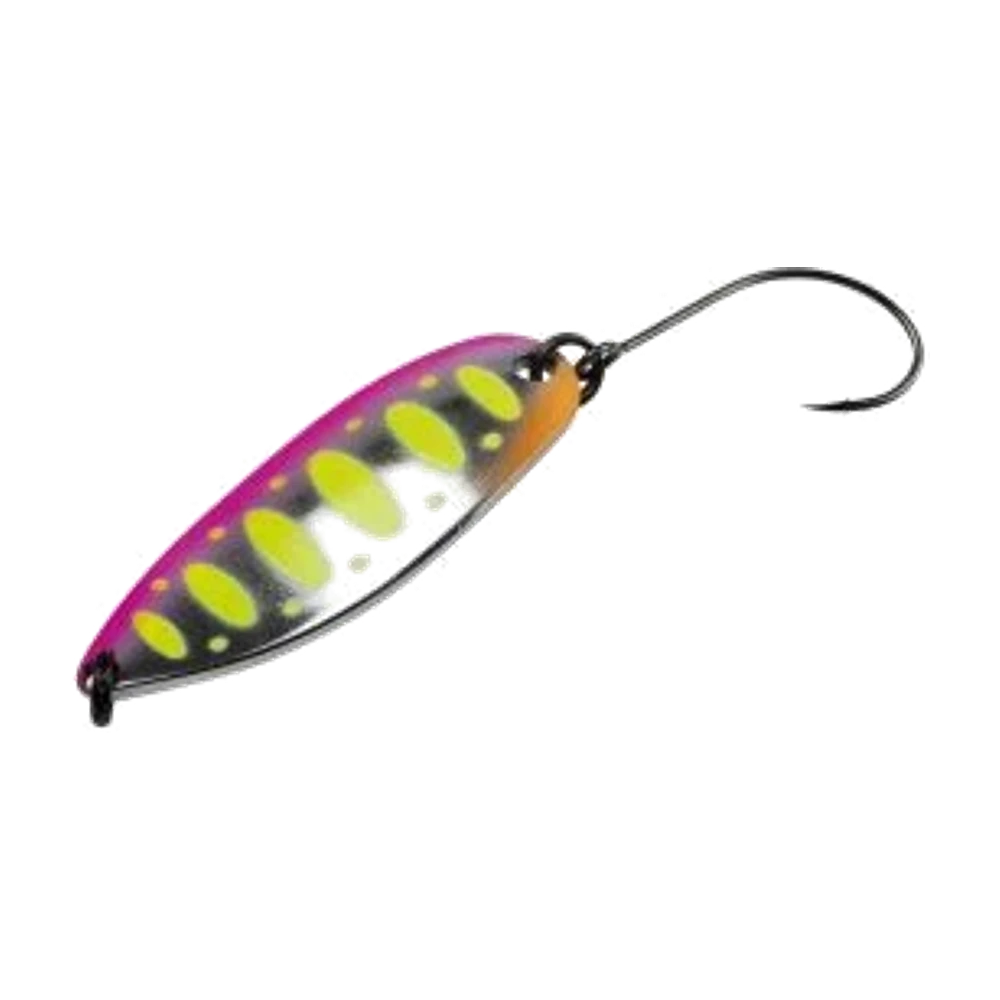
Forest Miu: the area fishing spoon that swims at two grams
One lure, endless conditions. CarnaFish reads your spot from a photo so you are not just guessing.
Area fishing — trout fishing on a managed trout fishery with micro lures — is a Japanese discipline with rules of its own. You fish spoons of one to three grams, on ultra-light gear, with an extremely slow straight retrieve, and you change colour every ten minutes.
The Forest Miu is one of the benchmark spoons of the discipline, and it shows perfectly what separates these lures from classic spoons.
Swimming at minimum speed
A classic wobbling spoon needs a certain amount of speed before its wobble sets in. Below that, it drags along like a dead sheet of metal.
The Miu is pressed in such a way that it keeps wobbling at speeds where classic spoons have already gone dead. You can retrieve so slowly that the lure takes a minute to cover ten metres, and it keeps working.
That is decisive on a trout pond, where the fish are often lethargic, over-fished, and refuse anything moving quickly.
The retrieve: slow and straight, nothing else
- Cast and count the sink to choose your depth band — one to three seconds depending on weight.
- Retrieve at a constant, very slow speed, one handle turn per second or less.
- Do nothing with the rod. No twitch, no pause.
- Change depth band on every cast by varying the sink count, until you find the fish.
On the water: in area fishing, the right speed is almost always slower than you think. If you can see the spoon wobbling clearly, you are going too fast. The wobble should sit right on the edge of perceptible.
Colour as an active setting
This is the sharpest cultural difference from European fishing. In area fishing, colour is not a detail: it is the main setting, and you change it constantly.
Pond trout tire of a colour extremely quickly. A pattern that takes three fish in a row can become completely useless within minutes.
The method is simple: change colour as soon as you have gone ten minutes without a bite. Experienced anglers carry twenty to thirty colours and rotate through them all day.
A few families worth having:
- Naturals (olive, brown, clear) for clear water and educated fish.
- Brights (orange, pink, chartreuse) at the start of a session and after a stocking.
- Metallics (gold, silver, copper) in bright light.
- Darks (black, dark brown) under cloud and at the end of the day.
The gear
Area fishing demands a specific setup, and there is no compromise possible with 1.4 g on the end of the line.
- UL or SUL rod, 1.60 to 1.90 m, parabolic action. It has to bend along its whole length.
- Size 1000 reel, preferably slow-retrieve.
- 0.10 to 0.14 mm nylon or fluorocarbon. No braid: too stiff for these bites and these fish.
- Barbless single hook, often compulsory on a fishery and far better at not tearing out.
A rod that is too stiff loses fish one after another: a trout has a fragile mouth and a sharp hookset tears through it.
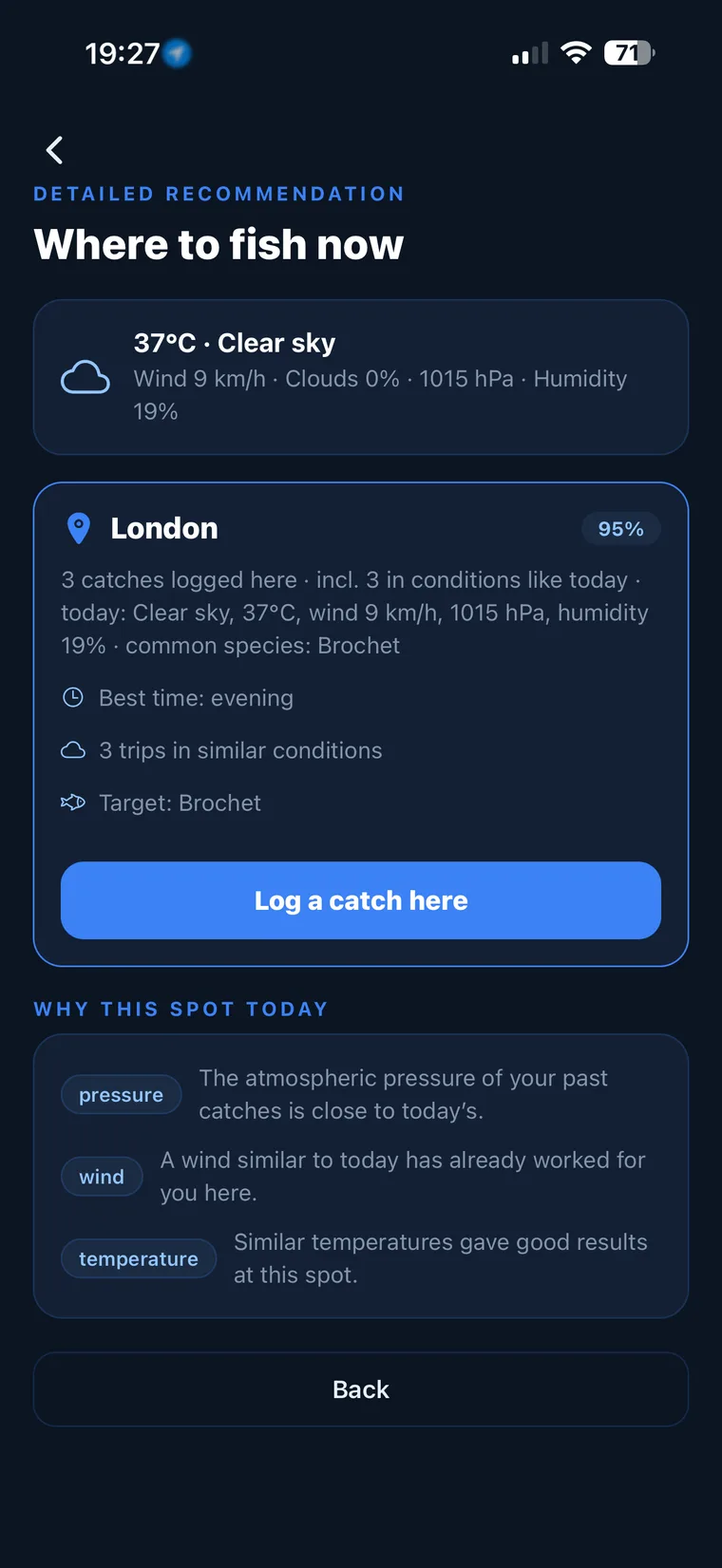
Not sure what to tie on?
Photograph your spot: CarnaFish reads the scene, cross-checks the conditions and gives you the zone, the lure and the retrieve. Free on iOS and Android.
Where and when
- Trout ponds and no-kill fisheries, the home ground of the discipline.
- After a stocking, when the fish are concentrated but get educated fast.
- Clear, cold water, mainly spring and autumn.
- Small waters where casting distance is not an issue.
The Miu also works in rivers on trout in small clear streams, as long as there is no strong current — its low weight cannot hold a fast seam.
Miu or a classic spoon
A classic wobbling spoon is built to cover ground, hold current and trigger with a strong flash. That is the river and lake tool.
The Miu is built for a slow, discreet, repeated presentation in front of fish that are numerous but wary. It searches nothing: it convinces.
Our guide to river trout fishing covers the running-water approaches. And if you do not know which depth band to explore on a fishery, CarnaFish analyses a photo and suggests a starting point.
Key takeaways
- It keeps wobbling at speeds where classic spoons go dead.
- Very slow straight retrieve, no rod work at all.
- Colour is the main setting: change it after ten minutes without a bite.
- A parabolic UL or SUL rod and 0.10-0.14 mm line are essential, never braid.
- Barbless single hook: more effective and less damaging.
FAQ
What is area fishing?
It is a Japanese discipline of trout fishing on managed fisheries with micro lures, usually spoons of 1 to 3 g, fished on a very slow straight retrieve with ultra-light gear and frequent colour changes.
How fast should I retrieve?
As slowly as you can, one handle turn per second or less. If you can see the spoon wobbling clearly, you are going too fast: the wobble should stay right on the edge of perceptible.
Why change colour so often?
Pond trout tire of a colour very quickly: a pattern that takes three fish can become useless within minutes. The rule is to change after ten minutes without a bite.
What rod should I use?
A UL or SUL rod of 1.60 to 1.90 m with a parabolic action that bends along its whole length. A stiff rod loses fish one after another on a trout's fragile mouth.
Can I fish it with braid?
No, it is too stiff for these delicate bites and these fragile fish. Nylon or fluorocarbon of 0.10 to 0.14 mm is essential, its stretch acting as a shock absorber.
Does the Miu work in rivers?
Yes, on small clear streams without strong current. Its low weight cannot hold a fast seam: in flowing water you will need a heavier spoon.
The full trout lure guideSeason-by-season strategy: which family of lure, when, and why.Go from theory to fish
CarnaFish reads your spot from a photo and gives you the game plan: zone, lure, retrieve. Free on iOS and Android.