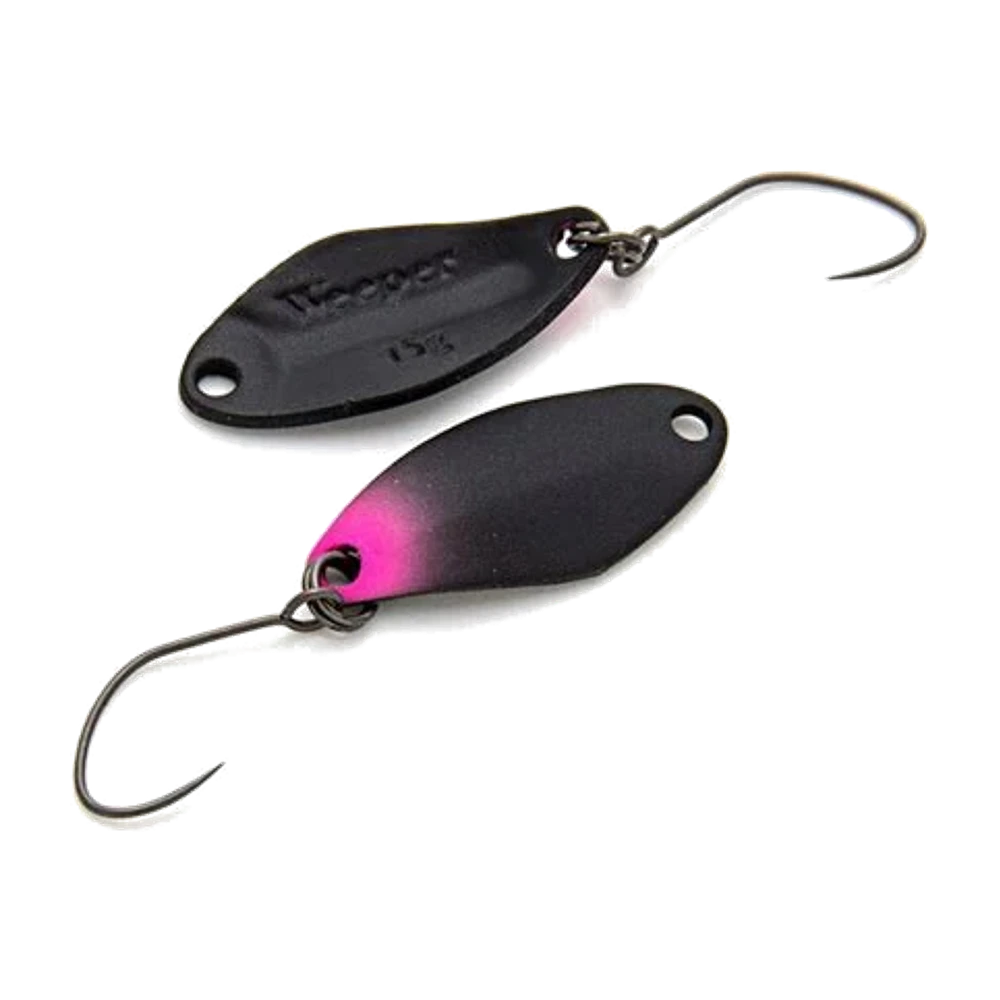
Nories Masukuroto Weeper: the wide wobble for trout glued to the bottom
Rather not fish it blind? Photograph your spot — CarnaFish cross-checks the conditions and points you the right way.
Two in the afternoon, the water has gained three degrees since morning, and the surface of the pond shows nothing at all. The trout that were cruising high at opening time have vanished. They have not left: they have dropped, and they are now sitting at a metre and a half or two metres, almost motionless, fifty centimetres off the bottom.
This is the point in the day where most area fishing sessions grind to a halt. You carry on mechanically fishing the same layer you fished at nine o'clock, with the same lure, changing colours faster and faster. Nothing happens, because the problem is not the colour: it is that the lure is passing three metres above the fish.
The fundamentals of the discipline — painfully slow speed, colour rotation, an ultra-light setup — are covered on the Forest Miu page. The Weeper fills a gap the Miu covers badly: the lower layer, fished slowly, on apathetic fish.
A wide swing where the others tighten up
Every area spoon wobbles. They do not all do it the same way.
A slim, elongated spoon produces a tight, fast oscillation: a high-frequency signal, very readable in clear water and on active fish, but one that loses a lot of its bite when the trout has gone flat.
The Weeper is pressed to produce the opposite: a wide, slow wobble, where the spoon tips right over from one flank to the other. Three concrete effects:
- The signal is lower in frequency, so it can be picked up from further away by a trout that is not actively looking.
- The flash is longer and more spaced out. Instead of a continuous shimmer you get separated flashes, which a fish's eye follows more easily in the slightly darker water down deep.
- The sink is slower than its weight suggests, because the body leans on the water as it wobbles on the way down. That matters when you are counting eight or ten seconds.
The trade-off is that it needs a touch more minimum speed than a flat spoon before the wobble sets in. You cannot fish it as slowly as a surface spoon — that is the price of the amplitude.
The retrieve: shaving the bottom without touching it
- Cast and let it sink on a semi-tight line, counting. On a three-metre pond, start at eight seconds.
- Watch for the line going slack, which tells you the spoon has hit bottom. Note the count: that is your reference for the whole session.
- Take two seconds off that count and start there. You are then fishing thirty or forty centimetres off the bottom without snagging.
- Retrieve just fast enough to feel the steady beat in the rod tip. As soon as that sensation disappears, speed up half a notch.
- Repeat exactly the same count on every cast. In the lower layer, consistency beats variation.
A useful variant when nothing responds: the long stop-and-go. Six handle turns, then a two-second stop during which the spoon flutters back down, then six more turns. On settled trout, that fall is often the only movement that makes up their minds.
On the water: in the lower layer, never strike on feel. The bite from an apathetic trout does not arrive as a sharp knock but as one second where the beat of the spoon stops in the rod tip. As soon as the steady vibration disappears for no reason, simply tighten by winding: the fish is already on it, and a sharp strike will pull the hook.
The window: the second half of the session
The Weeper is a spoon for late in the day and for hard conditions.
- Mid and late afternoon, once the surface water has warmed and the fish have dropped.
- Deep-dug ponds, gravel pits, old ballast pits where there genuinely is two to four metres of water.
- Educated fish, several hours after stocking, that have seen every surface spoon in the box go past.
- Cold days and bright sun, the two setups that pin trout to the bottom.
Where it is no use: on a shallow pond of a metre and a half, where the lower and upper layers merge. Straight after a stocking, when the fish are high and active — a surface spoon like the Forest Pal will be far more effective. And in a strong crosswind, where the bow in the line makes it impossible to count a long drop accurately.
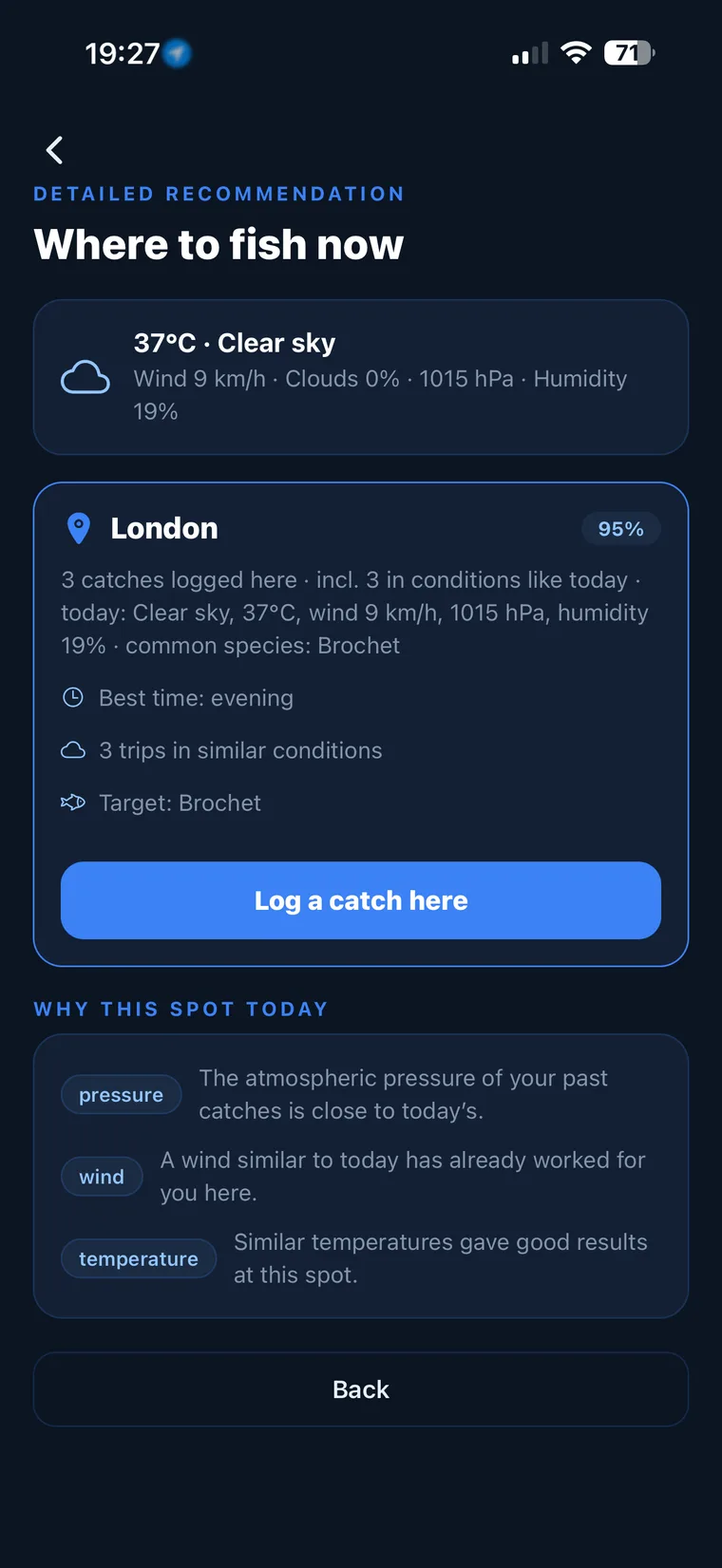
Not sure what to tie on?
Photograph your spot: CarnaFish reads the scene, cross-checks the conditions and gives you the zone, the lure and the retrieve. Free on iOS and Android.
Colours: dark and matt down deep
Two metres under the surface of slightly stained water, the logic flips compared with the upper layer.
Dark, matt tones — black, dark brown, deep olive, burgundy — stand out in silhouette against the light coming from above. That is often the most productive family at the end of a session.
Metallics — copper, antique gold, bronze — take the lead again in bright light, when enough of it reaches down to create a flash.
The bright fluos that worked at stocking time no longer work at all at that point in the day on educated fish. Save them for the first hour.
Weeper or a tight-wobbling spoon
This is the central call in an area box, and it hangs on the mood of the fish more than on the depth.
A tight, fast-wobbling spoon such as the Valkein Highburst excels on active trout that follow and commit. Its high-frequency signal handles speed and provokes a reaction.
The Weeper is aimed at fish that no longer feel like reacting. Its wide swing, its spaced-out flash and its low speed all aim to get noticed by a trout that is not looking for anything. It is not a spoon that provokes, it is a spoon that insists.
Over a full day the logic is simple: high and lively in the morning, tight and fast while they are moving, wide and slow when it dies. Our guide to river trout fishing covers the running-water side of this fishing. And if you have no idea what depth to attack an unfamiliar pond at, CarnaFish analyses a photo of the spot and answers.
Key takeaways
- Wide, slow wobble: a low-frequency signal and spaced-out flashes, readable by an apathetic fish.
- Count the drop to the bottom, then take two seconds off: you fish 30-40 cm up without snagging.
- The long stop-and-go lets the spoon flutter back down, and that is often what triggers.
- The bite reads as the beat disappearing, not as a knock: tighten by winding, do not strike hard.
- A spoon for the end of the session and for deep ponds, useless in shallow water and just after stocking.
FAQ
How do you fish just off the bottom without snagging?
Count the drop to the bottom on your first cast, then take two seconds off that count every time. You then start the retrieve thirty or forty centimetres off the bottom, which is enough to avoid snags on most ponds.
Why a wide wobble rather than a tight one?
Because it produces a lower-frequency signal and more widely spaced flashes, which a motionless, unreactive trout can pick up. A tight wobble is more effective on active fish but often goes unnoticed late in the session.
How fast should you retrieve it?
Just fast enough to feel the steady beat in the rod tip. It needs slightly more minimum speed than a flat spoon: as soon as the vibration disappears, speed up half a notch rather than slowing down further.
How do you detect a bite in the lower layer?
The steady vibration stops for a second for no apparent reason. That is the bite. Do not strike hard: simply tighten by winding, since a trout's mouth is fragile and the fish is already on the lure.
What colours down deep?
Dark, matt tones — black, brown, deep olive — that stand out in silhouette against the light from above, and antique metallics in bright conditions. The bright fluos from stocking time no longer work at that stage of the session.
What kind of water should you use it on?
On genuinely deep-dug waters, two to four metres down: gravel pits, ballast pits, deep ponds. On a metre and a half of water the lower and upper layers merge and a surface spoon is enough.
The full trout lure guideSeason-by-season strategy: which family of lure, when, and why.Go from theory to fish
CarnaFish reads your spot from a photo and gives you the game plan: zone, lure, retrieve. Free on iOS and Android.