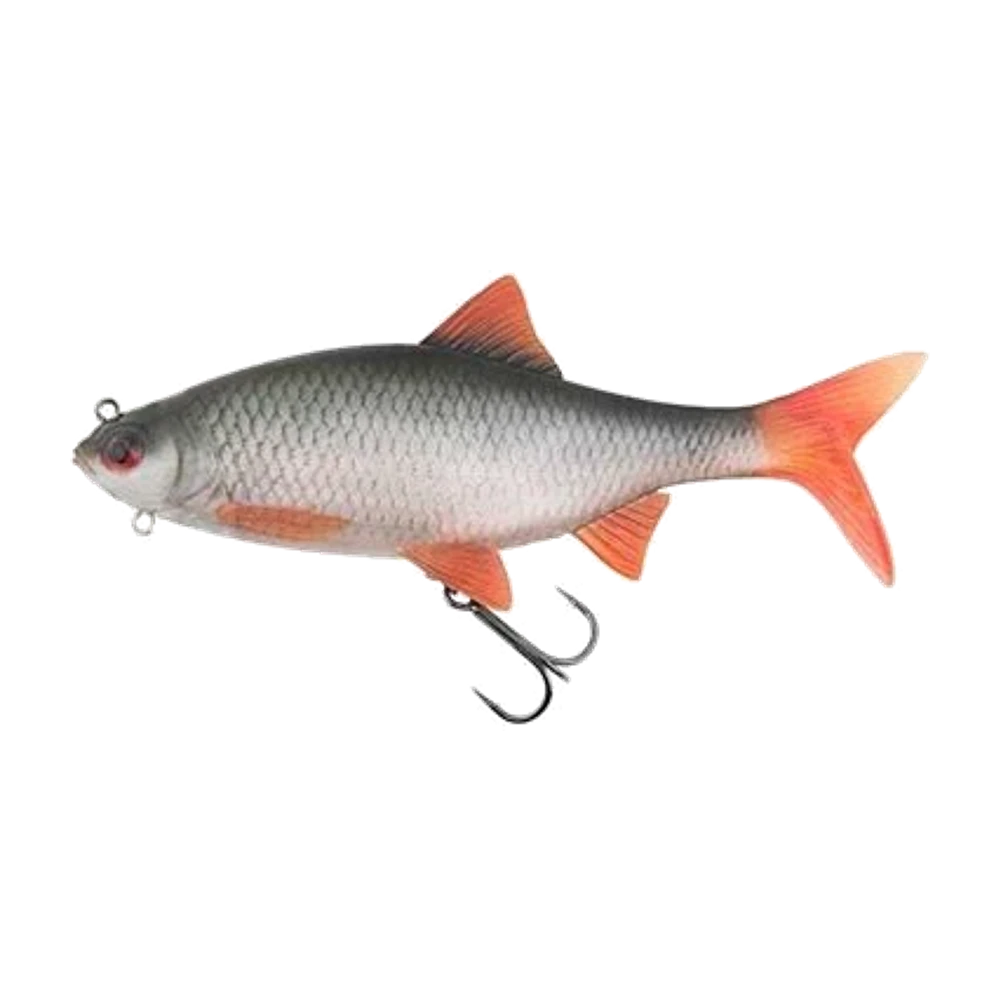
Fox Rage Realistic Roach: the soft roach you rig your own way
Rather not fish it blind? Photograph your spot — CarnaFish cross-checks the conditions and points you the right way.
On waters where roach are the dominant forage, pike end up looking for one thing only: a broad, deep-backed silhouette moving slowly and silently. The problem is that most roach imitations on the market arrive pre-rigged, with a weighting and a treble position decided at the factory — so one swimming depth and one behaviour, take it or leave it.
The Realistic Roach takes the opposite line. It is a bare soft body that you rig yourself. The same lure can swim a foot under the surface over a weed bed, or work down three metres along a drop-off, depending on the jig head or harness you put in it.
That freedom has a price: you need to know what you are doing. Which is exactly what this page is for.
A body built to stay supple under load
The difficulty with a big imitation soft plastic is staying mobile despite its bulk. A body that is too dense rolls badly; one that is too soft tears on the first pike.
The Realistic Roach is built around three choices you can feel in your hand:
- A deep back and flat flanks, giving a broad silhouette head-on and a very thin profile from the side. That is exactly roach geometry, and it is what makes the silhouette believable in clear water.
- A soft but non-tacky material, which rolls along the whole length of the body and not just in the tail.
- A thin, wide tail that beats without sending out a strong vibration. The lure does not thump in your hand like a paddle-tail shad: you barely feel it, and that is normal.
That last point fools more anglers than anything else. Many retrieve faster in order to "feel" the lure, and in doing so destroy its only advantage: a slow, silent action that does not look like a lure.
Three riggings, three different lures
The same body gives you three tools depending on what you put inside it.
| Rigging | Depth | When to choose it |
|---|---|---|
| 10-15 g jig head, weedless hook | 0.3 to 1.2 m | Weed beds, margins, lily pads, shallow water |
| Screw-in harness + offset belly treble | 1 to 2.5 m | Standard searching, mid-depth margins, edge of a hole |
| 25-40 g jig head | 2.5 to 4 m | Drop-offs, dams, wind and current, deep fish |
Two tips that save you grief. First, seat the screw or the head dead in line with the body: a body mounted crooked corkscrews as soon as you speed up, and line twist ruins the day. Second, put the belly treble a third of the way back, not halfway: most pike hits on this kind of silhouette come in sideways, and a treble set too far back misses the fish that take the head.
On the water: with an imitation soft plastic this size, do not set the hook on first contact. Pike often grab the lure across the body, hold it for a second, then turn it to swallow it head first. Count two seconds while keeping contact, then set hard — you will land far more fish and tear far fewer bodies.
The retrieve: slowness is the main setting
- Cast and let it sink while controlling the slack. Count the seconds; most drop bites come in the first five.
- Retrieve very slowly, right at the limit of what the rod lets you feel. The body rolls on its own.
- Every five or six seconds, come to a complete stop. The lure glides and sinks on a slant, flank slightly tilted. This is the most productive phase.
- Restart with one sharp turn of the handle, not a flick of the rod. The pickup flattens the body out again and triggers followers.
- At the bank, work a slow figure of eight, letting the lure drop under the rod tip at each change of direction.
On wary fish, one variant works well: retrieve for three metres, let it fall to the bottom, wait three seconds, then move off again. That staircase profile gives a settled pike time to leave its lie.
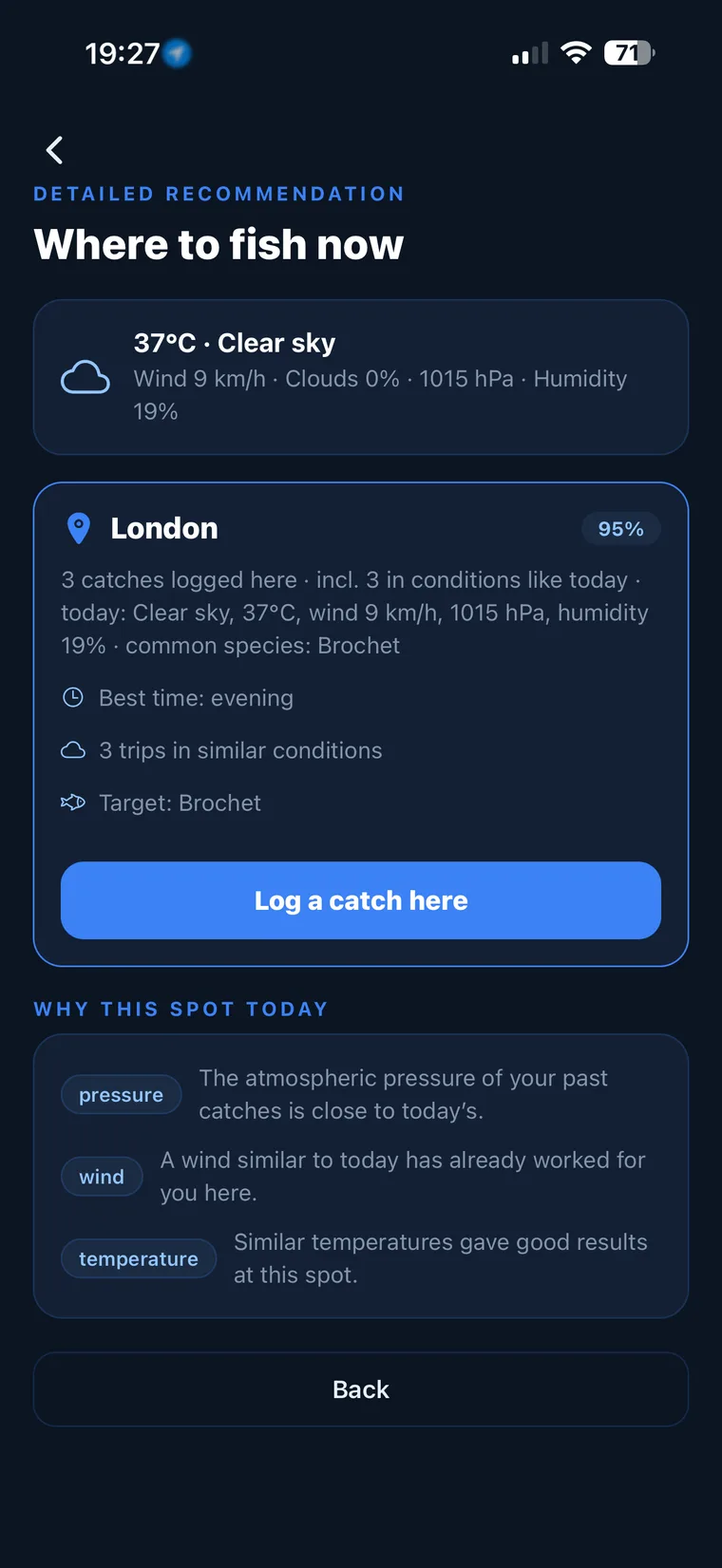
Not sure what to tie on?
Photograph your spot: CarnaFish reads the scene, cross-checks the conditions and gives you the zone, the lure and the retrieve. Free on iOS and Android.
Where it shines, where it adds nothing
It belongs on clear, pressured waters where fish refuse strong signals: gravel pits, clear reservoirs, late autumn when the water clears. It is also very good coming off weed beds and over shallow flats, rigged weedless, where a lure with exposed trebles just snags.
It is poorly suited to very coloured water, though: its quiet action and low vibration generate no signal detectable at a distance. In that case, a paddle-tail or a chatterbait will cover far better. It is also a poor searching tool: the slow rhythm it demands is incompatible with sweeping a large area in an hour.
Realistic Roach or Ricky the Roach
The Westin Ricky the Roach targets the same forage fish but on opposite logic: it is a jointed lure sold ready rigged, with the weighting and trebles already positioned. Out of the packet and fishing. Its action comes largely from the joints between segments, which produce a steady waddle even at slow speed.
The Realistic Roach is one piece and unrigged. Its action comes from the suppleness of the whole body rather than a joint, which gives a smoother, less pronounced roll. The trade is clear: you lose the simplicity and consistency of a ready-to-fish jointed lure, and you gain the ability to cover three depths with one lure and to replace a torn body for the price of a soft plastic. In the same range, the Fox Rage Replicant stays the choice when you want an imitation ready to fish without thinking about the rig.
Our guide to choosing a pike lure places these two approaches against each other through the seasons. And if you are unsure what depth to target when you reach the bank, CarnaFish analyses a photo of the spot and answers.
Key takeaways
- A bare soft body: your rigging decides the depth, not the manufacturer.
- Smooth, low-vibration action — do not retrieve faster to feel it, you lose the whole point.
- Belly treble a third of the way back, screw or head dead in line, or the lure corkscrews.
- Count two seconds before setting: pike grab sideways, then turn the lure.
- Excellent in clear, slow water, pointless in very coloured water or for fast searching.
FAQ
Does the Fox Rage Realistic Roach come rigged?
No, it is a bare soft body you rig yourself. Depending on whether you use a light jig head, a screw-in harness with an offset treble or a heavy head, you get three different behaviours and three different swimming depths.
What size should I choose for pike?
The middle sizes, around 12 to 15 cm, cover most situations and stay castable with an everyday outfit. Keep the biggest sizes for waters where large fish dominate, and for tackle rated accordingly.
Where should the belly treble go?
A third of the way back rather than halfway. Pike often attack sideways towards the front of the lure, and a treble set too far back costs you fish that were properly committed.
Why does my lure spin?
Almost always because the jig head or screw is not seated in line with the body. Take it apart, realign it carefully, and check that you are not retrieving too fast for this kind of action.
Should I strike as soon as I feel the bite?
No. Keep contact for about two seconds to let the pike turn the lure, then set firmly. An instant hookset pins badly and tears the soft body without hooking the fish.
How does it differ from a ready-to-fish jointed swimbait?
A jointed model arrives rigged and takes its action from the joints between segments, giving a steady waddle straight out of the packet. The Realistic Roach is one piece and unrigged: a smoother roll, the rig is on you, and replacing a body costs far less.
The full pike lure guideSeason-by-season strategy: which family of lure, when, and why.Go from theory to fish
CarnaFish reads your spot from a photo and gives you the game plan: zone, lure, retrieve. Free on iOS and Android.